

Please share widely!
The Hinternet Foundation’s inaugural online summer school, “Whither the Humanities?” is drawing to a close. This course has been offered free of charge, thanks to generous donors, and has served double duty as a meta-reflection on what the truest purposes and aims of the Foundation’s key para-academic initiatives will be in the coming years.
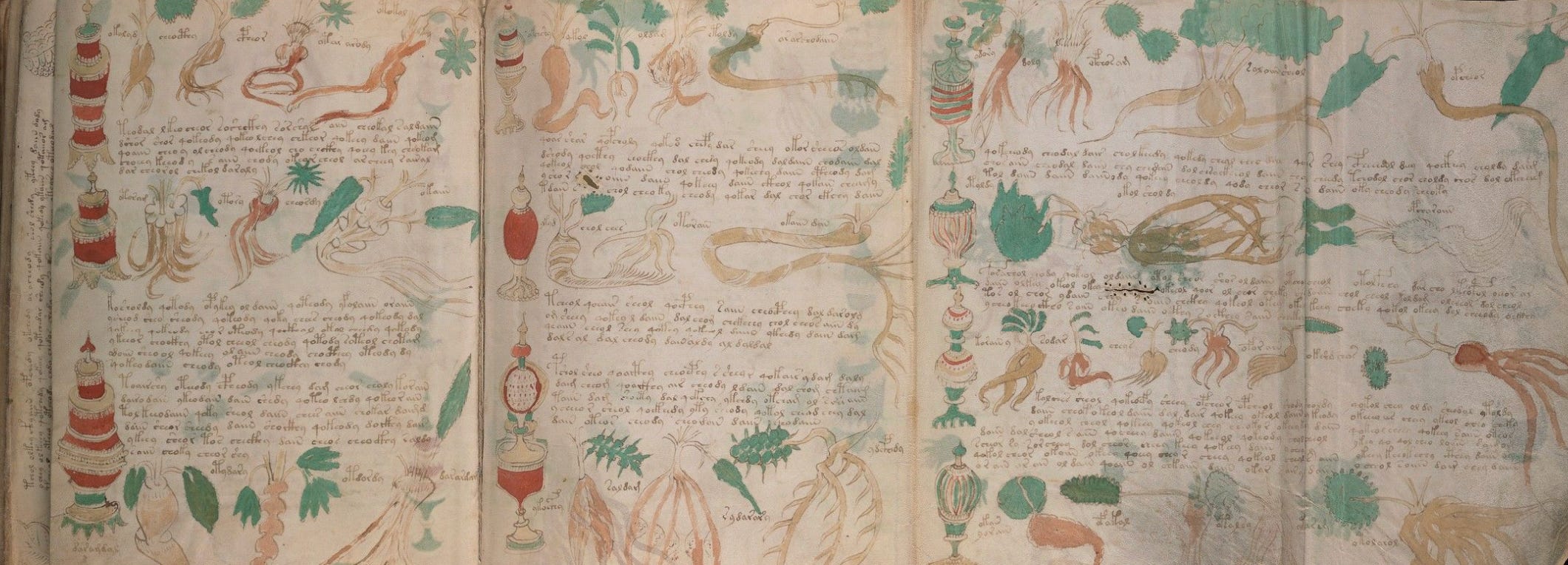
In October we will be launching our first “ordinary” course offering — ordinary both in the sense that it will not be “meta”, but rather hyper-focused on a particular topic, and in the sense that it will be supported by tuition revenues. We have chosen, as an almost too-perfect epitome of the Foundation’s central concerns and of its spirit —drawing lessons from the history of philosophy, science, and technology so as better to understand the present moment, while always delighting in those rivulets of history that truly are stranger than fiction— to do a “deep dive” (we deplore that expression) on the Voynich Manuscript, the Riverbank Institute, and the deep philosophical origins of the American military-information-technology complex we all know and love and hate today.
Final work for the course is optional, and may be written in either a scholarly or a creative key (or a hybrid of both). To gain some familiarity with this hybrid approach, see our own JSR’s partial “translations” of pages from the Voynich Manuscript here, here, and here. See also his further Voynich “world-building” (another expression we deplore), engaging with the life and work of William F. Friedman, Ethel Voynich (née Boole), and other players major and minor in this remarkable true comic epic, see here, here, and here.
In addition to the optional sole-authored course projects, we will subsequently be publishing, under the Hinternet Foundation’s imprint, a collaborative work of creative scholarship based on our class discussions in which all participants will be invited to participate as co-authors.
There will soon be a proper registration page up at the Hinternet Foundation’s website. In the meantime, we wanted to give the eagerest early birds among you a head start. To apply for the course, please send us a two-page application, consisting in (1) a one-page statement of interest, explaining why the course is of interest to you; and (2) a one-page biographical statement, explaining who you are and how you came to be who you are. There are no prerequisites for the course, other than that one must be interesting and thoughtful.
Applications may be sent to info@hinternetfoundation.org.
Application deadline September 15!
Once the registration page is set up, accepted participants will be invited to pay the $250 registration fee. Please act fast, as space is very limited — we expect to admit no more than 12-15 people.
Below you will find a provisional syllabus. We look forward to seeing you there!
A Hinternet Foundation Online Course
Led by Justin Smith-Ruiu (plus guest speakers)
October 1 — November 12, 2026
CLAVIS: The Voynich Manuscript, the Riverbank Institute, and the
Philosophical Origins of the American Military-Information-Technology Complex
Summary This course explores one of the most improbable episodes in modern intellectual history. At its center stands the Riverbank Institute, the private research laboratory in the suburbs of Chicago, founded in 1909 by the industrialist George Fabyan, where Renaissance cryptography, experimental acoustics and agronomy, and military intelligence converged. Its most enduring intellectual obsession, however, was the Voynich Manuscript, the world’s most famous undeciphered text, which drew to Riverbank some of the greatest cryptanalytic minds of the 20th century. From this unlikely setting emerged the power-couple William and Elizebeth Friedman, pioneers of modern American cryptanalysis, whose careers permanently reshaped the study of codes and ciphers. Following the intertwined histories of Riverbank and the Voynich Manuscript, the course examines an unmistakably American epistemology: the interplay of eccentric private initiative, scientific rigor, technological innovation, and state power in the pursuit of hidden knowledge. What began as an effort to discover secret messages in Shakespeare ultimately helped establish the principles of modern cryptography, whose influence extends from the First World War to the age of artificial intelligence.
This is a seven-week online course open to all participants, with no prerequisites. The registration fee is US$250. Each week consists of a recorded lecture accompanied by suggested readings and primary sources. Participants will have the opportunity to submit a final project, either in the form of a scholarly research essay or a creative and imaginative work inspired by the course. All submissions will receive individual feedback, and particularly promising work will receive suggestions for further development and, where appropriate, possible avenues toward publication.
All sessions will take place at 10:00 LA / 13:00 NY / 18:00 London / 19:00 Paris
Week 1 — Thursday, October 1: George Fabyan and Riverbank. George Fabyan (1867–1936) and the fortunes of the American Gilded Age — The founding of Riverbank Laboratories (1909) — Experimental biology, genetics, architecture, acoustics, and cryptography under one roof — Elizabeth Wells Gallup (1848–1934) and the Shakespeare authorship controversy — Why a private laboratory outside Chicago became the birthplace of American military cryptography.
Week 2 — Thursday, October, 8: Baconian Ciphers and the History of Secret Writing Secret writing from antiquity to the Renaissance — Johannes Trithemius (1462–1516), Giambattista della Porta (1535–1615), Blaise de Vigenère (1523–1596), and Francis Bacon (1561–1626) — Bacon’s biliteral cipher — The Baconian movement in Britain and America during the nineteenth century — Shakespeare, cryptography, and the search for hidden authorship — Why the refutation of the Baconian theory proved more consequential than its defence.
Week 3 — Thursday, October 15: Before Voynich: The Early History of the Manuscript The making of the manuscript (c. 1404–1438) — Script, imagery, codicology, and material evidence — Rudolf II, Jacobus de Tepenec, Georg Baresch, Johannes Marcus Marci, and Athanasius Kircher: the manuscript’s early owners and custodians — Kircher, the Society of Jesus, and the Republic of Letters — Jesuit scholarship, Egyptology, and the origins of modern conspiracy theories — Roger Bacon (c. 1219/20–1292), John Dee (1527–1608/9), Edward Kelley (1555–1597), and other candidates for authorship.
Week 4 — Thursday, October 22: Meet the Voyniches Wilfrid Voynich (1865–1930): revolutionary, exile, and antiquarian bookseller — George Boole (1815–1864) — Ethel Lilian Voynich, née Boole (1864–1960), The Gadfly (1897), and its extraordinary reception in the Soviet Union — The European rare-book trade at the turn of the twentieth century — The discovery of the Voynich Manuscript at the Villa Mondragone (1912) — Scientific investigation from the Friedmans to radiocarbon dating (2009) — The establishment of the manuscript as a fifteenth-century Northern Italian work.
Week 5 — Thursday, October 29: Meet the Friedmans William F. Friedman (1891–1969) and Elizebeth Smith Friedman (1892–1980) at Riverbank during the First World War (1917–1918) — Elizabeth Wells Gallup’s Baconian cipher enterprise — Experiments on lunar influence and crop growth — Scientific agriculture, pseudoscience, and comparisons with Soviet Lysenkoism (1930s–1960s) — The birth of modern American cryptanalysis — The Friedmans’ lifelong engagement with the Voynich Manuscript, culminating in The Shakespearean Ciphers Examined (1957).
Week 6 — From Riverbank to Silicon Valley Riverbank Laboratories as the institutional cradle of modern American cryptanalysis — The Friedmans after Riverbank: military intelligence, codebreaking, and the professionalization of cryptology — From Baconian acrostics to Japanese diplomatic codes: the expanding ambitions of American cryptanalysis — The institutional legacy of Riverbank in the Signal Intelligence Service, the National Security Agency (1952), and the culture of secrecy — DARPA (1958), Silicon Valley, and the continuing American model of privately funded innovation in the service of national security.
Week 7 — Thursday, November 12: Secret Knowledge and Creative License Why does the Voynich Manuscript attract such weirdos? — The manuscript in esoteric and conspiracy-theoretical context — Conspiracy theories and the social epistemology of mysterious objects — Artificial intelligence and the future of decipherment — Literary and artistic responses to the Voynich Manuscript — Fictional translation of the manuscript — Where does interpretation end and invention begin?
Selected Bibliography
Cipher Manuscript, aka “the Voynich Manuscript” (c. 1401-1599?), Beinecke Rare Book and Manuscript Library, Yale University, MS 408 1. Available online: https://collections.library.yale.edu/catalog/2002046
Craig P. Bauer, Secret History: The Story of Cryptology, Boca Raton, FL: CRC Press, 2013.
Ronald W. Clark, The Man Who Broke Purple: The Life of Colonel William F. Friedman, Boston: Little, Brown and Company, 1977.
M. E. D’Imperio, The Voynich Manuscript: An Elegant Enigma, Washington, DC: National Security Agency, 1978.
Jason Fagone, The Woman Who Smashed Codes: A True Story of Love, Spies, and the Unlikely Heroine Who Outwitted America’s Enemies, New York: Dey Street Books, 2017.
William F. Friedman and Elizebeth S. Friedman. The Shakespearean Ciphers Examined. Cambridge: Cambridge University Press, 1957.
Elizabeth Wells Gallup, The Bi-Literal Cypher of Sir Francis Bacon, Detroit: Howard Publishing Co., 1899.
David Kahn, The Codebreakers: The Comprehensive History of Secret Communication from Ancient Times to the Internet. Rev. ed. New York: Scribner, 1996 [1967].
