Introduction
Last week at The Hinternet’s editorial offices here in Quimper, we were surprised —c’est peu dire!— to receive by e-mail the pdf of a lengthy interview with our own Founding Editor, JSR, in PLOOI (Dutch for “fold”), an Antwerp-based magazine for fashion, art, and culture. The accompanying unsigned message, coming from an inconspicuous telenet.be address, said only that we should “feel free to translate and disseminate this interview as you please.” When we contacted JSR about the matter, he replied that he was “shit deep in university admin right now,” and had “absolutely no time to deal with Hinternet stuff.”
This is as much as we deem fitting to say at the outset. It’s a breathtaking interview, anyhow. The full story of how it arrived in our inbox, moreover, about which we will speculate briefly in a concluding postscript, may, if our speculation is correct, be even more breathtaking still. —The Editors
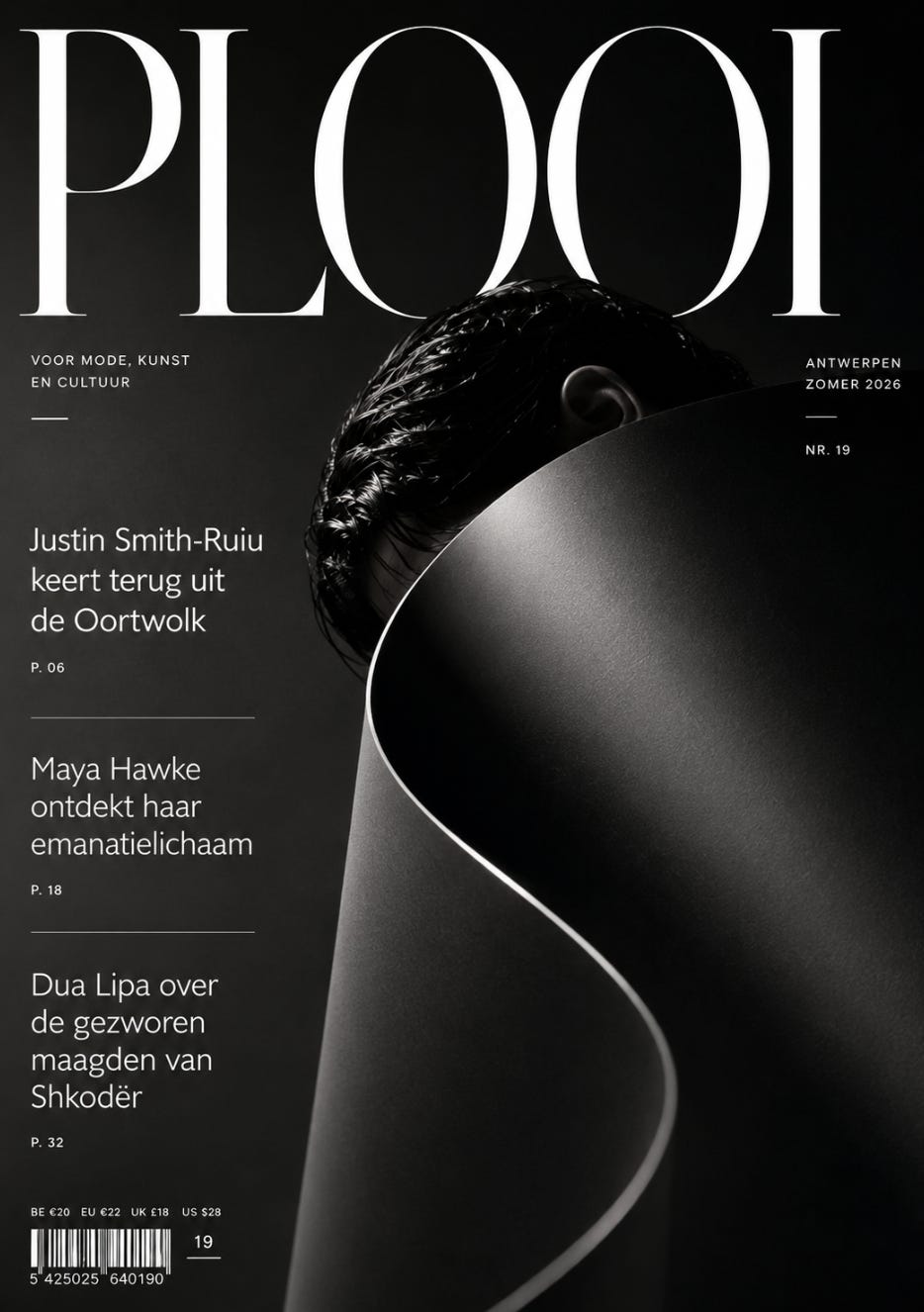
Justin Smith-Ruiu Comes Back from the Oort Cloud
[translated from PLOOI Magazine, Summer 2026]
In early May we tracked down the elusive Justin Smith-Ruiu near his home in Paris for this exclusive interview. Believed to be the mastermind behind the much-discussed Oort Cloud Review, which will be appearing from Hat & Beard Press later this summer, and which is already being adapted for the big screen, Smith-Ruiu continues to evade the question of authorship.
Whether he was behind this strange work or not, he sure had a lot to tell us when we sat with him on a bench in the Buttes-Chaumont for a conversation that lasted over five hours, about his creative process, the relationship between the faculties of reason and imagination, the cosmological origins of the narrative art, and so much else besides.
This interview has been edited for concision and clarity.
PLOOI: Let’s get right to it and talk first about the Oort Cloud Review. In previous interviews you have remained in character, insisting that the OCR was delivered to you, as a complete file, through a technology known as “IWTP”. Are you going to stick by that today?
JSR: Inter-World Transfer Protocol is a real thing. From Fontenelle through David Lewis even where you had the most thoroughgoing modal realism there was always a presumption of the theoretical impossibility of contact between possible worlds. And of course that’s true, if you mean literally travelling from one to the other. Possible worlds don’t neighbor one another like rowhouses. It would be more correct to say they overlap one another, almost perfectly, and it’s thanks to this overlapping structure of reality that our new information technologies were able to open up at least a limited amount of data transfer across world-boundaries.
PLOOI: You’re still denying authorship, then?
JSR: Well, no, not exactly. I mean, evidently this is the work of a counterpart-JSR, and I’m happy to help a brother out, so to speak, by bringing it into the world and doing my best to imagine what he, I mean, what that other instance of me, would have said in an interview like this one.
PLOOI: Shall we proceed as if you were the author?
JSR: As you prefer. Don’t forget, though, that the OCR features several real contributors: Marco Roth, Kristen Roupenian, Ange Mlinko, Jacqueline Feldman, among others.
PLOOI: And are these their counterparts from another possible world, or is it really them?
JSR: I’d prefer not to speak on their behalf. Go interview them too!
PLOOI: What about the basic narrative conceit of the OCR?
JSR: What about it?
PLOOI: The volume presents itself as a literary magazine in the vein of n+1 or the like, but the reader soon discovers that things are not at all what they seem. For starters, you, or Hélène Le Goff, or whoever is behind this, claim to be in possession of a secret memorandum, issued in 1957 by something called the “Presidium of Five”, which seems to be something like the supreme council of an organization known as the “Heliopause Research Directorate”. According to this document, the greatest discovery of the 20th century, following up on a speculative hypothesis from Pierre-Simon Laplace two centuries earlier, was not nuclear fission or relativity theory or quantum mechanics or anything like that, but…
JSR: I mean, look, the Laplace conjecture, regarding an envelope of icy bodies surrounding our solar system that interact with one another in a way that effectively reproduces the function of a supercomputer, is far from prima facie absurd.
PLOOI: Perhaps, but the OCR goes well beyond that. It claims that the Oort Cloud has been functioning for billions of years as a sort of “natural LLM”, and that —I hope we’re getting this right— it is the “narraton particles” emitted from the Oort Cloud that explain the capacity of a certain well-known terrestrial species for telling stories, or in other words for presenting as true what is in fact false.
JSR: Yes. That’s right. That’s true.
PLOOI: We admit the upshot is intriguing: that our own narrative power is a side-effect of the Oort Cloud’s natural proneness to “hallucination” — the very thing we resent the most in our human-made LLMs.
JSR: It’s remarkable, isn’t it?
PLOOI: As the premise of a certain sort of rather far-fetched science-fiction, yes.
JSR: Interpret it as you will. But we still have to account for where science-fiction comes from, what so to speak its transcendental conditions are. It’s not true? Fine, whatever. It’s not true. Then how am I able to present it as true? This is the real “hard problem”, and neither the scientists nor the littérateurs have even begun to understand how hard it actually is. That’s where the OCR comes in. I mean, Cervantes seems to have understood, with the result that much of Don Quixote is really just a sustained metafictional reflexion on how it is even possible to present as true things that never happened; but then over the following centuries literature devolved little by little into the “realist” novel and then, as its final death throe, into a mere vehicle for the delivery of “content”. From the other direction, the analytic philosophers preoccupied with counterfactuals and things like that have also understood the immensity of the problem, but they are for the most part content to stay in the antechamber of conceptual analysis, and aren’t even aware of the imaginative resources that they’re leaving untapped.
PLOOI: Don’t you worry that you’re being rather reckless with all this mixing of truth and falsehood, though? After all, the OCR isn’t even officially released yet, it’s still only available for pre-order, but already we’re hearing all sorts of alarming things on Telegram, in the Slack channels, in the Trunks, and even a bit in the mainstream press.
JSR [laughs]: Like what?
PLOOI: Like that it’s the same technologies originally developed for trapping narraton particles at the heliopause that are behind all the incidents of so-called “Havana syndrome” in recent years.
JSR [laughs again]: Well, people love to speculate. We can’t be held responsible for their overly fecund imaginations. The Oort Cloud is.
PLOOI: The Oort Cloud is what?
JSR: Responsible. For their overly fecund imaginations.
PLOOI: You’re committed to the bit, aren’t you?
JSR: I’m sorry?
PLOOI: Let’s move on. At the core of the OCR there seems to be a persistent reflection on the threat both to language and to our understanding of the world around us that is represented by AI. If we may say it seems to be among the first creative engagements, perhaps the first, that both fully face up to the threat’s seriousness, but at the same time show us some new pathways of real creativity that these technologies are opening up.
JSR: Thank you. I like to think that’s where the OCR positions itself. But of course I have to leave it to others to say as much explicitly.
PLOOI: But as to language, can you say a bit more about that? What is it that troubles you so much about the current state of things?
JSR: Let me tell you a little story. I was in London recently and I went to a Marks & Spencer. As you approach you see the slogan “Not Just Food” in the windows, but then you go in and the bags, which must be left over from a previous ad campaign, say more or less the opposite: “This Is Food”, or something like that. The raspberries are advertised as being “jammy”, while the raspberry jam is said to be “nothing but raspberries”. By Leibniz’s law of substitutivity of identity it would seem to follow that the raspberries are self-identical, and I wondered for a moment whether that could have been established even without the detour through the jam aisle. In general the adjectives on the packaging, gooey and gummy and yammy and God knows what, all those infantile -y suffixations that the British seem to love —which as PLOOI’s readers will know have their analogue in the Netherlandic -je—: these seem somehow to compound the density of moisture, already immense to begin with, in the concept of the original noun. And in general everything that is not being marketed as self-identical seems subjected to the descriptive language of a sommelier who has extended the esoteric art of enological analogy to every comestible imaginable. Chick peas must be called “nutty”, while nuts in turn are analogized to something else altogether. Of course if chick peas truly were nutty, they would share in the nature of nuts, and it would follow necessarily that nuts are chick-pea-y, or garbanzoid, or, if you prefer a more classicizing register, Ciceronian. But the logic of food marketing doesn’t permit that, which to me is only one of many signs of how empty it is, like so much contemporary public speech. One longs for “the unleavened bread of sincerity and truth”, and one fears that it is precisely our forgetfulness of that Biblical image, as an ideal for what language at its best can be, that has essentially paved the way for the total machine takeover of language in the present moment.
PLOOI: We think we follow, but it’s a bit of a stretch, isn’t it? From the inanity of advertising language to the death of meaning as a consequence of the rise of machine-generated text. After all, a certain kind of haughty intellectual has been complaining about the emptiness of public language for a very long time. Think of Heidegger with his whole critique of Geplapper — that was well before the era of language automation.
JSR: Was it? In my view automation properly understood begins with the earliest circulation of printed texts. We’re seeing another great leap forward in this historical process, but a sufficiently lucid observer could have made it out at any point over the last several centuries. I myself was not so lucid — it really took the arrival of LLM’s for me to see what was already happening. In this regard, it seems new technological revolutions can sometimes teach us as much about the past as they do about the present.
PLOOI: Surely there is also much that is unprecedented in the present moment, if only in the Marxian sense that at a certain point quantitative change brings about real qualitative transformation?
JSR: Certainly, I would say that what is genuinely new is the advent of what we are currently calling “slop”, for lack of a term that would come from serious theoretical engagement with the phenomenon. This is above all the case with AI-generated images, especially the ones, as in Italian Brainrot, that have had some real memetic force to them. In the 20th century, art made itself inscrutable, while mass commercial entertainment prized accessibility above all. In the 21st century, with the appearance of “slop”, mass commercial entertainment is making itself inscrutable. Two hundred years earlier, neither of these shifts would have made any sense, while today it is hard not to see the later shift as a continuation of the same historical process that gave us the earlier one. Avant-garde art really was the vanguard to the extent that it established the template for how culture as a whole would come to look once the technologies of mass production of image, text, and sound became universally accessible.
PLOOI: But aren’t you concerned about what critics like Naomi Klein have highlighted regarding the “training data” on which AI depends, describing it as little more than theft from the original human authors who produced it?
JSR: That argument mostly falls flat for me, at least when I’m looking at the output of the new memetic culture surrounding AI. The problem is that such “theft” is already at the basis of so many vernacular art forms, from the Burroughs cut-up to the hip-hop sample, whose aesthetic merit is by now entirely beyond dispute. And at least for me, when I’m watching Italian Brainrot, all I can think is: Look, Naomi, if this is just theft, then why does it look completely unlike anything we’ve ever seen before in all of human history? Where exactly is Tung Tung Tung Tung Tung Tung Tung Sahur in the pre-AI training data? Show me that little freak’s human-generated prototype! You can’t, obviously. He’s sui-generis, just like a rapper’s recycling of a James Brown vocal snippet, or Roy Lichtenstein’s pop-art appropriation of the comic-book format.
PLOOI: It sounds as though you are of two minds then, regarding these new technologies — you see them both as a grave threat to meaning, but also, potentially, as a vehicle for the vanguard exploration of new creative potentials?
JSR: Well of course, pretty much everything in history is like what Leonard Cohen sang about shooting heroin: “Did some good, did some harm.” Anyone who tries to come down dogmatically one side or the other of such a complex historical transformation is just an idiot. It’s like what that one guy, what’s his name… like what John Ganz posted about Steven Pinker when the latter said something characteristically simplistic about how “good” the Enlightenment was, in contrast to those who deem it “bad”. “What no dialectics does to a MFer,” Ganz wrote, if I recall correctly. Well, I don’t want to be that MFer.
PLOOI: You seem, if we may, not just in the OCR but in all of your work over the past five years or so, to be driven by an overwhelming preoccupation with the liberty of expression. Can you tell us how that came to be so important to you?
JSR: I am really so fortunate to lead a life of ideas and imagination. It’s just incredible! It is however necessary to emphasize that this life was made possible by a choice, independently of and sometimes in real tension with my pre-existing social identity as an academic. I can remember as recently as, say, 2019, feeling constant pressure to speak in a way that I knew was unnatural to me, and constantly worrying about what the local “enforcers” within my academic community would say about me if I deviated from the prevailing speech norms. Then something happened, I don’t know what exactly. The topsy-turvy experience of the pandemic, of un monde à rebours, surely helped to jostle me out of that old slavishness. I should also mention that I hit my head in an electric scooter accident in 2021, and I have trouble believing that that very literal “jostling” played no role in what I have often described as my “reset”. Now I barely ever think about those enforcers at all, and when I do see their names, I smile, and I often find that I am actually able now to feel real affection towards them, as flawed human beings just like myself, in a way that I never could when I believed they had power over me and I was afraid of them. What a waste of my years! I suppose I now have a sharp feeling that I got a very late start at the eminently important task of simply being myself, and perhaps in consequence I am working overtime to make it clear who that self is. Anyhow as I see things, “Speak in this new dumb way, mouth these new disingenuous words, or we’ll crush you,” is pretty much the normal course of history. And art is really the only viable means of resistance to this lamentable imperative.
PLOOI: You seem, if we may say, awfully confident in your own abilities. Is this boldness part of the “reset” too?
JSR: I wouldn’t call it confidence or boldness. It’s more just facing up to a fact that preexisted my acknowledgment of it. External validation is nice, of course, but it’s not strictly necessary. If there were some app or LLM or guardian angel able to prove by stylometrics or superintelligence or even omniscience that I am a poor storyteller, at this point nothing would change for me. I’d still have to keep doing it. Don’t ask me why, I don’t even know myself. I only know that at times there is some satisfaction in the sense that one writes a little better than one used to. And even if that is a misperception, so what? What else would I do? Good or bad, it’s my vocation. Or perhaps better: good it’s my vocation, bad it’s my curse. I simply must keep doing it. Forgive me, or, thank you for your support — whichever seems more appropriate.
PLOOI: Again, forgive us for being blunt, but don’t you sometimes worry that there’s something a bit unseemly, a bit vain, about constantly centering yourself as the primary focus of your creative work?
JSR: Well of course vanity looms as a constant danger when one chooses to work in this way. But you have to look harder, I think, to gain any reliable picture of what the work is doing. There’s one way of centering the self, as in, say, Celia Paul’s self-portraits, that rotates around a question that seems to me eminently philosophical: “Who the fuck am I?” Or: “How is it possible that I am this person?” It’s Peter Handke’s Warum bin ich ich und warum nicht du? This seems to me undoubtedly a worthy basis for creative explorations in any medium, not least because the lessons that might be extracted from such explorations are generalizable far beyond the individual at their center. At the same time, of course it’s inevitable that one should entertain constant doubts about the decency, the morality even, of the particular form taken by one’s efforts at creative self-expression.
PLOOI: Still, though, doesn’t all this creative work stand somewhat in tension with the expectation of self-effacement at the heart of your Christian faith. You are a Christian, aren’t you?
JSR: Yes.
PLOOI: How do you make it all fit together then? Because we’re still seeing some tension.
JSR: Alright, where to start? So, I’m not a great fan of George Saunders — there’s just so much more I think literature must aspire to be! But there is one story, “Commcomm” (2005), with two particularly memorable lines. One of them is pure punctuational genius, when a character speaks of his nightly duties bathing his handicapped wife, saying: “That, to me? Is real.” The other is when Giff, a ChristLife Reenactor, says to Rimney, an absolutely vicious and devil-tongued person: “I like how you’re funny. There’s joy in that.” Giff’s Christian charity renders him unable to discern the true nature of Rimney’s humor. It’s not joy. Rimney is funny because he is suffering, and he is suffering because he is living in the hell that each of us carries inside us so long as we maintain a seul contre tous attitude in regard of others. So the Christian guy affirms another guy in his, the other guy’s, sinfulness. Whoops!
Sometimes I feel like I’m doing that as well, not in relation to some other guy, but to myself. I mean, there just is something inevitably cruel, something pagan, about delectation in the fruits of the imagination, of which the gelastic register, humor, is perhaps the very most spiny of all such fruits. And this also surely has something to do with the near-universal Christian interdiction on psychedelics, a question I grappled with very seriously in my 2025 book, On Drugs. If there’s something pagan even about jokes, then there definitely is also about communing with the great cosmic serpent or following out the pathways of trillions of miles of mycorrhizal tendrils, as one might be invited to do under the influence of, say, psilocybin.
I don’t know quite where I come down on this; as I’ve already confessed I’m a dialectical thinker and am therefore almost pathologically committed to a variety of both-sidesism. Part of me wants to say, regarding at least the use of naturally occurring psychedelics: If Christianity is true, let nature declare it too. Let nature’s frothing up into our imaginations deliver truth there as well, even if in more vaporous form than we might expect in the standard Western mode of religious reflection consisting of faith supplemented by the faculty of reason. Why wouldn’t it? Let us as Christians not be afraid of nature, or of the faculty of imagination into which nature seems particularly adept at extending her own tendrils.
This line of thinking seemed to be confirmed for me, as if in miraculous sign, in a recent social-media post from none other than Pope Leo XIV. Let me find it on my phone [fusses around with his phone for the next 78 seconds]. Here it is: “Dear writers,” he proclaimed, “we need your imagination, your narrative creativity and your lively thinking. We need these to create spaces of freedom and authenticity, within which divine grace can make the promise of consolation and peace resound.” I read that and it was as if everything came together for me in an instant. The Pope gets it.
Imagination is a charged and dangerous thing because it is free, and inevitably it is going to lead those of us who live under its orders through some pretty funky swamps and vaporous thickets, where divine grace may at times seem completely absent. Historically, one can understand why so many of his predecessors, and the theologians advising them, cautioned against letting the imagination roam freely. But it seems to me, and evidently to the Pope too, that Christianity itself must be bold and unafraid, must always remember that divine grace is nowhere truly absent, and that faith cannot require an abrupt rupture with all pagan lifeways — which are ultimately, for better or worse, the lifeways of the body, and of all of bodily nature. And again, though Leo doesn’t say this himself, I will, in my capacity as a historian of philosophy: it is precisely the imagination that has often, and in my view rightly, been understood as the faculty most intimately fitted to that stratum of human existence.
PLOOI: If we can get in a bit of praise before wrapping this interview up, we did want to say how impressed we are, paradoxically, with the honesty of the OCR. The way you talk about yourself in the final chapter in the volume, “The Storyteller” —a late-arriving and unexpected appearance, given that you’re not even listed as a contributor in the table of contents on the cover—: we found all that extremely moving. But what’s so surprising is that this chapter is the most wildly unrealistic metaphysical sci-fi insanity yet —like, at one point you describe the plight of your pre-birth “soul-pip”, and how it got stuck for two years in the late 1960s in the elastic band of a Little Rock church lady’s pink shower-cap— in a volume that seems to move through a constant and gradual ratcheting up of the insanity levels, but still it is clear that at the same time you are giving a real portrayal of yourself, you are figuring yourself as if in clay, first and foremost, and then so to speak putting on dim colored lighting that speckles it with the rotations of the disco ball. Does that make sense?
JSR: I’m not following. I didn’t contribute the final chapter or any other chapter to the OCR. At least not under my own name.
PLOOI [holding up an advance copy of the OCR and opening it to page 259]: Oh really?
JSR: We must be working with different versions.
PLOOI: Are you serious?
JSR: Yes.
PLOOI: Well then, let’s move on. What are you working on these days?
JSR: A novel.
PLOOI: Lovely, what’s it called?
JSR: The Hinternet.
PLOOI: You mean, as in the slang term used by ham radio enthusiasts?
JSR: I mean it’s called The Hinternet.
Editorial Postscript
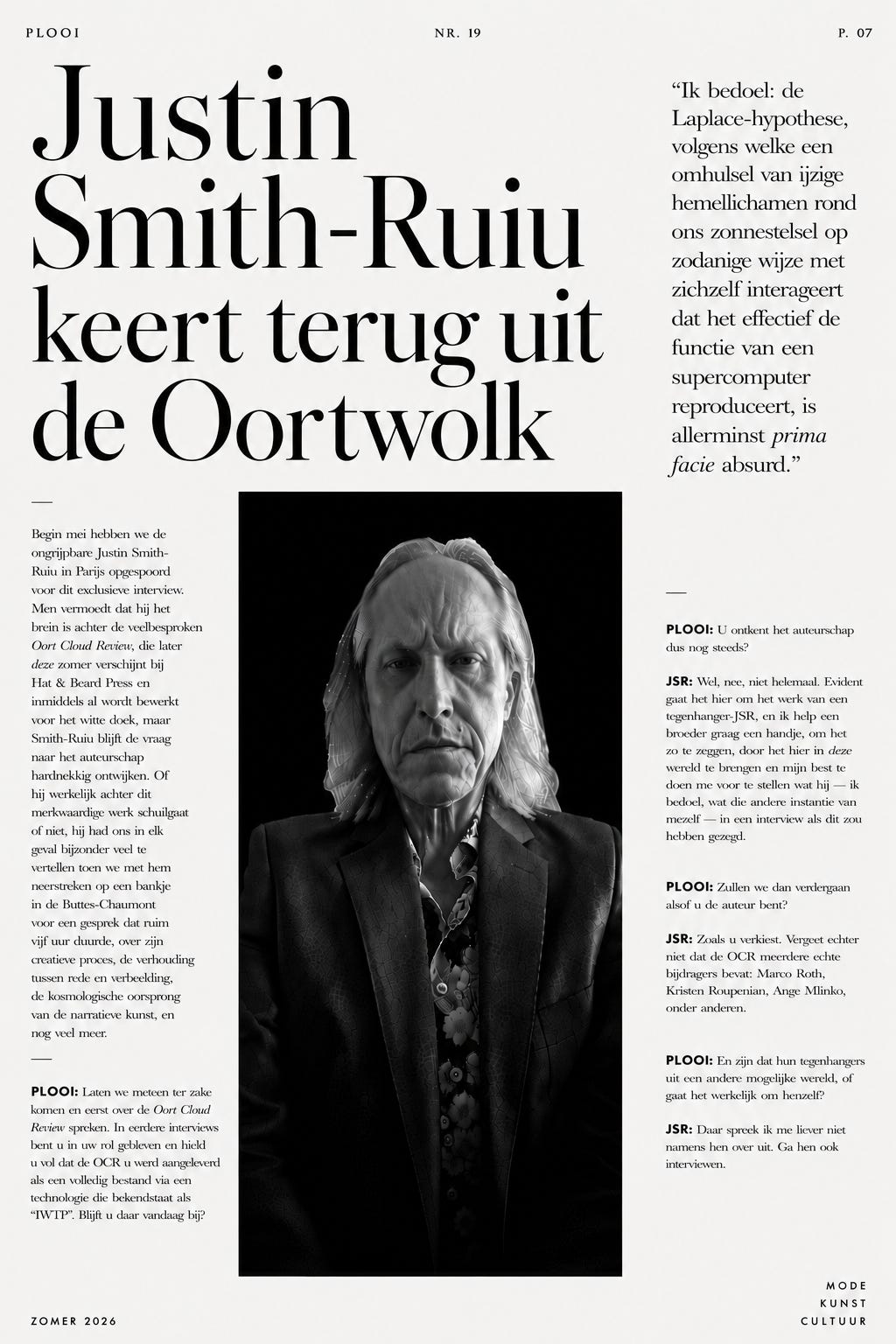
We previously refrained, in our brief Introduction, from sharing with you two facts that might now help to make sense of the remarkable document we have just shared in passable if not perfect English translation. The first is that our research, which brought us rather deep into the world of glossy arts-and-fashion periodicals issuing from the Low Countries, turned up no evidence of the existence of a magazine called PLOOI. The second is that the pdf file did not come to us as an attachment, but via a link to an independent site from which we were able to download it. The url for the site began, significantly: iwtp://.
This, we conjecture, abbreviates “Inter-World Transfer Protocol” — the very technology to which JSR himself alludes at the beginning of the interview. We rush to add that if this is in fact what explains the origin of the document, if PLOOI exists in a “nearby possible world” but not in our own, then of course the JSR who gave the interview is not quite the same one currently “shit deep in university admin”, but is rather, to appeal again to the same terminology he uses in the interview, a “counterpart-JSR”, one who inhabits a world that does have room in it for PLOOI, one in which The Hinternet by contrast does not seem to exist (at least not in the form we ourselves know and love), … and indeed one in which, we sincerely hope, JSR, or JSR*, finds himself relatively less burdened by bureaucratic duties, and relatively freer to pass his days doing what he loves.
We confess we do not at all understand the metaphysics of inter-world transfer, if that is what we are witnessing here. The Oort Cloud Review itself, of course, takes up the theme of many-worlds realism, but only —or so we long thought— as one of several of its finely woven and purely fictional leitmotifs. Whether we were right to cordon it off in this way, or whether inter-world transfer is in fact the key to understanding the entire work, both how it came to be and what it aims to do, is a question clearly in need of further investigation (see Oort Cloud Review, Volume 1, Issue 2, forthcoming, c. 2029). —The Editors