

1.
It is all very easy to accept that dog and chien are but arbitrary signs, sharing not at all in the essence of the dogs themselves. Then again the fact that dog has come to denote dogs twice along entirely different tracks —English and the extinct Aboriginal Mbabaram language— is at least some small bit of evidence for the true Adamic dog-nature of Canis familiaris.
Words anyhow are the easy part of language. The hard part is accepting that our punctuation is arbitrary too. Anglophones love to debate the propriety of the em-dash ; I meanwhile have spent the last thirteen years trying to bring myself to insert a space before my semi-colons when writing in French, an unnaturalness I have forced into the present English sentence in the aim of demonstrating just how deeply wrong it is. But rules are rules.
I saw some graffiti once: La France, c’est comme ta mère : pas de règles ! While I can’t be entirely certain, the author appears to have disproved his own point by inserting spaces after the relevant punctuation marks. The rule here is so deep that the native speaker does not know he is following it: no space for periods and commas, but a space for colons, semicolons, question marks, exclamation points, and guillemets (we’ll deal with the last of these separately). Thus, if you wish to cite Serge Gruzinski’s What Time Is It There? America and Islam at the Dawn of Modernity (Englished, 2010), and you wish to do it correctly, you are obliged to write something like:
Gruzinski, Serge (2008). Quelle heure est il là-bas ? Amérique et Islam à l’orée des temps modernes, Paris: Seuil.
My footnoting style, I confess, is vernacular. It follows no known system. Chicago? MLA? I haven’t checked. I simply do what I have always done. Sometimes editors let it pass, sometimes they modify it themselves, and sometimes —though with ever-diminishing frequency, as ever-younger editors have rightly learned to cower at the thought of having to instruct me to “go back and have a look at the manuscript formatting instructions”—: sometimes, I was saying, even now, they send the ms back and ask me to modify it.
But what I wanted to discuss is the space after là-bas (a fascinating compound adverb in its own right, which as the title of J. K. Huysmans’s 1891 masterpiece translates not as “over there”, as it does for Gruzinski, but as “down there”, implying some sort of infernal descent). I have already spoken, superciliously, of “correctness”, but obviously what is to count as correct is determined in part by the higher-level punctuational scheme one has presupposed. In the Gruzinski citation what I have shown you is not in fact a footnote, but a citation for the bibliography of a book I have written in English. However much I would like to preserve all the rules that would govern the citation of a French book in a French bibliography, I find that is really just not possible. I can import that language’s very different conventions as regards capitalization, for example. These conventions are typically not respected even in otherwise polished English-language publications, where you often see such impossibilities as L’Etre Et Le Néant (or worse!). But still, any copy-editor who would change heure to Heure could easily be persuaded to change it back. With the space before the question mark it’s not so clear. It simply looks too much like a mistake. It has no place in an English-language publication.
Do guillemets have a place? Arguing the negative, we might point out that these marks simply do not exist in English, strictly speaking, and to that extent they need to be converted, much like standard bibliographical convention requires us to transliterate titles in Cyrillic or Greek into the Latin alphabet. Thus:
Huygens, Christiaan (1717 [1698]). Kniga mirozreniia, ili mnenie o nebesnozemnykh globusakh i ikh ukrasheniiakh, trans. Iakov Brius, Saint Petersburg: Napechatsia v sankt piterburgskom tupografii.
Let us not even get started on how much we could have done differently in this entry. Should we have preserved a trace of the Cyrillicization of our Dutchman’s name as well: Giuïgens, Khristiaan? (I can still remember going to the Red Square McDonald’s in 1990, just opened, with a hammer and sickle superimposed on the Golden Arches; my crazy friend Jefferson, late of Knoxville, a real-life Suttree, got a good laugh out of ordering “gash browns”, though of course on its Eastern front, as it were, McDonald’s did not yet feature a breakfast menu.) Should we have returned our translator Iakov Brius to his ancestral “Jacob Bruce”? Should we have translated the city name, or simply transcribe what is on the page: Sankt-Peterburg — or, actually, Sankt’’-Piterburg’’, since this was published before the Bolshevik spelling reform and in order to capture everything that is there we would have to include the hard sign, ъ, transliterated as ’’, which as a rule used to follow every terminal consonant not followed by a soft-sign (ь), and which of course ends up looking like a misplaced quotation mark. Rules are rules, as we’re seeing, but that fact itself does not give us the rule telling us which rules to follow!
And why should we translate the city name while still preserving the archaic identifier for the publisher, which is in fact a complete phrase, not “The Saint-Petersburg Typography”, but “Printed at the Saint-Petersburg Typography”. What I’ve got here, plainly, is a compromise, a hybridization of two systems. A monstrosity. It’s wrong, and I don’t know how to fix it. (I am not asking for input. I am saying there are intractable problems in the art —yes, the art— of bibliography.)
But enough of that. For now our concern is with French alone. I was saying that to include an “«” or a “»” might plausibly be counted as a gesture no less out of place than to write Книга мирозрения (or, in fastidiously correct pre-Soviet style, Кнiга мiрозрҌнiя).
How much of the original should we allow in? How much should we permit ourselves to alter for the sake of legibility? Let us say we have permitted ourselves, as I in fact have, to write, for example:
Espagne, Michel (2025). “Premières découvertes des langues sibériennes et caucasiennes. De l’anthropologie à la lexicologie,” in Émilie Aussant and Fabien Simon (eds.), Documenter et décrire les langues d’Asie : histoire et épistémologie, Paris: Société d’histoire et d’épistémologie des sciences du langage, 349-375.
Again, there is so much that could have been different here. I have nativized the quotation marks (nor have I permitted a half-measure, English quotes with French spacing: “ Premières découvertes ”, or, alternatively , French guillemets with English spacing: «Premières découvertes»). I have put the comma inside the closing quote, while another sort of gesture to the original would have put it outside. I have referred to the editors in English style, while I could have written not “(eds.)” but “(dir.)” for sous la direction de. I have, you will by now be primed to have seen, placed a space between d’Asie and the following colon. But notice I have not placed one after the name of the city of publication. I defaulted to English convention there, while I preserved French convention in the capitalization pattern of the name of the relevant scholarly association. Again, what we have here is a grotesque hybrid. And again, do not offer advice. There is no satisfying solution.
Nor have I yet touched upon the difficulties confronted in citation of Latin texts.
Nowhere, indeed, does the fundamental hostility to tradition of our contemporary technological reality show itself more brutally than in its systematic effort, as blind as it is unrelenting, to efface all written traces of the Latin language. I write Jiěshì piān (that’s pinyin), a term long standardized as the Chinese title of Aristotle’s Περὶ ἑρμηνείας, and autocorrect knows it’s dealing with something foreign and rare that is best left alone. I write De Interpretatione in turn, which has been standardized in Latin since roughly the time of Boëthius, and damned if my machine doesn’t clip off the final e.
I do not experience this as mere automated correction, but as true violence. I swear it doesn’t just happen at the initial moment of typing the word. The machine will keep trying to disappear that last letter, like some Perecian evil demon, using every opportunity, even as slight as the chance passage of the cursor over the word, to do its tradition-hating work. If word-processors had been in use 400 years ago, you can be sure they would not have functioned like this. They would have been, effectively, engines for the preservation of good Latinitas. They would have been equipped with a spring-driven hammer to pop out and rap your knuckles if you got your case endings wrong. And don’t tell me that it’s precisely because we stopped caring so much about things like Latin that we were able to move on and start doing things like building word-processors instead. If you do tell me that, I will tell you it has not been worth it.
I have seen analytic philosophers grousing online about the absurdity of having to give the name of the city of publication in their bibliographical entries. Admittedly, now that Oxford University Press manages so much geographically indeterminate straight-to-internet content, and now that it has switched out its august medieval sigilium for a logo that sooner suggests some multinational investment firm, the requirement to indicate whether it was the Oxford office or rather the New York one that handled your manuscript, or on occasion the one in New Delhi or Singapore or even in principle Dar Es Salaam, does seem to belong to another era.
But for us dix-septièmistes the city of publication tells a whole story, and over the years we come to see the names of those cities, fixed in the Latin genitive, as belonging to another world overlain upon our own, and we are comforted to be reminded that in addition to being published “at Regensburg” a book can also be “Ratisbonae”, or in addition to being “at Leiden” it can also be “Lugduni Batavorum”. These names often reveal strata of meaning that the national vulgates have lost. Thus Leiden turns out to be the “Lyon of the Batavians”, while for other cities, including the better-known French Lyon, we often find vestigial pluralizations. Athens remained plural; Marseilles and Lyons and many other cities besides contracted into the singular (though Americans visiting France often, by some mysterious instinct, bring the terminal s’s back, even after several centuries of disuse). Where did the other lions go? What is it for a city to be plural?
I am not just a vernacular footnoter, but an “organic” and “artisanal” one too. I have never used a “citation management program”. Here’s what I do instead. I write an entire book in a single Word file, and I insert footnotes one by one. I type each one by hand, letter by letter, each time anew. My current book manuscript, weighing in at around 103,000 words, has 628 of them. These will probably be converted into endnotes by the time of publication, and their numbering will begin at 1 for each chapter.
I suppose if I were to automate this procedure I would also be automating away a number of the uncertainties I have already identified. But I can’t do that. The footnotes are the roots and leaves at once of the text, which both anchor it to the world and ornament it, like so many of Giuïgens’s ukrasheniia. I must tend to them. I must nourish them, as root; and I must variously clip them and sing to them, as leaf, if the work itself is going to have any share of beauty. (Whether beauty is a legitimate end of scholarly writing is another question, but as I’ve said many times this will be my last scholarly book, and I am aware that it gives strong indications of being transitional towards a mode of writing in which aspiration to beauty can be taken for granted.)
I suppose there is a lesson here, potentially an important one, regarding AI. Many of you have been fretting about the arrival of machine-generated writing, and have been quick to denounce others who show signs of having had recourse to it. But many of you have in any case already been letting the machines make your language for you for some time now. This is a different level of language than the word or the sentence, but it is language no less for that. If full-blown solicitous writerly care for the footnote falls beneath your seuil de perception, this is only because you are unaware of how much of your own linguistic power you have already outsourced to word-processing prostheses.
As far as I can tell, the arrival of LLMs is only the end of a process, not the beginning of it. And it’s a process that a good number of those now fretting have sanguinely helped along through their own partially automated habits of writing. It’s been a technology all along, I mean, and you’re going to have to go pretty far back in time, likely back to the age of oral composition techniques, if what you’re looking for is pure poïesis.
2.
Ever since I switched into high gear to finish this book a few months ago, I have found in myself so much to say about language, and languages. Most of it is unshareable, since in order truly to get across what I want to say, my readers would have to be able to appreciate the nuances in the target language that I aim to draw out and to marvel at. The result has been that most of my writing here at The Hinternet during this period has instead been about music — the language everyone knows, the first and in some sense the only real language.
But I have to try. I have only in these past few months truly begun to perceive the true richness of the Sakha language, the remarkable way subtleties of meaning can get packed, morpheme by morpheme, into agglutinative chains. I’ve been reading and slowly translating a lovely story, “Motuo” (1928), by Amma Achchygyïa, the pen-name of Nikolaï Mordinov (writers are among the only figures in Soviet Yakutia who had the privilege of re-Yakutizing their names).
Up until now I had mostly read socialist-realist hack-work — dutiful, predictable, tedious. Indeed for a long time I found myself thankful that the officials had imposed a style of writing that takes for granted that all readers must be idiots, since linguistically I was an idiot, and the predictability of these works, the two-dimensionality of their characters, the stereotypy of every action and intention, proved pedagogically necessary for me. Until now the only truly good literature I had read in Sakha had been Sakha translations of Chekhov and Tolstoy. (Incidentally, “A Day in the Country” is simply the most beautiful short story ever written.) My great discovery with Amma Achchygyïa (himself the Sakha translator of Anna Karenina and Resurrection, among other works) is that at least some truly indigenous Sakha linguistic expressivity managed to slip into the system of Soviet literary production, I suppose in part because censorship was mostly centralized in Moscow, and much more sharply attuned to what could and could not be said in Russian.
The result, in “Motuo”, as I often experience with Chekhov, is something that feels powerfully like what happens when a painting comes into view. There is a sort of transcendent experience, of coming to have a mental image of a landscape, say, that does not seem to be causally anchored in the decipherment of individual grammatical elements or the determination of the meanings of words, but rather from the whole of the text, even if one cannot at all say how this is happening.
I’ve developed, these past months, a new habit, indeed a new craving, that compels me to make the effort, a bit every day, to conjure such images out of what are initially mere lines of text. This practice, I find, keeps something like the crackle of the fire of microdosed mystical experience going in me all the time. It makes me a “seer”.
There is a sentence in “Motuo” that says:
Кэдэлдьи алаас уонна Баатты хочото чараас тыаллах үрдүк арҕас халдьаайынан быысаһаллар.
To the extent that I’ve been able to clarify it, the English is something like:
The Kedelji alaas and the Baatty hill are separated by a narrow, windy, high ridge-slope.
But as with our footnotes in the previous section, there are countless problems I can see, and surely several more that I can’t see, even in this rather short passage. As the so-called “Leipzig Gloss” reveals (or my vernacular approximation of a Leipzig Gloss), the actual structure of the original looks very different the English:
Kedelji alaas and Baatty hill-3SG.POSS narrow wind-ADJ high nape ridge-INST separate-RECIP-PRES.3PL
But I want to focus here on just one word, арҕас, ordinarily a noun, but here seeming to function adjectivally as a modifier of халдьаайынан, itself an instrumental noun that I am translating as “ridge” (it’s the instrumental case ending that provides the “by”, which in the English occurs several words before “ridge”).
The ordinary meaning of арҕас is not orological however, but anatomical, denoting the nape, withers, or spinal ridge of an animal, paradigmatically domestic cattle, but also deer, wolverines, and even fish. It can also denote the vertebral column of a human being, or, sometimes, in special cases, it can indeed refer to a mountain crest. Халдьаай also means “ridge” or “crest”, and while nominal doubling like this is very common in Sakha, here the doubling seems to me subtly to highlight the parallelism between a mountain ridge and an animal’s back, and I don’t really see any way to capture this in English.
I could be wrong, mind you, about all of this. (Are you out there reading this Дьүгүөр? I know you’re busy, but feel free to chime in, доҕорум, if you have any insights.) But what I do want to say is that, after spending a good amount of time with this sentence, and thinking about the many meanings of several of its words, this evening a mental image appeared that utterly stunned me.
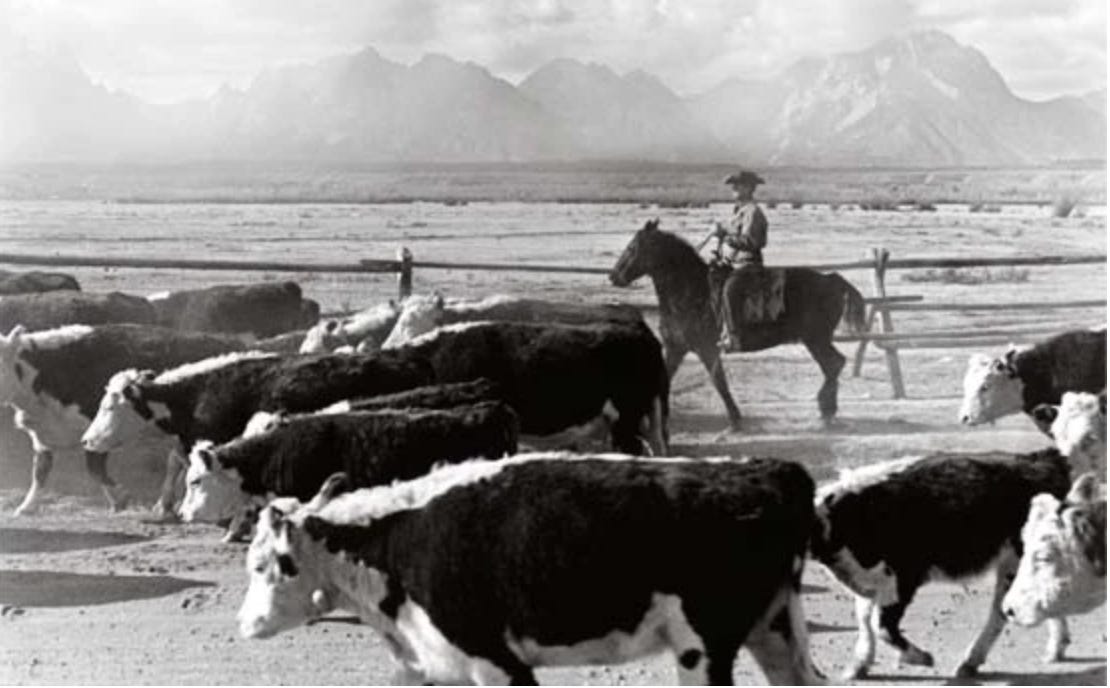
A beast stands in the foreground in a meadow, its back arched, and in the distance behind it a mountain range roughly duplicates that same line. Now I grew up in part in the shadow of Camelback Mountain, and it should not come as news to me that human beings habitually perceive parallels between features of the landscape and the physical traits of domestic animals. But suddenly, through the mediation of a “foreign” language, the human capacity for such a perception seemed, last night, infinitely more wonderful to me than any abstract theory or scientific breakthrough that came after it. How awesome that our ancestors, surely not yet human, looked at the ridge of an animal’s back, and at the ridge of the mountains behind it, and said: same.
The first thinking was the first writing, it seemed to me, for this was when we noticed that things can stand for other things. Thinking, it seemed to me, just is taking something for something else, which, I supposed, correlatively, is why we can’t think the things themselves.
Metaphor, I really do think, is at the origin of all the operations of thought, even the duller ones like calculating that we’ve tried to set up more recently as most exemplary of our essence. Metaphor is carrying over, as from a beast’s back, to the mountain ridge that doubles it in the distance. To notice such a possibility must have been a small miracle, not entirely unlike the parhelion or the eclipse — jogging the mind to discernment, or to creation (depending how you see things), of new patterns and world-orderings.
3.
A subsequent sentence throws a new problem my way. It features the word толлон, which is plainly an imperfective converb. (How do you translate a language with converbs, functioning somewhat as verbs and somewhat as adverbs, into a language without them? The simple answer is you don’t, not really.) But I can find none of its possible verbal roots in any reference work. What I usually do when I arrive an impasse is to try a simple Google search. Often there are no occurrences at all, on the entire internet, of the Sakha word that interests me. Sometimes the hits that come up are to the very same sentence I am currently trying to decipher. Imagine that! A written language largely constituted by hapax gegrammena! Think of the difference from our own hegemonic, cosmopolitan language, whose very most obscure words are still amply present in online search results.
This time what I got, for толлон, were several Russian-language articles on the French cheese known as “Thollon”, à pâte persillée demi-cuite, but also, thankfully, and finally, a confirmed match for толлон in a passage from the Sakha translation of Acts.
What a resource, the Bible! How presumptuous it is to imagine oneself a scholar, while knowing next to nothing about the massive millennia-long accretions of commentaries, apocrypha, legends, translations! This is tradition at its richest and most well-aged, and whether you are committed to it in faith or not, if you have any commitment at all to the idea of tradition itself as providing a necessary intellectual frame for making sense of human history, then you must study the Bible. (There are other scriptural traditions that are equally rich, and you are encouraged to study them too; but if you are reading this in English —and you are—, you are going to have to read John Milton, for example, to get the most out of your own language, native or adopted, and in order to do that, again, willy-nilly, you’re going to have to read the Bible.)
So the next thing I know I am reading Acts, with Bible Gateway open in English (New International Version), in Greek in another browser, and in Sakha in yet another. The verse that features our mysterious Sakha converb runs as follows:
Paul gathered a pile of brushwood and, as he put it on the fire, a viper, driven out by the heat, fastened itself on his hand (Acts 28:3).
I’m gradually figuring out the the relevant Sakha verb denotes a sudden motion made in fright, something that isn’t quite expressed in the English, even if the scene suggests it generally. But I have by now moved on from my language study, as, uncharacteristically, I find myself drawn in by the directness and transparency of the NIV. That’s my language: the English language, in a register so clear I don’t even see it as language, but only as whatever the language is saying.
Among other things it replaces the “brethren” of King James, which I usually claim to love for its archaic Anglo-Saxon plural, with “brothers and sisters”. I can see them now, the young women with their hair parted down the center, running with joy from the tavern to the docks at the first sight of the ship, with the figurehead of Castor and Pollux carved at the prow, so eager and overjoyed to reunite with Peter and the others. And this in turn allows me to indulge the misperception, I know, that Jesus’s first followers were something like “hippies”. The Greek is ἀδελφοί, which is generally more gender-inclusive than “brethren”, perhaps enough to justify the explicit inclusion of the sisters in our English edition; perhaps not.
What matters is that this is the first time that I am reading Acts, and seeing the scenes of it in my mind. What a document! This is not wisdom teaching or prophetic proclamation, as we find throughout so much of the New Testament. This is just straightforward Hellenistic historiography, and it seems impossible now for me to doubt it. Why would Luke have written that Peter was bitten by a viper, if he was not? Why mention Castor and Pollux? These things, I know as I read, happened. It is the same certainty I feel reading the journals of Lewis and Clark. There are some things ordinary chroniclers would simply never bother to make up.
I have for a while now been saying that, while I am a Christian, and I am some kind of scholar, when it comes to the scholarship of Christianity I am an absolute bonehead. I now anticipate that it may well be my reading of Acts —with a sufficient number of browsers open to Bible Gateway, with its variants in several languages, plus one open to ChatGPT, ever at the ready to summarize the exegetical tradition that has been spun out around every name that figures in it, no matter how minor, around every last Matthias or Barsabbas— that will finally enable me to pay the sort of attention to these words that I have spent my life paying to other ones.
4.
It is now two in the morning. I’ve moved gradually from footnote revisions, to Sakha study, to Bible study: a typical evening, more or less. I am listening to Andrew Bird’s My Best Work Yet (2019). What an uncompromising artist. It would be pointless to engage critically with his work, at least the way most critics engage today. What would they say? “I don’t like all the whistling”? Irrelevant. Andrew Bird will keep doing what’s in his nature.
Before dimming my screens for the night old habit brings me back for a few minutes to Substack Notes, where I mostly see young people jockeying for status, in a world they call the world of “writers”. But virtually none are writing about anything other than the world of writers itself, unaware evidently that the true scope of writing is the universe as a whole, and everything in it, in the broadest sense of “in”: manganese, corn, converbs, the angels and the saints.
Some of these young writers are truly great, and many others are at least, well, let us say, lively. And it’s not as if I cannot recall jockeying in that way myself, to only modest results, for many years. It has really only been with the total evacuation of all desire from the fundament of my person over the course of the present decade that I stopped doing that. Ironically, that is also the period when the work started, well, working. You really can get what you want in this life, but only on the condition that you stop wanting it.
My friend Marco Roth’s recent essay at Romanticon was moving for many reasons. Among them, it moved me to think about whether I should also start thinking about finding a literary executor. Is that what all this is? “Literary”?
Some anon on Notes described a recent metafiction of mine as “schizo-posting”. But this implies, I think, an absence of what might be called central command, whereas I know exactly what I am doing — even if, as I’ve just admitted, I don’t know how to classify it, nor what will come of it. One anon’s schizo-posting, anyhow, is another’s electronic literature, and as Nietzsche said, “You seek followers? Seek zeroes!” —which really should be the motto of anyone who writes with metrics in mind—, so either way I’m going to stay at it.

Are we all just schizo-posting at this point? Are we suffering from AI psychosis? My friend Blaise, who sits at the nerve center of all these transformations, reports that he knows of many such cases. But as for me, I am more lucid than I have ever been, and whether Andrew Bird was being facetious about himself or not, I confess I can’t entirely shake the feeling that I am in the course of doing my finest work yet.
These have been unusually productive months for me, with truly surprising breakthroughs in the way I think about problems that have exercised me for years. Some of these breakthroughs have come with AI assistance, but the questions I’m asking are as anchored to the world as any ever could be. My use of AI, too, is organic and artisanal, not so different in the end from the way I have, since 1988, used Microsoft Word to write.
There is still so much that cannot be automated: the mental image that sometimes comes from reading the arbitrary marks filling up a page; the discovery of real likeness between a mountain crest and an animal’s nape; the experience of certain knowledge of the truth of what one reads; the final determination of the form of a footnote.
Assuming that either -н or -он must be the converbal ending, I've found:
"толло [см. 2-толун]," leading to:
"2-толун, толлор (v). Трусить, робеть, бояться, страшиться, стесняться, не решаться, не сметь, не отваживаться, не дерзать, с Abl."
E. K. Pekarskii, Slovar' Iakutskogo Iazyka. Tom III. Leningrad: Akademiia Nauk SSSR, 1959 [Trudy iakutskoy ekspeditsii, snariazhennoy na sredstva I. M. Sibiriakova. Vypuski 10-13. Leningrad: Izdanie Akademii Nauk SSSR, 1927] s.v. "толло"; "толун".
With this and the context of the passage from Acts, I'm convinced by the "quick, fearful movement" conclusion, but I'm no expert in Sakha, and I might be playing fast and loose with verb forms.
Regarding Biblical linguistic data, I'm reminded of an odd rabbit hole I went down a few years ago. While my wife and I were casually browsing a late-'90s book of 30,000 baby names, I saw one entry that gave the name's origin as "Eskimo" with a meaning of "hyena." I messaged a friend who works in the Alaska Native Languages Archive in Fairbanks, and the only instance of "hyena" that he could find appeared in an Inuktitut translation of the Bible. How or why this word found its way into an otherwise unassuming book of baby names is beyond me.
Wonderful stuff, as usual. "A real life Suttree" had me cracking up, mainly because the scene with the watermelon in the field is frequently referred to in my family. And the anecdote about the beast's back and the mountain ridge reminds me of a study with illiterate Uzbek villagers where they were asked to describe colours and rather than refer to shade or hue, they said things like "cotton in bloom," "decayed teeth" "sky" and "pistachio." I've always found this metaphorical thinking very moving and, as you say, awesome.