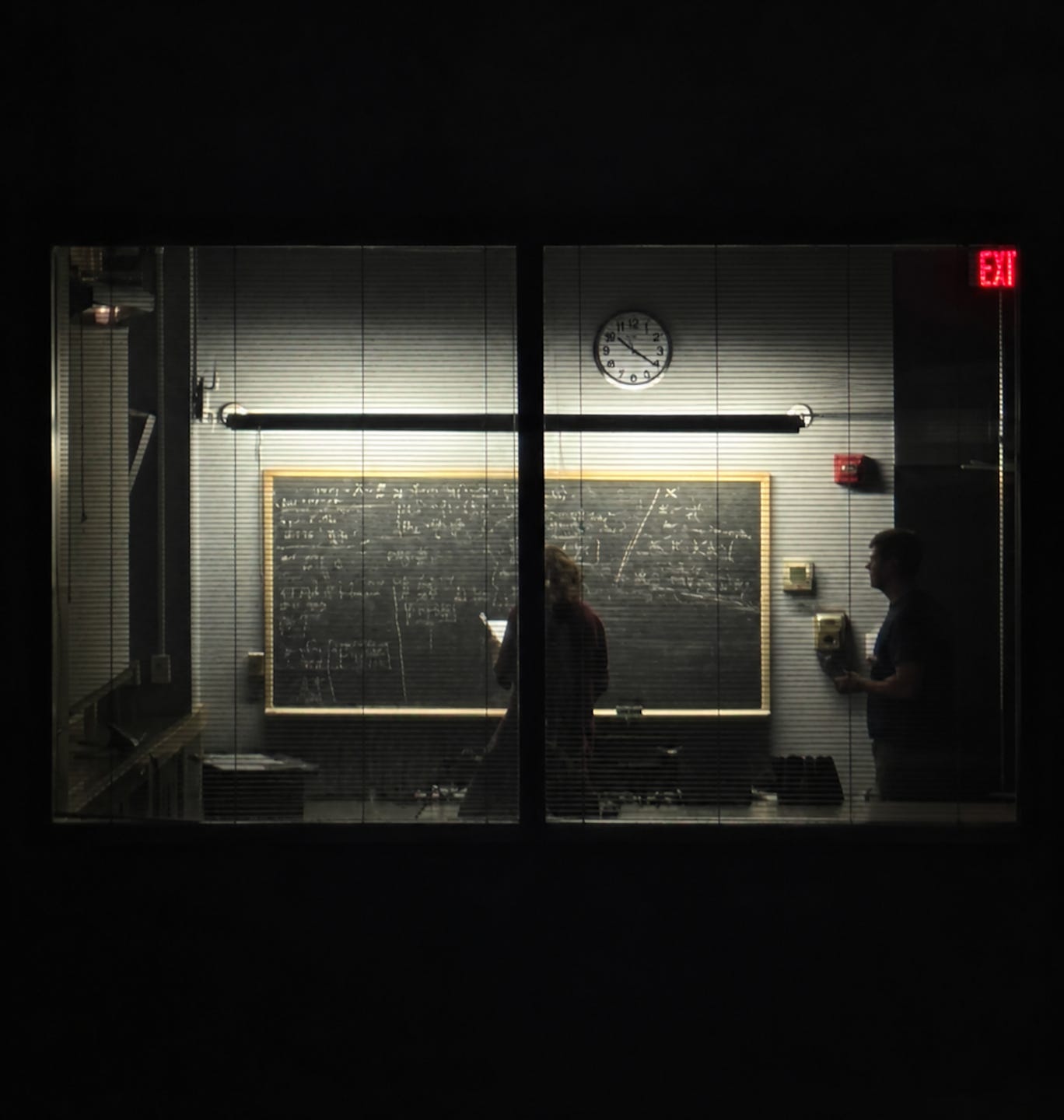
The picture below was taken only a month and a half ago, in Cambridge, Massachusetts. In spite of its recency, the image seems to belong to another era, with several elements in its composition that will almost certainly have no place in our near future: an analog clock, a chalkboard, mathematics as a meaningful human cultural practice…
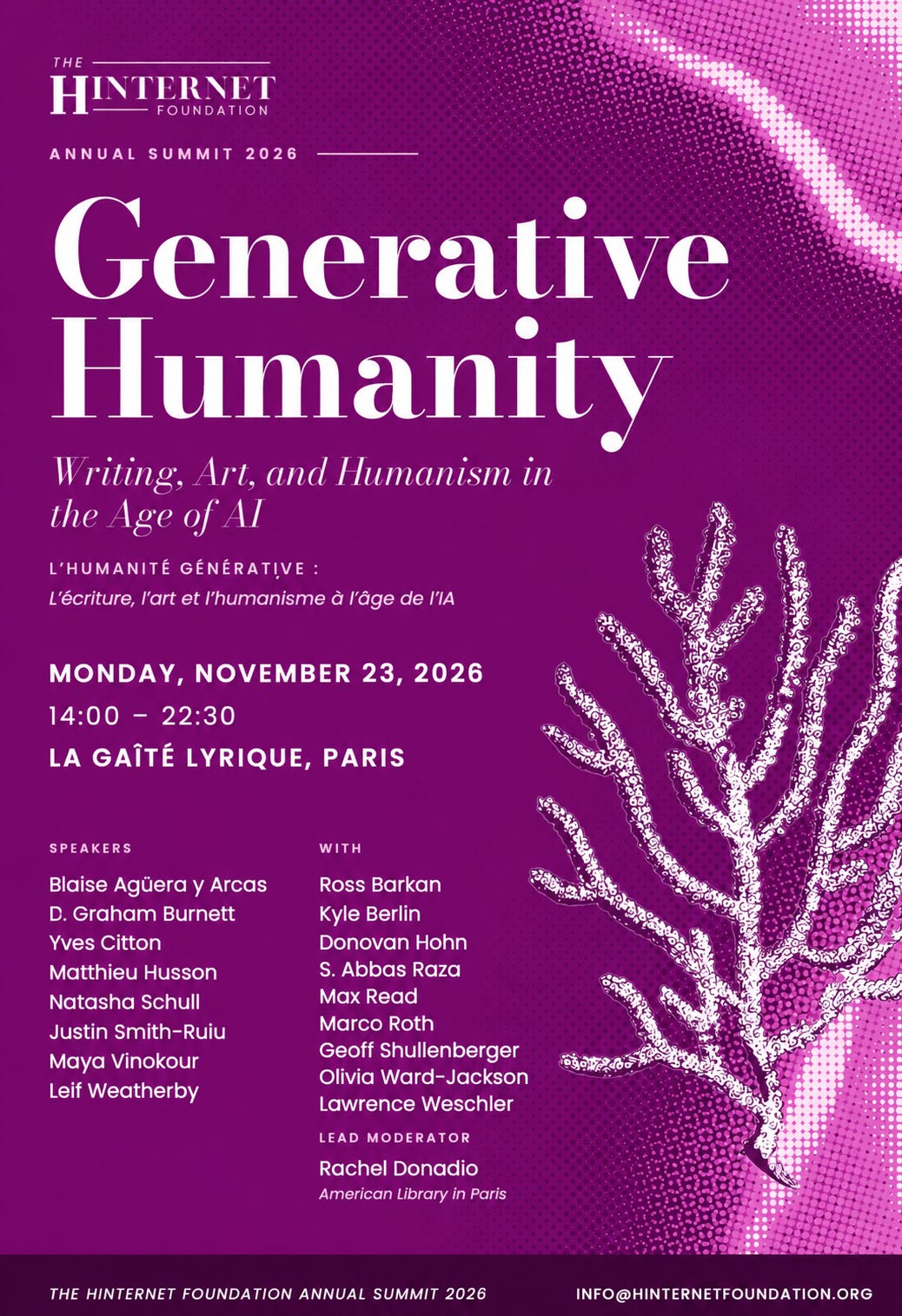
When we decided around a year ago to organize a big international meeting on the question of the fate of the humanities and literacy in the A.I. era, we were sharply aware that November, 2026, was far away indeed, and that we could have no way of knowing what the state of culture, technology, and research was going to be by then. None of us could have predicted that by the time the Hinternet Foundation Summit came around, it would turn out to have been mathematics, of all fields, to put on most vivid display both the tragedy and the promise of the present moment.
With the apparent Claude-assisted proof of the Riemann hypothesis just a few days ago, a good number of mathematicians are now accepting the fact that there will be no going back to work now, at least not to a form of work that looks anything like what they imagined they would be doing over the course of their entire careers. Outsiders to the field are resorting to proud and ignorant dismissiveness; mathematicians themselves, and experts in neighboring fields, are mostly speaking in terms of “disbelief” and “shock”, and of the simple unavailability of words to describe the momentousness of what is happening.
As to whether this is all momentously awful, or momentously awesome, opinions differ. Some see it only as an end, a going out of business, while others see potential for great renewal. If we must transfer the bulk of the work of hard number-crunching and similar operations to the machines, these latter expect or hope, perhaps this will enable a corresponding revalorization of the human role in mathematical inquiry as a creative and to some extent aesthetic one, and a revival of the human study of mathematics as not only or primarily an effort to solve problems —again, we’ve got the machines on that now— but to enjoy the freely engaged powers of intellect and imagination. Mathematicians, in short, as Terence Tao is not alone in recognizing, are going to have to restyle themselves as some variety of humanists, if they do not wish to die out altogether.
While the speakers at the Hinternet Foundation Summit will represent a diverse set of views —indeed, the principle of the Summit’s organization was to maximize such diversity—, a good number at least are now thinking: well if even the mathematicians are going to have to become humanists, surely it’s safe for the humanists to start being humanists now too? That is, given that we now have language machines capable of churning out whatever positive research results a human scholar might also be able to produce at a much slower pace, perhaps it’s a good time, now, radically to rethink the academic production model that has long had humanists aping the goals and methods of the positive sciences? Perhaps it’s a good time for humanist scholars to recall, and to take seriously, the fact that “scholarship”, and “scholar” and “school” and so on, have at their origin a common Greek word for leisure? School was supposed to be the opposite of work. And now that machines seem ready to do the work for us, like it or not, for better or worse, we may have no other option than to go back to “school” — that is, to rediscover, and to reclaim, a leisurely comportment to the life of ideas.
Is it even possible to imagine a political and economic regime in the near future that would tolerate for a minute such an open attitude of freedom in the work we humanists (now including mathematicians) do? Well, it’s going to be tough, and that’s part of why we have to come together now, some participants believe, to find new language to articulate the value of free inquiry, grounded in irreducible and non-transferable human experience, in a world now overwhelmingly shaped by the forces of automation.
There is also a question —perhaps even a tension that will inject some lively disagreement into tomorrow’s proceedings— as to whether this vision of “fully-automated luxury humanism”, where the machines produce the positive research results while the human beings delight in free and leisurely reflection on the grand history of human endeavor, amounts in the end to an expression of the sort of compensatory sour-grapes thinking that Leif Weatherby has called “remainder humanism”. Could it be that humanists are now retreating into a defense of all that is irreducible in human experience, a defense as doomed as it is disingenuous, only because they find themselves cornered and with no other options?
We can’t entirely predict where things will go tomorrow, but there does seem to be a productive rift opening up, between those participants who consider the tasks that await us humanists in the A.I. era to be but paltry compensation for the loss of an earlier and more elevated purpose, on the one hand, and on the other those who see this not as a loss or a retreat, but as a boon and a renewal of an older and more venerable and indeed more human vision of humanistic inquiry.
All we’ve got left is our power of attention, and the freedom of choice as to what to do with it and how to cultivate it. Whether that’s cold comfort, or whether it’s all that ever mattered anyway, is perhaps just a matter of perspective. But perspective may for its part, when put into words in public dialogue, such as we propose to undertake, turn out to be shaped in part by values, which, we think, it may do some real good to get out in the open.
The entire Summit will be live-streamed, beginning at 14:00 CET, for all audiences, here at The Hinternet. It will be archived at the new Substack page for The Hinternet Foundation, which you are encouraged to visit, and to which you are encouraged to subscribe.