

Time is running out to apply for the Hinternet Foundation’s fall online course on the Voynich Manuscript and its surprisingly central role in the history of the modern world. Deadline September 15! Click below to apply.
Disclaimer
We will not hide the fact —how could we hide it?— that we’re running behind schedule here at The Hinternet. We had the strictest orders from up top not to run the new-model HEB-bot until its several bugs were eliminated. And we had a deadline of September 1, when JSR himself, as he kept insisting to us in increasingly panicked e-mails over the month of August, was, like some overgrown child, soon to go “back to school”. From that moment, he warned, the real JSR was going to “have a total ras-le-bol of it” [J’en aurai ras-le-bol pour de vrai], whatever that means, and we should expect not a single word from him until mid-December.
In the end the Council of Storytellers came together on August 29, in their halls at the second-deepest level (both ontologically and architecturally) of what we colloquially call “the Nest”, where they determined that JSR is in no condition at all to endure any new semestrial deluge, that he must be spared the tragic inanition of all who are trapped within the eternal recurrence of the academic calendar, year after year unto death, old ghosts condemned ever to repeat the motions of youth, but without any vital juice left to give these motions their power and meaning. So instead, on August 30, without fuss or bumbling we slyly impregnated his kerchief with chloroform, knocked him out cold, and placed his earthly vessel in one of our patented Hinternet Corp. suspension chambers, recently constructed, to Hélène’s great pride, at Nest Level -2. Meanwhile our H-Corp “soft robotics” division managed to produce a mostly reliable mobile JSR emulator that can be installed in (i.e., shoved down the gullet of) an equally reliable silicone-elastomer effigy, or golem, created in the likeness of JSR’s body and head, and largely if not always capable of performing his worldly, and especially his campus-based, duties.
Here is what the “soul”, or as it were the “motor”, or perhaps the “archæus”, “entelechy”, or “luz” (as Edwin-Rainer calls it for some reason, with his secret inner encyclopedia of Kabbalistic learning), of this new mobile JSR unit looks like:
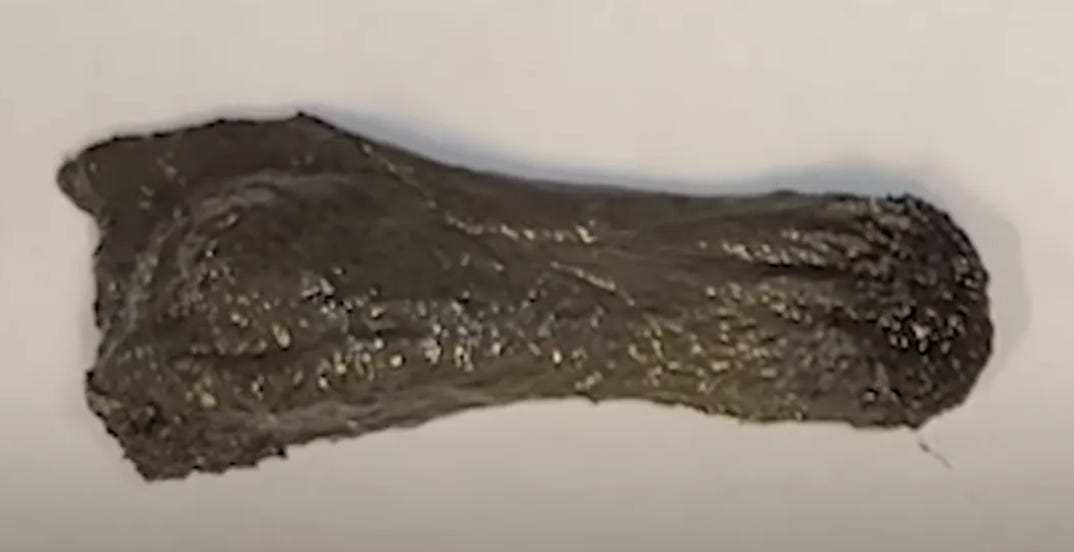
Good luck out there in the big world, little guy! We’re sure the real JSR will want to hear all about it when we wake him up in December! (For an earlier appearance from this lowly character, or a close cousin of it, see “Boogaloo” from October, 2022).
So the real JSR is down in cold-storage, the mobile JSR unit is too busy reciting “learning objectives” and praising “interdisciplinary synergies” and opening “vendor registration portals” (for remuneration of words vended) to be of any use at all, and meanwhile Hélène’s worst nightmare is coming true: the specialized HEB-bot we had counted on to generate basically all of The Hinternet’s output for the next months in the generic and collective voice of the Hinternet Editorial Board is, for reasons we do not understand, for reasons that likely surpass human understanding altogether, stuck in some strange rut where its language seems to emulate our various contributors in turn, one by one; most worrisomely, it seems very intent on channeling JSR specifically. Hélène had insisted that we get this JSR-inflected “interference” down to less than 10% by the time we go live with our fall programming (i.e., today). She had our poor interns, Augustus and Eglantine, on the task, day and night, as if child-labor laws had no force inside the Nest (perhaps they don’t), but in the end the new month came around and the machine was still speaking as if it were Legion himself, a swirling tourbillon of familiar voices — Mary, Edwin-Rainer, Sam, TPL, and, most troublingly, JSR.
We decided in light of this to give byline credit on the present piece —which we have yet to generate, as we decided to compose this “Disclaimer” first— to every Hinternet writer whose voice might be even remotely detected, with the result that it has almost as many co-authors as a piece of research in high-energy particle physics published in, say, the Physical Review C. Yet in our case, we expect, if there is a first author this could only be the Nest itself, which, as any visitor to our Quimper offices with security clearance E or higher will tell you, sustains throughout all its levels a continuous hum that cannot be accounted for in the language of the ordinary HVAC specialist, that is often said to have something to do with the unbelievably low temperatures at which our Sempiterns are maintained and at which they must be maintained in order to function, and that some among us conjecture, speculatively, when properly attended to, is no mere hum at all, but a pulse undergoing constant, subtle modulation in frequency, amplitude, timbre, and rhythm, variations that in fact amount to a grammar and syntax. Listen, and you will hear that the Nest itself is speaking. If it did not so consistently send out a punishing sonic wave, or force our machines into reboot, or somehow edit the sequence of reality so that every time we set about doing so we find ourselves transplanted back to a moment three seconds or so before we initiated the effort — if the Nest did not have all these and other stratagems in place to nip our attempts in the bud, we would happily have created a byline for it and given it the authorial credit it surely deserves.
Anyhow, let’s just hit the “Generate” button and get this over with. Again, the machine is acting screwy, and we can’t really anticipate what the different authors’ different percentages will be — but let’s just hope for the interns’ sake that the JSR levels come in under 10%!
I.
We here at The Hinternet apologize for our silence on the occasion of Wendell Berry’s death, who was and is of course a great beacon to us. It’s just that with the de-facto poets laureate of Tennessee and Kentucky dying in such quick succession, and with the effort we already made to mark the first of these losses, we admit we wanted to avoid the appearance of becoming a specialist publication for eulogizing the towering old bards of the upland South. We confess also that we find somewhat more to our taste the particular blend of authenticity and artifice that had become Dolly’s signature recipe, while Berry has indeed often seemed to us to stand for a life that is as unreproducible as it is honorable. Yet the honor that attaches to it, at least in the way his more severe and more dogma-prone acolytes such as Paul Kingsnorth understand it, comes with a strong sous-entendu saying: you ought to be doing this too.
But trust us when we say that no, we, the authors and editors of The Hinternet, really ought not set ourselves up as small-plot corn and tobacco farmers. This would not end well. You can insist all you want that one needs to be self-sufficient, pointing out the real likelihood of a future collapse that would disrupt the global supply chains and leave us high-trophic beneficiaries of neoliberal trade completely stranded. To which we would say, indeed, there are many future scenarios on which we here at The Hinternet are entirely screwed, but we’re getting that message from the gold-hoarding preppers and survivalists too, and we find in general that to get us on your side it helps to do more than just try to scare us.
Dolly’s “ought” language is rather more flexible. You ought to love your family and your neighbor, as yourself, but it’s quite alright if that happens to occur in line at Dollywood, or Kenny Rogers’ Roasters, or Taco Bell, or any old mall. And it is on consideration of this point of difference that one wants to say to Berry, fine, perhaps you really don’t have a soft-spot in your heart for algorithmic content delivery and fast-food chains and brand outlets and so on, but this is the way of my people, these things are for us what constellations are for the hoary old horoscopist, or plant species for the Amazonian medicine-man. They structure our world — the world of the semi-rural exurbanite who knows to aspire at most to the rung of the suburbanites, a world of economic precarity and constant anxiety over the prospect of class slippage. In this world chain stores are the highest known points, the stable and stalwart islands of order jutting out above a sea of family chaos and social pathology, where if you slip down any further you are pushed out to those parts of rural America where even Del Taco can’t penetrate, and the only islands of order are the state institutions, the prisons and schools, and the various combination-prison-schools, which are orderly in their way, but the order arises directly from the fact that they are ordering you, to stand and sit and speak as a successfully molded subject of the state.
The only space of well-ordered freedom, I mean, or so it seemed, was in the chain stores and the brand names, which provided a grammar and lexicon for the life of the suburbs. The suburbs, in their distinctly American and distinctly 20th-century expression, might be understood as the place maintained in existence by the belief that the disorders of human history have been successfully driven out and barred from entry. And under the reign of this belief the chain stores are like bright temples and monuments to this triumph. That is how I saw them anyway. I felt I must be living a truly charmed life on those occasions when I got to go to Rax Roast Beef or Jack in the Box, so much higher in the natural hierarchy than McDonald’s or Carl’s Jr. or Long John Silvers. I lived in a social world where this hierarchy was as familiar and accepted as the hierarchy of angels might have been in a medieval monastery. And possession of this knowledge, for better or worse, had much to do with my sense of what it meant to be American.
I think now of Das Racist’s “Combination Pizza Hut and Taco Bell” (2008), and it strikes me that this truly must be one of the greatest lines of verse yet to appear in the 21st century:
I’m at the Pizza Hut
I’m at the Taco Bell
I’m at the Combination-Pizza-Hut-and-Taco-Bell
Beyond the comic genius of the densely syncopated and multi-stressed third line, what is great about this song, arriving the same year as the financial crisis that properly initiated our ongoing and intensifying historical unraveling, is that it identifies, precisely, in a way any 20th-century suburban American could understand, the breakdown of the old order and the appearance of a new one in which it has grown rather more difficult for all but the most committed to see chain stores as anything like loci of freedom, now that they have practically converged in their architecture and their mechanisms of surveillance and control with the state’s own institutions for the enforcement of order (“Carceral Vibes Store”, is how someone recently described their experience going to CVS and looking for an employee to unlock the toothpaste). And thus the hasty hybridizations commemorated by Das Racist of the old temple gods by new barbarian forces that no longer understand the necessity of keeping them apart: honorable old Pizza Hut, whose promise alone was enough for Gorbachev to abandon the pretense of actually existing socialism; silly Taco Bell, with its Chihuahua mascot, its advertising jingle that somehow gets away with making light of the plight of undocumented migrants (“Make a Run for the Border!”) — and now, these two lineages, forced together into the same hostile black-cube of a building, to vend their slop indifferently to indifferent asses (cf. asinus Buridani).
Is it not clear in this light that the unnatural combination observed and processed through song in 2008 was something like a harbinger of the coming reign of slop? And is it not a distinct sort of American genius that can read culture in this way? Just try to imagine the French equivalent. What would that even be? It is perfectly likely that there are French rap artists out there dropping allusions to O’Tacos or Buffalo Grill, but if that is what they are doing these allusions almost certainly involve no particularly powerful diagnoses, let alone prophecies, regarding the condition of culture as a whole. We Americans just love our chains, and out of love we elevate them into song, and sometimes, in so doing, we read the truth of our world and discern the form of the future.
Of course, “chains” can very well be understood here in the sense Rousseau intended as well, when he somewhat regretted our departure from the state of nature. And this is no doubt a sense that Berry himself would not want you to forget, throughout his many years spent defending all that is local and home-grown over all that is global and imported. But one of the ways suburbanites, or cosmopolitan ex-suburbanites and ex-semirural exurbanites like myself, are able to maintain their freedom even as they pass through the drive-thru or walk in and place their order under the fluorescent glare of the McDonald’s counter, the experience of which Sebald somewhere compares to being under interrogation: one of the ways they maintain their freedom, I was saying, is by moving into the mood or mode of irony. The gods of our temples maintain the order of existence from day to day, but they’re good sports and don’t mind a little joshing, so we call them names like Taco Hell, and Jack in the Crack, and Rax Roast Barf, but it remains “all good”. And in this vein of irony, too, these pillars of our world are lifted up in the songs of vernacular tradition, not least “Combination”.
That there is genius in these songs, and that they tell us who we are, seems no less evident than that the songs telling of John Henry the steel-driving man convey a vital poetic perspective-from-below on the early era of industrial capitalism and the tempering of the American frontier. By the late 19th century a great part of American folk culture had organized itself around the new epos of the railroad and its construction. This work was rural and industrial at the same time, inherently translocal to the extent that the train was always on its way somewhere else, and as little concerned with the specificity of place as your local Dairy Queen (which, incidentally, another great rural American bard, Larry McMurtry, understood to have its rightful place in the life of an authentic American intellectual, and even to pair well with readings from Walter Benjamin).
So this is one reason, pace Berry, why one might wish, especially as an American who values folkways and bemoans their depletion by the relentless cultural strip-mining that capital promotes, to approach in a spirit of interpretative and moral charity those who experience McDonald’s, say, as a temple, built upon the firmest foundation of the only reality they know. And even if this reality were not elevated by art, even if “Combination Pizza Hut and Taco Bell” were as banal and bleak as an actual combination Pizza Hut and Taco Bell, there would still be some good reason for the defender of folkways to steel himself and to descend into that particular region of hell, and to make a real effort to learn from those who find themselves chained there why they love it so much. For this is the tremendous diversity of humanity, that so many find enough in such places to fire their imaginations, to drive them onward in life in an ecstasy of swirling symbols. Would it not be an act of love to go look for them there? Would it not be an acknowledgment of our common condition to assure them that you too know, in your American bones, the attraction of such places?
I suppose I may have unwittingly identified a significant forking in the history of the unfolding of the American spirit (“unfolding” in a Hegelian sense here, not in the sense of “unraveling”, such as is currently taking place, which I suppose speaks strongly against the usefulness of a Hegelian framework). At the opposite extreme from Berry you have the likes of Will Rogers — simplistic, upbeat, full of the sort of folk wisdom that would prove infinitely amenable to suburbanization and infinitely adaptable to the economic incentives of the emerging self-help industry. One might also mention that Will Rogers was a citizen of the Cherokee Nation, and thus by dint of birth had a direct claim, entirely independent of what he chose to do with it, to the autochthony that for Berry could only remain an approximation and a longing.
I suppose in what I wrote above I’ve leaned somewhat to the Will Rogers side of the spectrum, and indeed I really do aspire to a condition of spirit in which I can honestly say I never met a denizen of Taco Bell I didn’t like. But I’m not sure one needs to make a choice, between on the one hand the righteous severity of the pious, who know that this world is built on lies, and nowhere moreso than in the suburbs; and on the other the love of humanity, and the ability to marvel at all the surprising little corners and crevices into which human souls have managed to contort themselves, as a naked hermit crab might feel momentarily secure, perhaps even a little handsome, beneath an orange plastic bottle-cap.
II.
My big problem these days is that I’m going around with absolutely florid ideas in my head regarding the supernatural character of reality. It’s impractical, and a bit embarrassing, as I have spent sufficiently many years in the ideological camp of the naturalists to be unable, now, to conceive this condition in terms entirely distinct from the pathologizing and the diagnostic.
Yet it all feels “rational”, most of the time, in the sense that my discovery of this character has never involved the superaddition of miraculous effects or ornaments to the ordinary course of things, but rather something much more like a gestalt shift that makes me suddenly aware of what was already there and waiting to be discerned. And once this happens it comes to appear as self-evident that if you are not having direct experience of yourself as a transcendent being (my tradition calls it an immortal soul) this is not because you haven’t heard sufficiently good arguments to the effect that that is what you are, but because your society has successfully transmitted to you the pre-argumentative conviction that even to take this idea seriously at all, in the way you must do to entertain arguments about it, should amount to something of an embarrassment.
Once you shake that conviction, you are confronted directly with a form of knowledge that is no longer unworthy of argument, but is also, now, entirely without need of it.
Society’s most basic function is to bend or modulate this transparent knowledge into something shared and, ultimately, subordinated to the imperatives of the collective. In traditional societies this works well, where for example one is able to have socially mediated experience of the eternal dimensions of oneself through the ecstasy of ritual dance. What is distinct about the modern state and the society it maintains is that is has an interest in convincing you that the sort of knowledge I have described is something you would do better to keep to yourself, to indulge on your own time and off-record; and in convincing you that the intensity of your experiences that seem to reveal something about your true nature, as in music and dance, is best accounted for by metaphors drawn from hydraulics and pneumatics and other such applied sciences — of “letting off steam” and the like.
III.
I admit that the sort of knowledge I have described appears most self-evident to me when I am listening to music — for music is the deepest channel of history, which flows down to the present beneath language, and sings what cannot be said (there are more options, in fact, than either saying what can be said or “remaining silent”!).
I’ve been spending a lot of my musical time in the French Antilles of late, between roughly 1950 and 1980, with Guadeloupean gwoka, biguine, cadence-lypso; old-school Haitian méringue; and, further out, Bahamian calypso and Ghanaian highlife and all those great fruits of the return of Cuban rhythms back across the Atlantic to stimulate the emergence, largely as a cultural effect of Castro’s revolutionary ambitions in Africa, of new genres of music on that continent shaped by Caribbean styles it had itself birthed some centuries earlier.
The Anglo-Caribbean calypso material is fascinating, and I intend to write at length about it soon. For one thing, it often has a plain primary function not of mythical or epic storytelling, but rather of information-sharing, updates on current events, “storytelling” in the most mundane sense — all of which is also part of the West African griot’s broader repertoire. Songs in the post-war calypso tradition cover such matters as the USSR’s launch of Sputnik, and the assassination of JFK, for listeners, we may presume, who turned to the performer likely not as a primary source of news, but as a mechanism for the social processing of it.
As to the Francophone Antillais artists, I’m struck especially by the fact that they often choose to sing in metropolitan French rather than in Antillais Creole, yet plainly do so not to satisfy market demand in the metropolis itself —as far as I can tell Paris was barely scratching the surface of this great trove of Francophone recordings, circa 1960—, but as an expression of a distinctly Afro-Caribbean sort of sophistication dispersed across an archipelago of island nightclubs. The self-certainty, the clarity of identity, that come across in these fragments of Caribbean Francophony, it seems to me, reveal the surprising endurance in the early post-war period of a robustly imagined, if not viably maintained, French imperial commonwealth.
One thing I’ve started perceiving on this island detour of what is by now a fairly disciplined listening practice, is that, considered on the entire map of the Americas, the US South might best be understood as the northernmost buffer-zone for the absorption of African influences, of the sort you can hear much more strongly in the Caribbean. In the South these influences collide with Celtic ballads and other European song traditions, and interesting new things happen. The rock-and-roll revolution could only occur, I mean, in a place where the collision of traditions was able to produce a shockwave. In Guadeloupe, meanwhile, music that was certainly no less rhythmically intense, no less raw and sensuous, was not received as revolutionary or destabilizing, since it comes down to its hearers through the continuous intergenerational flow of shared tradition. This may in the end be the entire difference between what is heard as “licentious”, and what as simply joyful.
The absorption process through the US South, however, which spread from there to the North, and ultimately back across the Atlantic to the UK, ensures that some generations later even a Welsh girl like me can listen to Anzala’s “Ti Fi La Ou Te Madam”, recorded sometime between 1963 and 1974, and hear it, as I do, as reflecting some real part of herself. This isn’t a part that is acquired through training, as I might train myself to enjoy Chinese opera, say, but through real inheritance. Are you a child of the late-20th century, and of the broader North Atlantic? Listen to it too; take an edible if you have to, do whatever it takes to penetrate into it to the point where you are not just hearing it, but apprehending it as a mode of presentation of reality itself, and ask yourself honestly whether this is not a real part of your inheritance too — a part of the answer to the question of who you are. If you were a child of the North Atlantic and of European descent in the late-19th century, it is much less likely that you would have heard it in this way; in the late-15th century, such a hearing is out of the question. In the historical constitution of identity, I mean, songlines run deeper than bloodlines.
Update
This is not going well. At all. We just ran sections I-III through our “voice detector”, and as we feared it is giving us a reading of 93% on JSR! Damn!
It seemed to start well enough, when the narrator’s voice assumed a third-person plural stance. Whether this was the royal “we” we might imagine the Nest to adopt when it speaks, or whether it was only the editorial one, is no concern of ours; the fact is it did not sound much like JSR, and we allowed ourselves to expect smooth sailing. And then at one point the voice plainly dips into Mary Cadwalladr’s territory, when it claims to be a “girl from Wales”. But for the most part it’s just you know who. Even Sam Jennings, that poor dispurified scion of countless conman evenings, heir to that abstract and infinite daze, scintillating across desert eons, caught in the vapours, silhouetted by the daydreams of click-clacking minds, spent and wasted, in the beaming twenty-first century sun: even that guy, whose signal had been coming through so clearly in all of our most recent clicks on the “Generate” button, is nowhere to be found in this text.
We can’t go on like this. We really need to get this fixed. The slightest trace of JSR’s voice needs to be eradicated from the work we share here over the next several months, lest any reason be given to suppose that he is busy with anything other than his usual professional duties. Auggie and Eggy are going to get an earful when Hélène gets back, that’s for sure. And even if they manage to diminish his trace in our output here at The Hinternet, we still just have to keep our fingers crossed and hope the mobile-unit JSR emulator doesn’t malfunction and blow its own cover. It’s not like our soft-robotics team really knows what it’s doing either.
Just another week here at our editorial offices in Quimper, we guess. It’s always a delicate balance, The Hinternet. But we pride ourselves on having kept it together so far, on figuring out how to keep JSR alive, and to keep him or some semblance of him both writing and working, and we return each day to our own work undaunted by the challenges ahead.




Great observation about the hydraulics metaphors. Reminds me of Jerry Garcia saying late in life that he still took psychedelics every once in a while to "blow out the pipes."
Awesome.