Introduction
I am grateful to the Hinternet for allowing me to return, after the “gross betrayal” for which the Editorial Board collectively denounced me in an otherwise forgettable piece last September. When the full story of that incident finally comes out, I am certain I will be vindicated.
But today my concern is different, if not any more modest. I have been asked to speak on behalf of the dissenting minority of editors, assuredly including myself, who do not at all accept the most familiar origin story for this publication — that, namely, its mission and spirit were fixed for all time in a dark secret grimoire, delivered on the back of a devil-dog dispatched to Bretagne half a millennium past by my own dastardly countryman, the notorious necromancer Heinrich Cornelius von Agrippa.
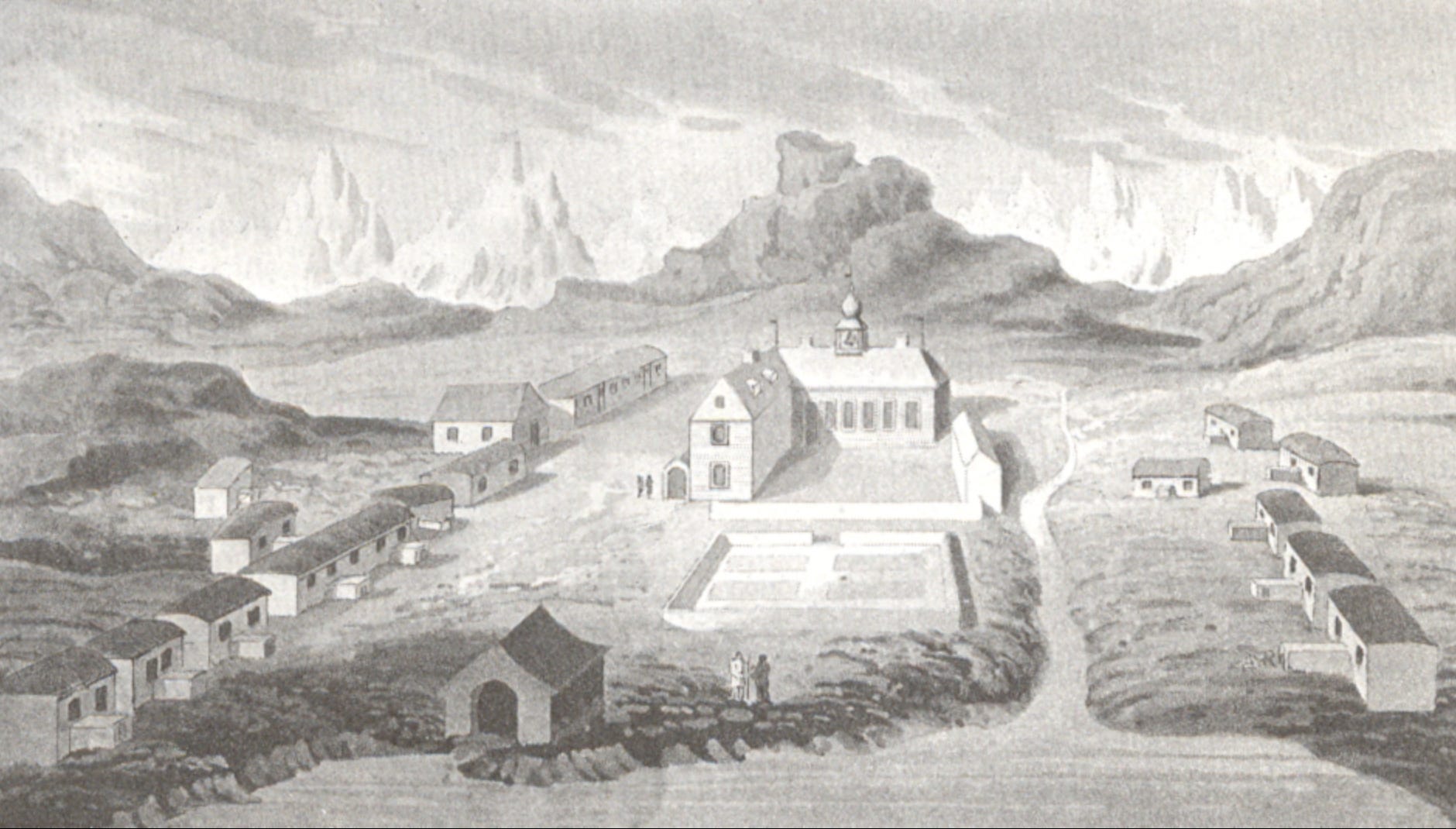
Our true origins are rather less obscure than that, and to learn them is to learn, again or for the first time, the great message of hope that came into the world by grace long ago. Our beginnings, some of you will already know, may be traced to one Johann Laurentius Köhler (c. 1709-1754), an early Moravian missionary in Greenland, and to the so-called “Qeqertarsuak Birchbarks” on which this peculiar young man took to writing —while waiting out the long winter of 1736-37 in an iced-in harbor— the luminous text at the basis of all our true editorial operations.
I am aware that there are no birch trees in Greenland; there are no trees at all in fact. This is in fact only one of many elements that make Köhler’s story appear implausible, yet all of these elements taken together show his work to be only more luminous, not less. For if there is mystery here it is not the kind to hide in shadow, but rather to beckon us closer with its glow.
Nor, though I’m really not at liberty to say much in this regard, should I have to point out, given the recent flurry of media attention, that the disputed existence of these birchbarks is of direct relevance to understanding the recent geopolitical crisis —now slightly abating, but for how long?— surrounding our planet’s largest island.
Historical Background
A scholarly article published in the Danish-language journal Meddelelser om Grønland in the summer of 1937 by the largely forgotten ethnographer Rasmus Fincke may serve as a useful point of entry into our subject. In “Sagn om herrnhuterne blandt eskimoerne på Diskoøen” [“Legends of the Moravians among the Disko Island Eskimos”], 1 Fincke relates a curious detail about the narrative tradition of this region’s inhabitants: one of its recurring characters is a pure-hearted yet simple and mostly incompetent missionary by the name of Bror Johannes [“Brother John”], also sometimes occurring as Bror Qilalugaq, or “Brother Beluga”, in view of the joyful, innocent, yet somehow tragic smile that seems as if fixed by nature on his face.
By the 1930s tales of Bror Johannes had mostly gone extinct, and among the few remaining elders who still enjoyed reciting them, and who would have learned them at their own grandparents’ knees in the 1860s or ‘70s, our hero now appears as a hapless colonial administrator fresh from Copenhagen, now as a stranded Basque whaler who yearns to return home to his beloved, and in other variants less faithful still to what we know of the historical Köhler. At the same time, German researchers of an esoteric leaning, drawing inspiration from field notes published by the Silesian ethnographer Samuel Tobias Lauch a decade earlier,2 came to see this personage as a sort of Hyperborean Prester John. Surely the most absurd contribution to this line of inquiry was Nazi occultist Ernst Alarich von Thalheim’s 1938 pamphlet, Licht aus dem Norden, in which the author, citing the Indian nationalist Bal Gangadhar Tilak’s The Arctic Home in the Vedas (1903), argued that Brother John was an Aryan giant and bard, native to the North Pole, whose works were in fact proto-Vedic hymns first composed in the early post-Glacial period between the tenth and eighth millennia BCE.
Throughout all these delirious permutations one feature of Brother John’s character remains more or less stable: he is consistently represented as wearing his own writings, wrapped around his bare calves like an insulating gauze, and as removing them only to make further additions or to read out appropriate portions to his Kalaallit flock. In certain variants of the tale these wrappings are depicted as makeshift sealskin vellum, in others they are a heavily compressed felt made from the qiviut or the fine-haired undercoat of musk oxen, and in others still as an abnormal growth of enormous flaps of his own flesh, for which, in rolling and unrolling and composing and storing his great work upon them, Bror Johannes, turning misfortune to fortune, had found a most ingenious practical use.
We may eliminate the skin-flap theory as mere fantasy, though it may also serve as a vivid illustration of the well-attested perception of writing, by Indigenous cultures throughout the world, as a variety of bodily modification: the oldest and realest writing is the alteration —whether through ornamentation, piercing, elongating, amputating, or tattooing— of the body itself.3 Whether, beyond this, the surface written upon was made primarily from seal, musk ox, or birch, has been the subject of some scholarly controversy. But this has only been because up until now other scholars have not been able to inspect, as I have, the original documents. For this opportunity of course I must thank my late great mentor, Herr Professor Doktor Balthasar von Cyr (1906-2024),4 whose reputation, you may understand, had the power to open many doors — even those of the secret archives of the Greenland Division of the Ministry of Foreign Affairs in Copenhagen. This is all I can say for now in the matter. I have studied the documents, and they are birchbarks.
Brother John’s writings, I can confirm, are far more capacious than has usually been supposed. My AI tools have given an estimate of 1.2 million words making up the total corpus, and thus of a work roughly comparable in size to Proust’s À la recherché du temps perdu. The bark is of inconsistent texture, but is mostly paper thin, and still has the shape of the cylindrical rolls in which he wrapped them, layer upon onion-like layer. The two cylinders have a thickness of roughly 200 “plies” each, and each still bulges in the center to accommodate what must have been Brother John’s unusually muscular calves.
Small quantities of driftwood, including birch, have always washed up on Greenland’s shores, and have been exploited there opportunistically as early as the Paleo-Inuit Dorset culture. But such quantities could never have sufficed for the composition of this massive work. The raids into Markland of the original Norse Greenlanders seem to have been driven at least in part by a need for lumber, and while the later Danish colonists did not resume this practice, some textual evidence —notably Brother John’s occasional references to the “coureurs des bois”, suggests that our hero was involved in networks of trade that included mainland North America or Labrador, where so-called “paper birch” (Betula papyrifera) grows in abundance.
A thornier problem arises in trying to understand the sources not of Brother John’s materials, but of his knowledge of the particular techniques of birchbark writing. Unlike the so-called birchbark gramoty, which for centuries sustained a surprisingly literate culture in medieval Novgorod, the Qeqertarsuak Birchbarks were not composed simply by applying pressure with a stylus. Instead Brother John seems to have innovated a fairly novel technique involving two successive steps: first, disrupting the fibers on the surface of the bark by making a shallow incision with a sharp point, and only after that rubbing in a black carboniferous soot collected from the coastlines of Disko Island. He taught himself, in effect, to tattoo the bark.
A similar technique may also be observed in the idiographic carvings made in standing birch trunks by Yukaghir girls, in playful competition over shared love interests, in the Upper Kolyma basin. While nothing is known of Brother John’s life prior to his arrival in Greenland, it is conceivable that he had studied at the University of Halle, as did Count Nikolaus Ludwig von Zinzendorf, the founder of the original Moravian Herrnhut colony in Eastern Saxony. If so, it is in turn conceivable that he had come into contact there with members of the original Kamchatka expedition, who may have brought back knowledge, and even material samples, of North Asian birchbark writing. Or he may have devised the technique entirely on his own.
We cannot resolve all scholarly questions related to the Qeqertarsuak epic (as I have come to think of it) within the scope of a single essay. So what I would like to do in the space remaining to me is, first of all, to share with you a few very carefully selected excerpts —all greenlighted for publication, of course, by the Danish Defense Intelligence Service— from Brother John’s work. I would then like to say at least a few words —and my apologies in advance if these turn out too cryptic and evasive to satisfy all of the reader’s curiosities—, about the historical and as it were spiritual relevance of this work for understanding the ultimate scope and mission of our work, at its best, here at The Hinternet.
The Qeqertarsuak Birchbarks [Fragments]
Fragment 1. Scripture often describes food poetically as “meat”, but in Kalaallit Nunaat this is the simple and unpoetic truth. There is seldom anything other than meat to eat at all. But how fitting, that upon conversion their priests should consume the inner organs of the walrus instead of a consecrated host.5 The Brothers say that this is because the organs, especially the pancreas [Bauchspeycheldrüse], are forbidden to their holy men, but none have yet noticed the delicious irony of this particular exchange, whereby the πάγκρεας [pancreas] becomes the Πάγκρατος [Pancras]: the “all-meat” becomes “all-powerful”. The Brothers tell me this is but a childish play on words, yet I see it as harboring some great truth, on which I have spent many long nights meditating…
Fragment 2. The Brothers say I have gone mad, and I suppose I have. When I was barely yet a man I already understood that our world itself is mad. For many years this only made me indignant. It is simply undignified, I long thought, to be compelled to live in a world of war and brutality and injustice. I went into inner spiritual exile, always telling myself: I have no part in this. But of course I did have a part in it. We all do. That’s what it means to say that we are sinners. Over time I came to understand that any man born into this world of sin has not only the right, but the duty, not to secede into isolated idiocy, but to live strictly according to the law of that other world, the one that is governed not by madness but by love. The part of oneself that remains in this world will appear mad in relation to it, but one must not fear appearing this way. For it is instructive to others to serve as a vessel or as it were a windsock of the world’s madness, so that they may plainly see it exemplified, and in this way may discover their own longing for another world, governed by another law…
Fragment 3. I invent delirious stories, I know, and for this too the Brothers say I am mad. But didn’t Christ himself speak in fables? I say to them in reply. Are stories not the vehicle by which most people, in most places and times, have come to know the truth? In all honesty I often do not know where my stories are taking me, but I go along with them as if riding on the back of a half-wild horse who can barely be steered or dominated, always trusting that this is the voice of my true Christian conscience, or perhaps of something deeper than that, of a sort of sub-conscience [Unter-Bewußtseyn], and therefore that this wild horse is in the end a trustworthy steed, and will only carry me to the right destinations. This is what I tell myself, anyhow, but a worry lingers. It says: you are fabling, Brother John, not to appeal to the people by presenting the truth in digestible form, but only to conceal the truth from yourself, by adding so many layers and twists and needless narrative complexities that at the end you can have no possible idea as to what is the message, and what the pleasing ornament. Christ spoke in fables to enable others to understand; you speak in fables —ô sad Brother Beluga, with that frozen and deceptive smile of yours—, to keep yourself from understanding…
Fragment 4. Someday, I pray, I will be able to tell the simple truth, unaided by talk of the race of giants that formerly stalked the earth and left their bones behind to make us feel just as small as we truly are; no relations of my travels to Jupiter and Saturn, where I, as I enjoy telling it, encountered races of long-legged creatures with the most counterintuitive yet undeniably powerful instruments and methods for the advancement of a new agricultural science [scientia agraria].6 Someday there will be none of that. But forgive me for now, ô Lord, as I continue to lie in your name, and believe me, ô Savior, when I tell you sincerely I am only trying, in my mad way, to follow your own parabolic example in the Gospels…
Fragment 5. It often seems to me the world must be ending very soon. It is simply too mad to go on like this much longer. The Brothers at Herrnhut thought I was after glory in this world. They said I was not only mad, but, far worse, that I was vain. They read my freewheeling exercises in the style of Tacitus, of the sort we are all made to compose as students, and they mocked me for allowing so much of myself, and of my phantasmatic power of narration, to enter into what was supposed to be a faithful duplication of the voice of the master. But they did not understand. Vanity might yet make sense in an ordinary world of mortals — knowing that one will soon die, yet still hoping to construct a nice little monument to oneself, in the form of one’s writings. But it can make no sense at all in a world that is itself, as a whole, mortal.
What does it matter how we write? It is clear that our present age is host to countless vain men, whose manner of expression often seems more to reflect a desire to escape mortality through the construction of monuments to themselves, than a desire to face the truths that can only properly be made out in light of knowledge of man’s mortal condition. But believe me, Lord, even if my fellow Brothers will not. Believe me when I say I know very well that all such monuments are dust in the wind too, gone tomorrow if not later this very day, and the only thing that matters is that somehow, at least some of the time, the stories I tell —yes, Lord, the lies I tell— should bear the one true message of love [die eine wahre Botschafft der Liebe], and of the reality of the other world in which it reigns…
Fragment 6. The Brothers take as a sign of my madness, too, the amulet of a white bear, carved in walrus ivory, that I have long worn around my neck, and that knocks throughout the day against the cross I likewise wear on a chain. Brother Matthæüs tells me to “go live with the skrælings” (an old Norse term, apparently), if I cannot distinguish between their superstitions and our truths. I try to explain that this bear does not come from the “skrælings” at all, but was brought down from the far North, and made by the artisans of a people who are no more related to the Kalaallit, than the Kalaallit are to us. Besides, I begin to explain, there really is no such thing as superstition. There are only infinite ways to try to express, and to fail at expressing, the real order of the world — how could any of us do otherwise than to fail? I begin to explain this, but soon silence myself. How could Brother Matthæüs ever understand? …
Conclusion
In spite of my stated intention to conclude with an account of the relevance of these materials to The Hinternet’s historical origins and currently contested mission, it now seems to me ill-advised to say much more than I already have. It will perhaps suffice to recall that Balthasar von Cyr is a man who even in death can make great things happen. While I introduced something of his legacy in a previous piece, I was too circumspect at that time to reveal much of anything about his relationship to The Hinternet. But now that the “black-dog” faction has announced its open hostility to my own, I feel I may as well come clean. Representing as it were the Germanic branch of our publication’s noble lineage, not only was von Cyr an absolutely indispensable figure in resurrecting our operations after more than a century in the exclusive hands of the Breton clan with its utterly spurious Liber Infraretis — he was also, in case you haven’t figured this out yet, the driving force behind my own arrival as a Hinternet featured columnist a year or so ago.
So let me be clear: I intend to stay. And no one, not even a coven of Breton sorceresses, has any power to stop me — not with the estate of Balthasar von Cyr on my side.
I intend to stay, that is, and to represent as it were the spiritual interests of our branch of these operations. Our interests lie not in casting dark spells or in the pursuit of such illicit knowledge as may be found in counterfeit grimoires, but in the production of parables of love fit for our mad and broken world.
There are for now heavy theoretical and practical reasons why our parables continue to require considerable forbearance on the reader’s part, and a willingness to have one’s expectations messed with in a way that at least formally gives off all the signs of being a joke, in that we so often work by means of the classic “sudden transformation of a strained expectation into nothing”, as Immanuel Kant defined the Witz.
But believe us, or believe me, when I say that we really do hope, someday, like Brother John before us —especially in the parts of his work that Danish Intelligence has not permitted me to share with you—, to tell the truth simply and plainly, as it comes to us from that other world he describes so well, with none of that madness we at least for now continue to borrow from this one: this mad world that, for all the indignity of living in it, never ceases to make a great story.
—Edwin-Rainer Grebe, St. Denis

See Rasmus Fincke, “Sagn om herrnhuterne blandt eskimoerne på Diskoøen,” Meddelelser om Grønland 4/24 (sommer 1937): 38-54.
See Samuel Tobias Lauch, “Bruder Johann als Heilsfigur,” Zeitschrift für Volkskunde 26/1 (1925): 28-37.
See Simon Schaffer, “ ‘On seeing me write’: Inscription Devices in the South Seas,” Representations 97/1 (2007): 90-122.
Balthasar von Cyr’s contributions to Greenlandic studies are immense, yet as far as can be determined he only held forth publicly on the geopolitics of that autonomous Danish territory once, late in his life, in a letter to the editor published in the Jornal do Brasil in May, 2020. The particular occasion is the interest expressed in 2019 by Donald Trump, during his first term as president, in the possibility of acquiring the island and enfolding it into the United States. The letter, regrettably, betrays what appears to be a streak of alarming prejudice on von Cyr’s part, though in his defense he was 114 years old at the time, and suffering from a mild case of what he called until the very end his “early-onset dementia”. The letter reads in part as follows: “A preservação de uma presença dinamarquesa no Hemisfério Ocidental é absolutamente crucial para afastar aquilo que, de outro modo, seria inevitável: a degeneração de todo o território das Américas naquilo que, de fato, seria uma América Latina ampliada. Até recentemente, podia-se apontar para os próprios Estados Unidos, com sua herança colonial britânica, como uma exceção muito mais significativa. Mas olhe para aquele país agora! Não é evidente que seus verdadeiros pares já não são os Estados do Norte da Europa, que têm servido com tanto êxito como os mais poderosos laboratórios e exportadores —na medida limitada em que tal exportação é possível— da razão prática e da modernidade secular, mas sim os Estados da América Central e do Sul? Existe hoje algum lugar nos EUA que se pareça tanto com o nosso próprio Brasil disfuncional quanto Minnesota, aquele outrora pacífico enclave de honestos protestantes escandinavos? Os EUA são um mosaico grande demais, excessivamente mestiçado, para jamais servir como um lar seguro para esse povo singular. Somente uma presença soberana dinamarquesa duradoura pode garantir isso” [“The preservation of a Danish presence in the Western Hemisphere is absolutely crucial for staving off the otherwise inevitable: the degeneration of all of the territory of the Americas into what would de facto be a greater Latin America. Until recently you could point to the United States themselves, with their British colonial heritage, as a much greater exception. But look at that country now! Is it not plain that its true peers are not the states of Northern Europe that have so successfully served as the world’s most high-powered laboratories and exporters —to the limited extent that exportation is possible— of practical reason and of secular modernity, but rather the states of Central and South America? Does any place in the US look quite so much like our own dysfunctional Brazil at present as Minnesota {plainly a reference to the civil disturbances following in the wake of George Floyd’s murder, which were ongoing at the time of this letter’s publication —ERG}, that formerly peaceable enclave of honest Scandinavian Protestants? The US is far too great a patchwork, far too mongrelized, ever to serve as a safe homeland for this unique people. Only an enduring Danish sovereign presence can guarantee that”].
For a comparable account of this practice, of substituting a walrus’s inner organs for the consecrated host, in view of the strong taboo against their consumption by Inuit shamans, and thus of their symbolic power to create a sharp rupture between the old and the new religions, see Knud Rasmussen, Ultima Thule. Grönländische Reiseerlebnisse, Berlin: Morawe & Scheffelt Verlag, 1920.
See Emmanuel Swedenborg, De telluribus in mundo nostro solari (London, 1758), §§32–39, for a similar account of a personal voyage to the outer edges of our solar system, including a description of the farming implements used by the race of Jovians.


Against Brother Beluga's Jobean pals, who, at the end of Frag. 3 assert that "Christ spoke in fables to enable others to understand," I hope our lonely birchbarker would have recalled, if not to them, then in some further mad parable, Christ's words in Mark 4:12. From these, too, arises the child's voice at the end of Frost's (another birchbarker and -bender) late poem "Directive": "Under a spell so the wrong ones can't find it, / So can't get saved, as Saint Mark says they mustn't." And so neither must we tell...
My favorite part of the Witz was Bert Lehr's confabulation at the gates of the Emerald City which reminds me of someone, but I cannot quite put my paw on it.