Prelude
We confess we are feeling pretty stuck. Since the beginning The Hinternet has sought to speak from a position of total freedom, which is to say, among other things, not so much a nonpartisan perspective, but what the Germans call an überparteilich or as it were a “transpartisan” one. We have also sought to proceed in a way that is entirely unbound to the constant flood of faits-divers in our newsfeeds, whether intrinsically trivial or only trivialized in the course of their delivery, that serves as fuel for the neverending agonism of the internet.
However, while it is possible to remain unbound to the news cycle, it is significantly more difficult to remain unbound to history; nor would it be interesting for a reader to be exposed to a piece of writing entirely unaware of its own historical moment. For this reason we have generally sought to strike a balance between sub-specie-aeternitatis detachment, on the one hand, and the vapid but comforting presentism that dominates our culture on the other. That golden mean, if it exists, we have long thought, would be something like a controlled magnification of our present reality through the telescopic effect of historical distancing, and, at the same time, a controlled coloration and rearrangement of our present reality through the kaleidoscopic effect of imagination.
Is that mean really so golden? That’s how it seemed to us two or three years ago. But properly conceived the career of the writer must include something akin to what the faithful conceptualize as “examination of conscience” — analogous, our thinking goes, in the sense that it, too, must be constant and ever-provisional in order to count at all. For writing to be worth much of anything it has to have a strong sense of why it exists, but good answers to this “why?” question necessarily change from one historical moment to the next, and to be honest the world is changing so fast that we find ourselves here at The Hinternet unable, at least for today, at least to our own satisfaction, to justify what we do.
This is normal, and salutary. It implies among other things that we haven’t given up trying to justify ourselves, and that, if we’re fortunate, we will come back soon with a better and more compelling answer to the question, and one better fitted to both our own age, as a rambunctious six-year-old publication who, we have sometimes started to think, might be big enough now to start learning some real responsibility; and to the age of our world, which is old and exhausted and erratic, and appears in need of some serious help.
But we are already in the thick of it as regards several projects of ours, and even if we can’t find compelling justification for spearheading new projects in this topsy-turvy moment, that does not at all mean that we are justified in abandoning the ones already in full swing — and man are they swinging! For we find that the projects we set in motion, once in motion, are not subject to the same doubts and crises of faith and lulls and stagnations as we are.
A juggler with only two balls is not a very talented one, so let’s just say that of all the many, many balls we have in the air at the moment, two are sufficiently large as to remain constantly visible to us no matter how high we pitch them. Today we will remind you what those are, encourage you to keep an eye on them yourselves, and then we will call it a day — a Sunday, at that.
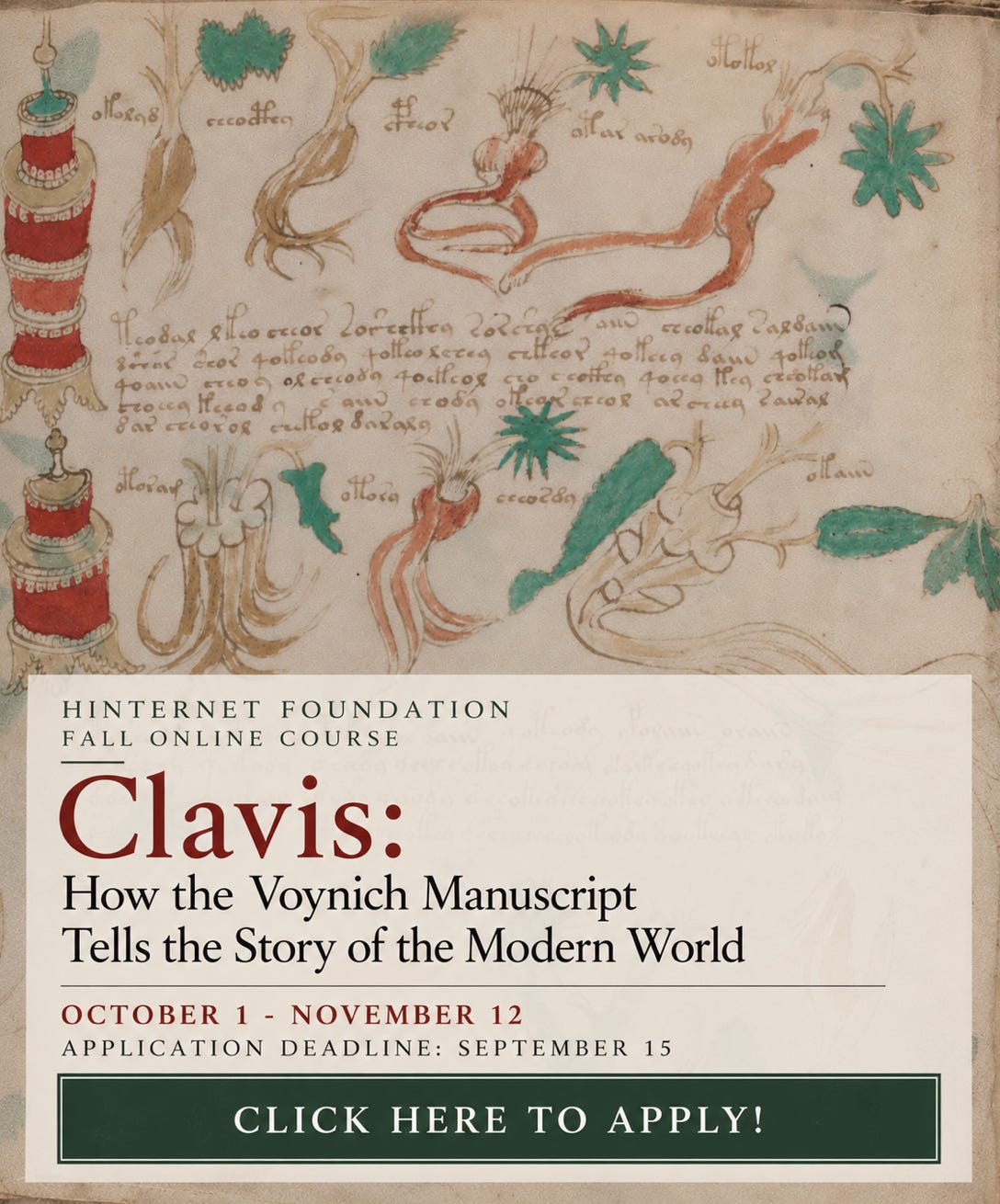
Voynich Deadline Approaching!
The first and most urgent item is to remind you that there are now only two days left to apply for the Hinternet Foundation’s online fall course on the Voynich Manuscript, its remarkable role in 20th-century military cryptography, and more generally in the emergence of the American military-information-technology complex that we all know and love and hate today. This course is in many ways the perfect epitome of everything we care about most at The Hinternet — critical engagement with matters of direct relevance to understanding the contemporary world, from a perspective shaped by scholarship in the history and philosophy of science, and always with a concern not only to fire our imaginative faculty, but to hone its power in the aim of enhancing our understanding of complex problems. The course will be so to speak a proof-of-concept for more or less everything we’ve been doing here for the past years.
We have received many, many applications from people with fascinating backgrounds and reasons for wishing to take the course. But we want to be certain, in the run-up to our imminent deadline, that nobody who would have loved to take the course should end up finding out about it too late. So please, dear readers: help us get the word out! Help us share this experimental endeavor with all the people out there who really ought by rights and natural inclination to be a part of it! Tell your friends! And send in an application of your own too!
Oort Cloud Review — Review Copies Available!
Secondly, in the coming months you are going to be hearing a lot about The Oort Cloud Review. There will, for one thing, be several launch events between October and December — in, among other places, Paris, London, New York, Los Angeles, and maybe also San Francisco and Cambridge, Mass. Dates and venues will be made public very soon.
Today we have a different OCR-related matter to discuss with you. We are currently hard at work to get copies of this enigmatic text into the hands of every living person who, for one reason or another, really needs to read it. We are especially concerned to send copies to those individuals and media operations best positioned to write about our work in a thoughtful and critical way. We welcome negative criticism, of course; what we mainly want, we’re not afraid to say, is critical attention of any sort, as long as it engages seriously (and also playfully, if so inclined) with the project and its deeper theoretical ambitions.
We have 40 copies to give away free of charge, and we’d like to offer, say, 15-20 of these to anyone who writes to us to request a copy and who, if moved to do so after having read it, is willing at least to consider writing about it, either in the narrow form of a book review, or in some more expansive and less genre-specific way. Requesting a copy does not entail a promise to write about it —you might find, upon receiving it, that you’ve got nothing to say—, but if you do request one you must at least have a good-faith commitment to writing about it should the spirit move you.
If interested, please send an e-mail to editor@the-hinternet.com, giving us your postal address and also, if relevant, a few words about yourself and your publication.
Finally, if you are Paris-based, we are interested in bringing together a small group of energetic, limber young people who can help us with distribution logistics here on the European continent. If this is you, please be in touch! editor@the-hinternet.com
Si vous êtes basé.e à Paris, nous souhaitons constituer une petite équipe de personnes jeunes, énergiques et agiles, qui pourraient nous aider à assurer la logistique de la distribution européenne du livre. Si vous vous y reconnaissez, n’hésitez pas à nous contacter ! editor@the-hinternet.com.
—The Editors