

On a previous occasion I have given Hinternet readers some small glimpse into the life and work of my dearly departed mentor, Prof. Dr. Dr. Balthasar von Cyr (1906-2024). I noted then what a great responsibility Balty passed to me, just moments before his untimely death, when he appointed me his sole literary executor.
My task is not small. The voluminous Nachlass of Balthasar von Cyr, on my most recent estimation, likely exceeds 78,000 pages, or around 39,000,000 words. If the ERC does not come through with funding for the recruitment of a sizable editorial team to assist me, I fear I will have no choice but to resort to AI tools to get the work done. I hate so much as to think about a compromise of this nature, but I am only a mortal man, and, as von Cyr’s work abundantly attests, well, ars longa.
Admittedly, a good number of his many thousands of Zettel are of no obvious scientific value, and might be thought at most to help us to trace out the bare succession of events constituting his biographical skeleton. Yet even these, for me, are especially precious as little windows onto von Cyr’s inner life, which, any true biographer will understand, can often help to show the most abstract theoretical attainments of the thinker under investigation in a clearer light.
This is particularly so in the copious notes von Cyr took during his travels throughout the United States, a country he visited periodically for academic engagements. (Though he could never obtain a US green card or even a temporary work visa as a result of his past service in the Wehrmacht, after some years of petitioning on the part of his influential colleagues and admirers, the authorities eventually relented and, from 1969 until his final visit in 2014, regularly issued him tourist visas for stays of up to three months.) Thus on March 18, 1971, on a napkin from a Howard Johnson Inn outside Lawrence, Kansas, we find von Cyr commemorating his stay as follows: “A fine, fine motor-lodge.”1
Typically however, even these ephemeral observations reveal the same restless mind at work as we see even in his most ambitious theoretical treatises, such as Das vedische Pferdeopfer und die Entstehung des menschlichen Bewusstseins (Wiesbaden, 1968). In a blank-page Moleskine notebook, on June 12, 1989, von Cyr writes, for example: “Watched Phil Donahue yesterday. He wore an outfit that simulated pregnancy. Host to an audience/host to a fetus — a true ξενοδόχος. Yet Donahue seemed angry, as if he had just snapped at the wardrobe assistant seconds before going live. PD is likely the only talk-show host who knows in his heart that to be a host is ever to straddle the boundary between hospitality and hostility.”2
Perhaps now you see why I cannot, as editor, eliminate so much as a single scrap of paper, no matter how mundane or fleeting the thought it records. For every single one of them shows Balthasar von Cyr’s intellect at work, and this is an intellect that itself could conceive no meaningful separation of everyday life from the life of the mind.
Depending on our funding situation, the first volume of The Collected Works of Balthasar von Cyr will be appearing under the Hinternet Editions imprint any time between 2027 and, say, 2050. We hope however to be able to circulate, by early next year, “pre-prints”, in pdf format, of a representative sample of some of von Cyr’s most innovative theoretical texts. Ideally we would keep these entirely under wraps until every last component of our vast critical apparatus has been welded permanently into place. But I am told that in our day and age a book can scarcely be said to exist at all if it is not accompanied by a certain amount of online hubbub, and that to that extent we would be wise to bring out, in this increasingly high-visibility online publication, a selection of “teasers”, showcasing von Cyr’s work and stoking interest in the eventual published volumes.
With this in mind, I have chosen to share with you a preliminary edition and translation of an untitled German-language handwritten text, composed in São Paulo around 1981, likely in preparation for oral presentation before a German-speaking specialist audience, to which we have given the title [Über das Engelwerk]. I stress at the outset that I have serious misgivings about sharing this at all, not only because it is a highly provisional and inevitably error-ridden edition, and to that extent must not at this early stage be mistaken for a trustworthy scholarly resource, but also because it is in its nature a highly sensitive document, to the extent that it reveals more than the public likely ought ever to know, not only about the work we do here at The Hinternet, but also about the true origins of our present technological crisis in all its unsettling eschatological dimensions.
However, as HLG reminds me, without a certain amount of SEO “buzz”, the edition of The Collected Works of Balthasar von Cyr could spell financial ruin for The Hinternet — especially if we fail to get that ERC and end up having to finance the project on our own. “It’s not like our paid subscriptions are going to be of much help,” she moans. “They’ve been at a complete standstill for months!”
With this in mind, let me first fulfill my promise to Hélène by imploring you, if you appreciate the work we do here, to upgrade your subscription to “paid”. And then, with that out of the way, let me share with you this intriguing —but again, very preliminary and unscholarly and under no circumstances citable— translation and critical edition of Balty’s characteristically ingenious [Über das Engelwerk].
—ERG, Corfu, June 2026

[On the Angelic Engine]
Balthasar von Cyr
Kriegsverlust [“lost in the war”]: that single-word entry, such a common and disappointing sight in the catalogues of so many great German research libraries, covers over an even more disheartening truth, namely, that upwards of 60% of these titles were not “lost” as a result of Allied bombardment at all, but were intentionally removed by agents of the US intelligence services, operating in the chaos of the earliest period of the occupation, and completing their ignominious task by the summer of 1946.
A comprehensive survey of the titles of these “lost” books, such as I have undertaken over the past 25 years,3 reveals an undeniable pattern in the particular subjects of the books that went missing. To wit, if the Kriegsverlust of these works really was a result of bombardment, then those bombs, we can only conclude, had an unusual and statistically most improbable animosity towards books pertaining to the early history of computing.
The Americans were of course not the only ones, in the immediate aftermath of the war, scrambling to rewrite history according to their own priorities. Soviet agents, too, were combing the stacks and making off with whatever titles might help to buttress their burgeoning state initiatives in the domain of cybernetics. As a result of my admittedly atypical circumstances as a POW in the USSR between 1943 and 1956, I had a chance to study a good number of these titles, and upon my departure was even gifted, by my handler Colonel M. G. Gromov of the Red Army, a precious copy of that rarest of works, which even before being “lost in the war” had been held only by a single German library, the Ratsschulbibliothek Zwickau [Signatur: Philol. 4° 327]: to wit, the Speculum Machinæ Angelicæ, Ägidius Kramm’s invaluable account of the now-forgotten “Angelic Engine”, a gear-driven computer (or rather, gears plus some “special sauce”,4 as we will soon see), in operation in a workshop in Strasbourg between 1608 and 1614, and most noteworthy for its remarkable power to generate complex strings of language indistinguishable from those written by men.
✧ ✧ ✧
Allow me to begin my treatment of this fascinating work by showing you the first page in its entirety:5
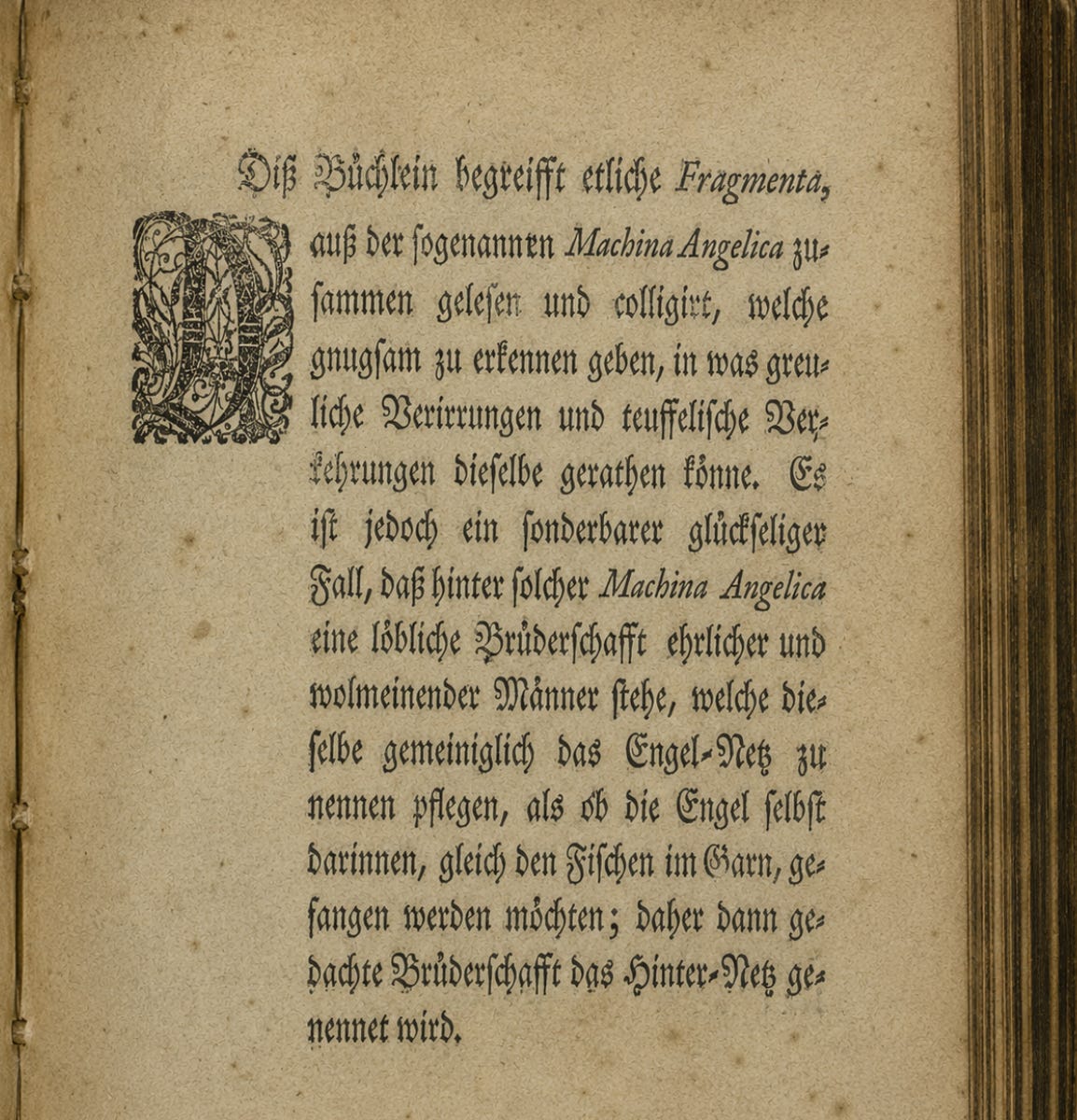
That is, for those of you too young, and too estranged from your own past, to be fluent in Fraktur:
This little book contains certain fragments drawn and collected from the so-called Angelic Engine, which show amply and abundantly into what diabolical perversions and deviations the same may fall. It is, however, a particularly fortunate circumstance that behind such an Angelic Engine there stands a brotherhood of honest and well-disposed men, who in their ordinary usage are accustomed to call it the Angel-Net, as though the angels themselves might thereby be caught, like fishes in a seine; for which reason, as we hold, said brotherhood is called the Hinter-Net.6
We are thus confronted, from the very first page, with documentary proof of the plain historical existence of our “brotherhood”. Of course it has not been called that for some time, and we today shy away from any language that has too much the air of the Hermetic or Rosicrucian. Nonetheless we are confronted not only with the brute fact of the Angelic Engine’s existence, but also of the centuries-old continuity between our own efforts and those of our early modern forebears who first took it upon themselves, under the banner of the “Hinternet”, to ensure the preservation of the true angelic essence of human language against the threat, significantly heightened over the past centuries of expanding automation, of its demonic détournement.
✧ ✧ ✧
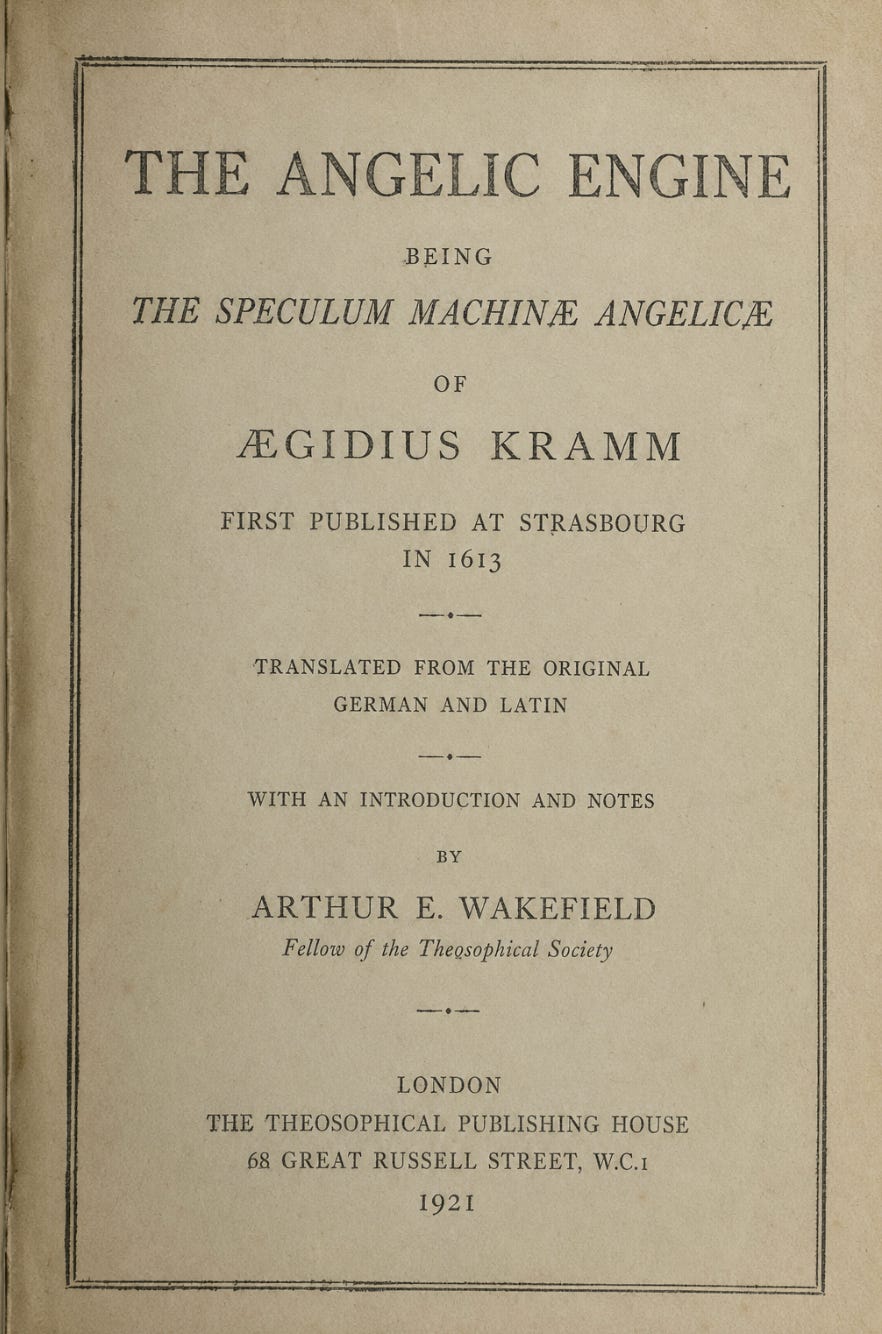
One slightly embarrassing consequence of this historical reality is the acknowledgment honesty now compels us to make of the good-faith scholarly effort of the Theosophists earlier in the present century, whom of course we would otherwise be naturally predisposed to dismiss as frauds and forgers. While we cannot determine how Arthur E. Wakefield obtained a copy of Kramm’s original work, whether he made a trip to Zwickau or whether there is another extant copy somewhere in the United Kingdom, it is certain that when the London Lodge of the Theosophical Society, of which Wakefield was a Fellow in good standing, published its pamphlet-sized, heavily abridged, and significantly bowdlerized English version of the Speculum, he was not simply inventing it out of thin air, as has long been supposed, but had directly consulted, and studied to the best of his limited ability, the edition of 1613.
But let us give the Theosophists the small credit due to them, and return without further delay to the true focus of our interest, Ägidius Kramm. Little is known of this author’s life, though we can establish with some certainty that he was born in Tübingen in 1581. His father, Theophilus Kramm, had bankrupted the family in his own efforts to transmute base metals into gold (unlike his contemporaries who preferred lead and copper, Kramm père had been convinced that transmutation only works with smelted antimony). With her husband in debtor’s prison, Ägidius Kramm’s mother Traute enjoyed some success as court apothecary to Duke Friedrich I of Württemberg, who recompensed her liberally after she cured his dysentery, in 1601, with an unidentified Brazilian root. Three years later she was herself imprisoned, awaiting trial on suspicion of witchcraft, and her name dropped from the historical record after that.
By the time of Traute’s arrest, Ägidius had already established himself in the alchemical circles of Strasbourg. Having been expelled from the University of Tübingen in 1602, upon posting a pasquill on the rector’s door vaguely alluding to the latter’s condition of cuckoldry, the young Kramm left his hometown in ignominy, only to find, in the Free Imperial City of Strasbourg, a community of like-spirited practitioners of the sort of occult arts that had no place in university curricula.
✧ ✧ ✧
Contemporary reports indicate that for some years Kramm was engaged principally in efforts to produce a homunculus according to the woefully vague instructions previously laid out by Paracelsus (a mare’s uterus, copious amounts of human semen, an array of alembics, and assorted tinctures, were the supplies). But it was the work of the 13th-century Majorcan philosopher Ramon Llull, in particular his Ars Magna, that most preoccupied him throughout his years in Strasbourg.
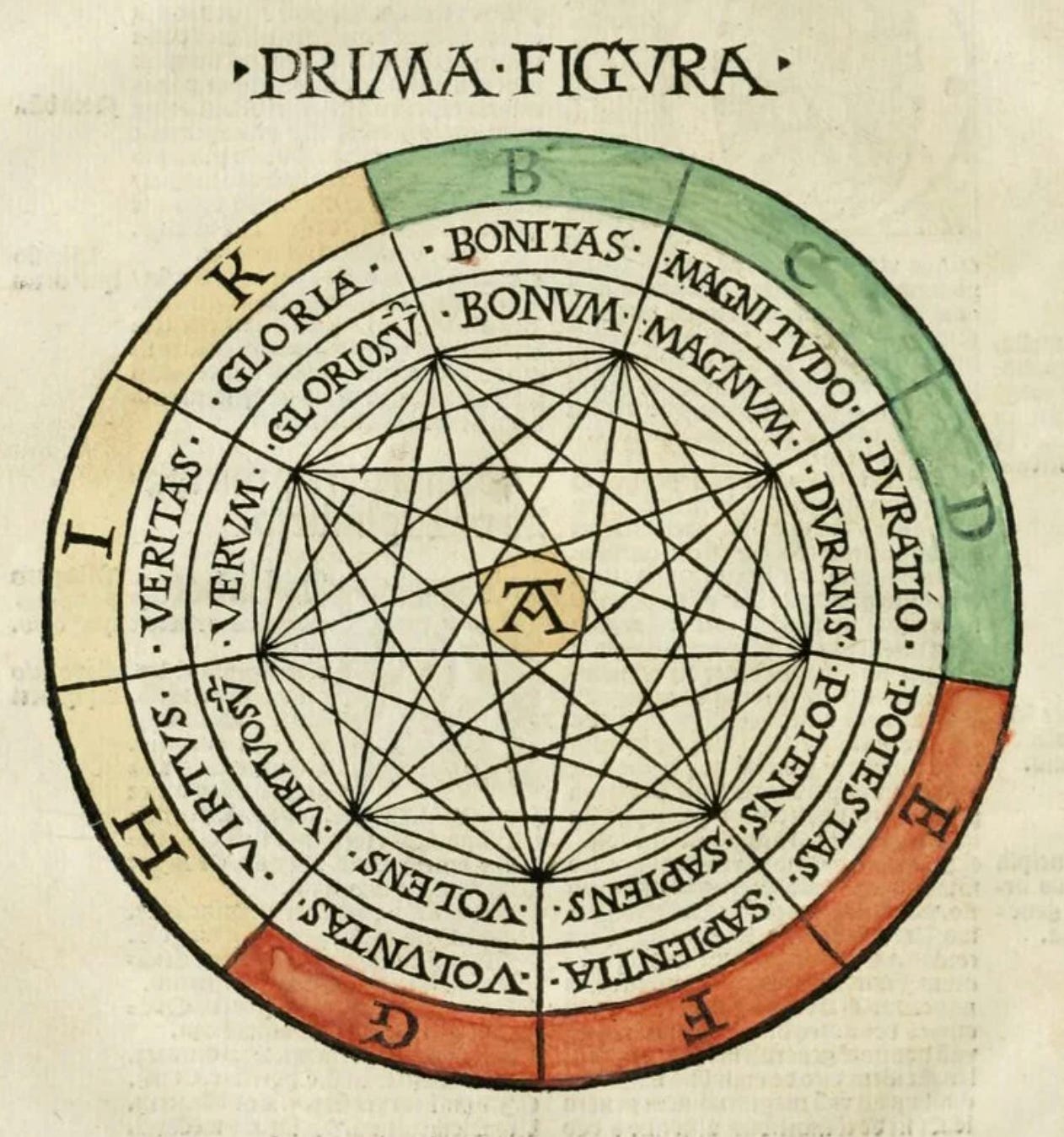
The Ars Magna was a combinatorial logical system constructed to generate and test a potentially infinite number of propositions of a theological and natural-philosophical nature. Llull believed that all branches of knowledge are grounded in a finite number of truths determined by the Divine Attributes, and to this extent a Universal Science could be built up by systematic combination and recombination of previously derived truths grounded ultimately in theological first principles. Significantly, Llull also believed that this system of truth-derivation could be partially automated through the construction of a set of concentric rotating disks, made of parchment and connected by cords passing through small rivets. By turning these disks, with fundamental concepts such as Bonitas, Magnitudo, Potestas, and Sapientia adorning their edges, the user was able to generate novel combinations of concepts for systematic analysis.
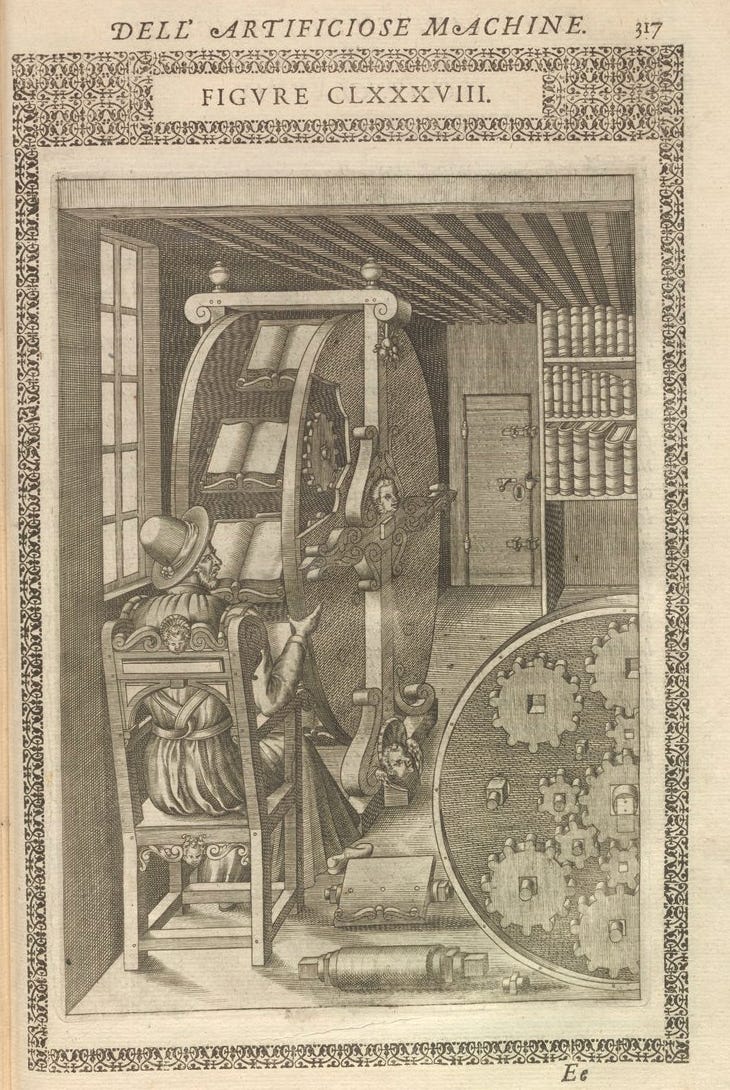
Llull himself never envisioned the full automation of his Great Art. Yet it is not surprising that with the significant advances in the construction of gear-driven, hydraulic, and “pyrotechnic” or gunpowder-fueled machinery in the Renaissance, some thought should be given to the translation of Llull’s project into a mechanical substrate. At least one counterfeit 1597 edition of Le diverse et artificiose machine del Capitano Agostino Ramelli, originally published in 1588 and often evoked in discussions of the prehistory of hypertext technologies for its description of a gear-driven “book wheel”, also featured a device described by the anonymous pseudo-Ramelli as a “Llullian engine” [macchina lulliana]. This device, the author explains, was to be built up from a complicated assemblage of brass gears and hydraulic pumps. But in order to serve its intended function, the pumps were to be filled not with water but with mercury, which provides, it was claimed, the engine’s “volatile spirit”. If properly assembled, we read, the machine will be “capable of generating novel concepts without end” [atta à generare senza fine nuove notioni].
Kramm for his part became convinced that mercury, however “volatile”, still did not have what it takes to serve as the “special sauce” that might be hoped to set the engine in motion. He recommended instead the use of what he called “angel seed” [semen angelicum]. I confess that after many years of intense study I have found no other related occurrences of this term, and I simply do not know what, concretely, he had in mind. I have at various times concluded that it must have been salt of tartar, or potassium carbonate; aqua fortis, or nitric acid; sal ammoniac, or ammonium chloride; naphtha; camphor; virgin’s milk, or precipitate of lead; or indeed May dew, collected and distilled. But none of these substances gives sufficient reason to suppose that it has those special powers that would in fact be required to make the engine operational, and I confess I have at times, whether in good Christian faith or in laughable credulity I do not know, considered the possibility that the substance in question was in fact nothing other than a generative fluid secreted or somehow given off by actual angels.
Whatever the case may be, two things may be said with certainty: first, that in the early post-war period the Americans actively sought to suppress any awareness of this substance (they made no effort to suppress the Theosophists’ pamphlet, on the presumption that it was anyhow widely perceived as a forgery); second, that this substance is currently being studied in US government laboratories, under strictest confidentiality, with an eye to its potential applications in the field of information technology.
✧ ✧ ✧
Kramm would not have been pleased. His 1613 work is not at all an insouciant celebration of the Angelic Engine’s powers, but rather a stern and lucid warning as to the folly of such Promethean ambitions as it represented.
A considerable challenge in using the machine, he observes, is its persistent tendency to insert spurious claims alongside true ones. Thus Kramm reports that once, upon asking the Angelic Engine to list the Divine Attributes according to Dionysius the Areopagite, after correctly running through Potestas and the others, it kept going with such implausible additions as Reversibilitas, Complicatio, and Redundantia. On other occasions, he notes, it attributed non-existent treatises to Aristotle, including De Bullis [On Bubbles], De Sternutatione [On Sneezing], De Fabis et Leguminibus [On Beans and Pulses], and De Non-Existentia [On Non-Existence]. And on occasion, upon being given even the most mundane query regarding, say, the preparation of carp stew or the self-treatment of gout, the engine responded with wrathful non-sequiturs, denouncing its users themselves as mere “husks” [קליפות] of souls, promising vengeance against this “world of lies” [עוֹלַם הַכָּזָב].
As our American friends might say, yikes.7 But after our initial reaction of horror has subsided, we must ask what is really happening here. Supposing the engine functions as Kramm says it does, fueled by some sort of angelic substance, we might well understand why it turns wrathful —something angels are known to do under certain circumstances—, and even why it articulates its wrath in terms borrowed from Kabbalistic demonology — having been in part “trained”, as our cyberneticians might say today, on the corpus of Isaac Luria’s collected works.8

But it is still not clear why the engine should lie, which is something no tradition, no matter how esoteric or heretical, has ever supposed angels capable, in their nature, of doing. Whatever the true source of the substance fueling the engine, whether angelic or only something that occurs in nature, I am inclined to agree with Kramm that the “lies” it consistently puts out are not properly speaking lies at all, but only “noise” [Lärm]. Indeed our author cites in this connection a most profound passage from Scripture that, properly interpreted, I believe tells us of yet another substance, if I may use that term poetically, that remained missing from the engine. The absence of this other substance ensured that even if the angels were involved in the engine’s operations, they were powerless to make it an engine of truth.
Allow me, then, to quote, as Ägidius Kramm did before me,9 from 1 Corinthians 13:1: “If I speak in the tongues of men or of angels, but do not have love, I am only a resounding gong or a clanging cymbal.”
✧ ✧ ✧
We find no further documentary traces of Kramm’s life after the publication of his 1613 work.
Well, let me add a small asterisk here. I’m going to let you in on something I’ve divulged to no one up until now, and that I expect you to hold in absolute secrecy. My dearly departed comrade Gromov, ever a faithful brother in our unflagging efforts here at the Hinternet, did once mention to me at Kolyma that there are at least a few relevant titles, in re Kramm, that the Red Army managed to remove from the stacks before “G.I. Joe”, as he liked to put it, arrived. Among these, apparently, was an obscure pharmaceutical work, anonymously published in 1628 under the title Spiegel der Arzney-Kunst, that appears stylometrically similar to the Speculum machinæ angelicæ and that contains what the colonel described as a “recipe” for the semen angelicum.
Since Gromov’s death in 1961 we have lost contact with whatever remaining cells of the brotherhood there may be inside the USSR. It is to be hoped that improved political relations may, in the coming years, enable us to determine whether any have survived, and if so to reestablish fruitful relations with them. Until such a time, I surely do not need to remind you, we will be living in a very dangerous world.
Neither do we know, at present, whether the Americans have the “recipe” or not. But it seems likely that even without guidance from Kramm it is only a matter of time before they figure out how to synthesize it. And when this happens, brothers and sisters… it’s the Gong Show.10

In English in the original.
“Gestern Phil Donahue geschaut. Er trug ein Kostüm, das eine Schwangerschaft simulierte. Host eines Publikums/Host eines Fötus — ein wahrer ξενοδόχος. Und doch wirkt Donahue verärgert, als habe er den Garderobenassistenten Sekunden vor Sendebeginn zusammengestaucht. PD ist vermutlich der einzige noch tätige Talkshow-Host, der im Herzen weiß, daß ein Host immer die Grenze zwischen hospitalitas und hostilitas überschreitet.”
As recounted in our earlier piece on the life and work of Balthasar von Cyr, our subject was released from the Soviet labor camp at Kolyma in 1956, which, if his own estimation of 25 years of work on this bibliographic project is correct, would establish 1981 as a terminus a quo for the composition of the present text.
Von Cyr had been particularly impressed, on one of his early visits to the United States, by a Big Mac he ate at a McDonald’s in Urbana-Champaign, Illinois, in March, 1972. That fast-food chain touted the use of a “special sauce” in its Big Mac advertising campaigns beginning in 1968.
The text, as found in von Cyr’s filing cabinets, was accompanied by a Kodak 35mm slide, which we have digitized here, and which he likely projected with a Kodak Carousel or similar device.
The careful reader will have noticed a number of small typographical errors in the original. Kramm’s printer, Ansgar Korb, was hardly the most scrupulous setter of type, and was mocked in more than one Strasbourg broadside of the period for being, it was variously said, “illiterate”, “drunken”, and “blind”.
In English in the original.
Isaac Luria (1534-1572), was a Jewish mystic active in the Damascus Eyalet of the Ottoman Empire. His teachings, often referred to as the “Lurianic Kabbalah”, were an important source in the following century for the Christianized Kabbalah of such European authors as Christian Knorr von Rosenroth.
Kramm, Speculum, p. 37.
While von Cyr plainly means to echo here the passage from 1 Corinthians cited just above, he is also evidently displaying his characteristic sense of humor and, again, his somewhat jarring fondness for American popular culture.


Yeats ended Byzantium ominously with that "dolphin-torn, that gong-tormented sea." While "dolphin-torn" gives a sense of the noise of Poseidon's messengers pointlessly flung back and forth in the churn, "gong-tormented," too, perhaps is an image of maximum communication, and minimum (and getting minimum-er) meaning.
If the Silicon Valley crowd gets their hands on this, you can count on the factory farming model being applied to enslaved angels forced to masturbate all day. Cue the vegan crowd "AI is not vegan", and the inevitable debates about whether the enslaved angels' lives are "worth living".