

The Enigmas of Gerhard Richter
A Conversation between Justin Smith-Ruiu and Lawrence Weschler
Gerhard Richter is perhaps the greatest living painter. He is certainly the most versatile one, moving freely from astounding photorealism to grey monochrome, with several stops between these two extremes. He is also famously circumspect, deflecting questions about the meaning of his work with a flat insistence that it means nothing at all: this even as it weaves in its subject matter through many of the most momentous events of the 20th century —events Richter himself witnessed up close—, not least the Second World War and the bombing of Dresden. His claim is all the more implausible in light of what we know of his personal connection to many of his paintings’ human subjects: a beloved bipolar aunt sacrificed to Nazi eugenicism; a sinister gynecologist father-in-law who was himself, by remarkable coincidence, the immediate cause of this sacrifice; a pregnant nude wife descending a staircase; a daughter, Betty, who plainly shares in the essence of both the aunt and the wife. Often working from photographs, Richter’s paintings do not so much show us the photograph itself as the experience of looking at a photograph — of a loved one, of a hated one, of family living and dead and heavy with memory and trauma, receding into the past but still, always, defining the shape and the inescapable weight of the present.
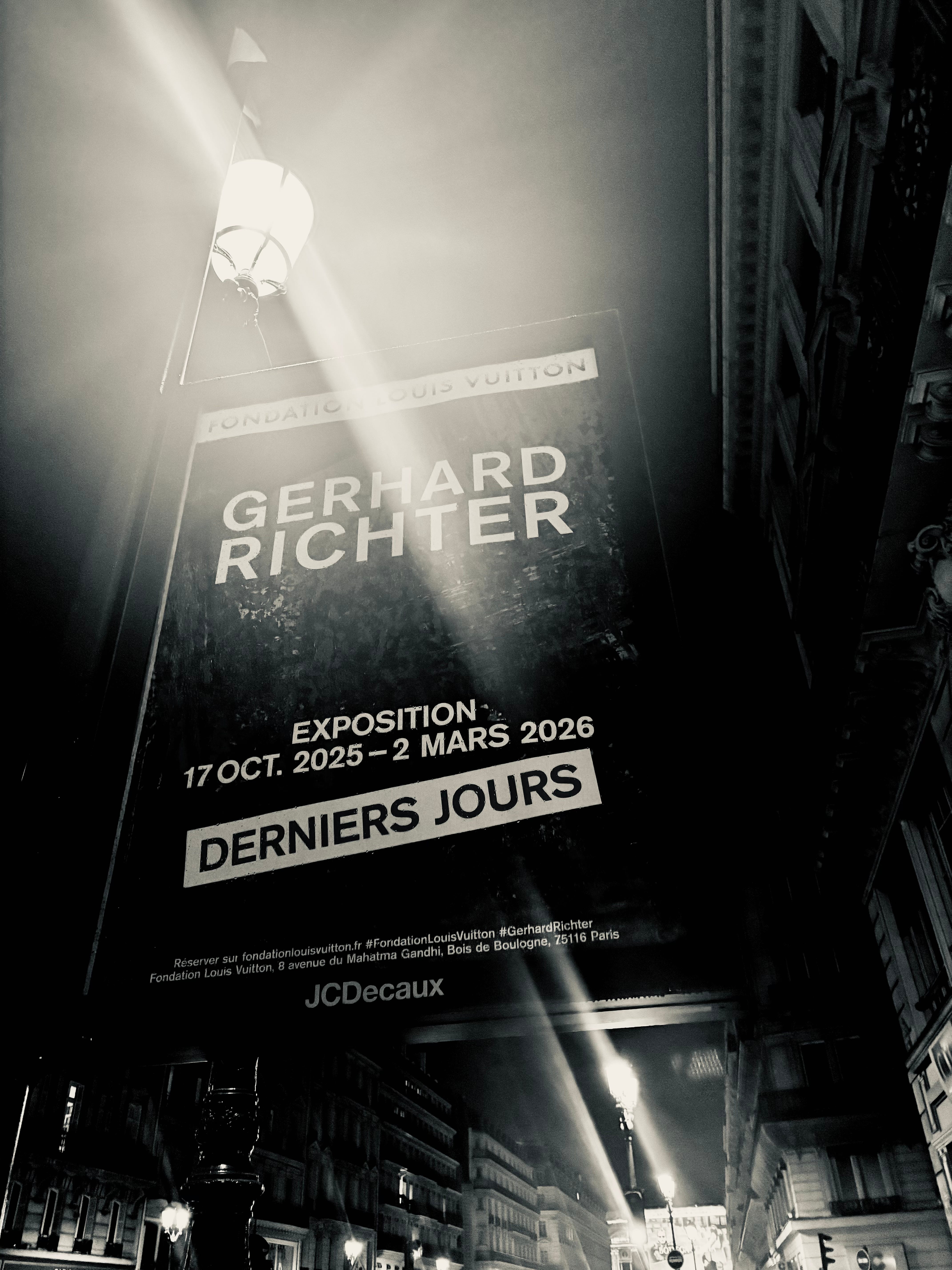
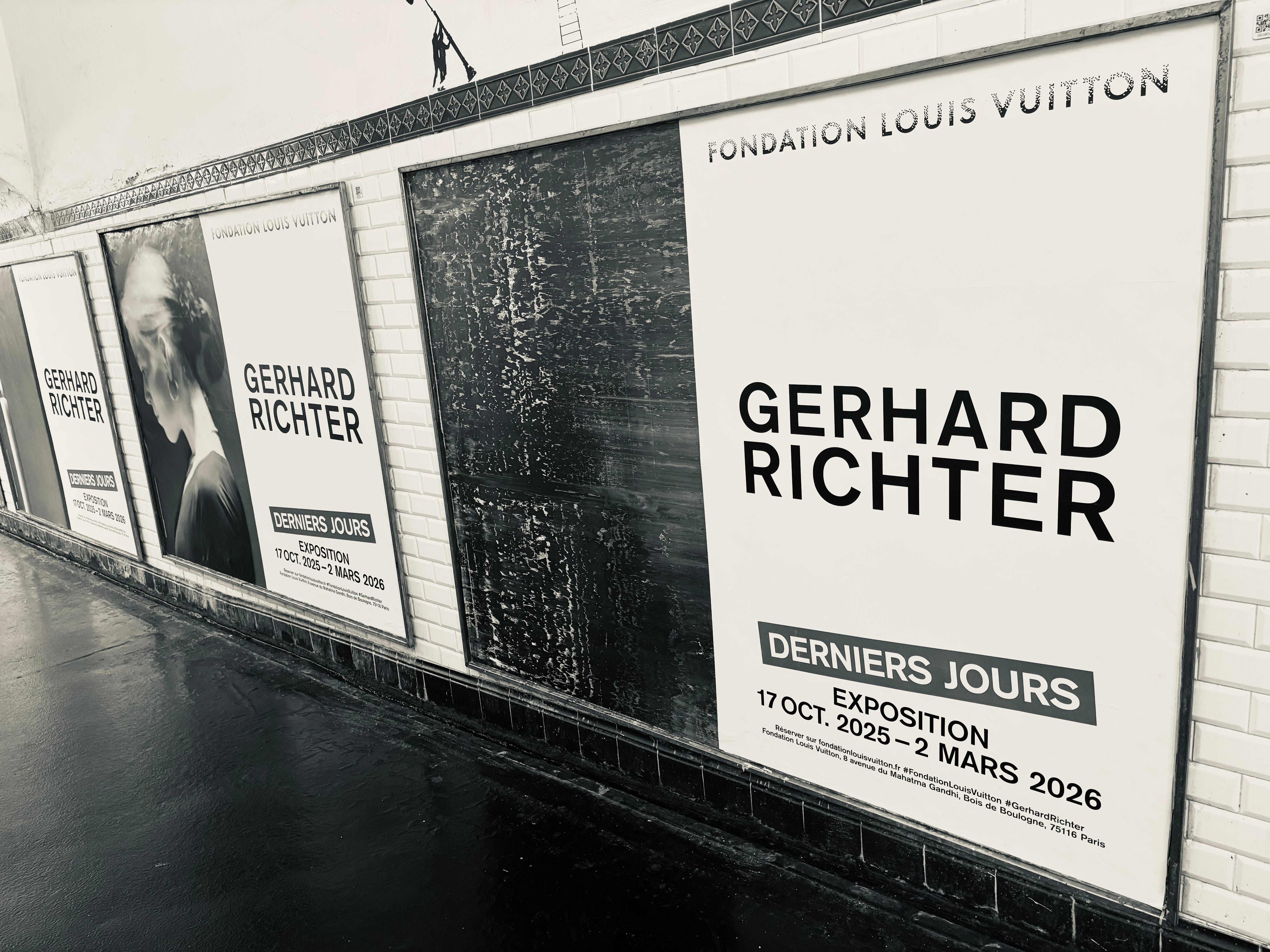
Last November Ren, Justin, and Adina went to the massive retrospective of Richter’s seven-decade career, at the Fondation Louis Vuitton outside of Paris in the Bois de Boulogne. Ren hated the building, a Frank Gehry rush job that looks, he says, like an overturned yacht. Justin in turn hated the Florian von Donnersmark film, Werk ohne Autor [Never Look Away] (2018), that shows us a fictionalized version of Richter’s life, but with a narrative arc and an emotional tenor dictated entirely by Hollywood. Nonetheless, Ren and Justin agree on more or less everything else: that Richter’s greatest innovation comes in 1965, with the discovery of the photographic blur technique; that the color panels and monochromes are stunning too, but that it is impossible to make any sense of them independently of what we know of the entire range of his work; that the smear paintings of the 1980s and ‘90s reflect the cynicism of the art world’s increasing financialization in that same era; that the grey-scale paintings documenting the end of the Baader-Meinhof gang are powerful indeed; that the late-career Birkenau paintings are Richter’s greatest aesthetic failure and maybe even his greatest moral failure; and, again, that Gerhard Richter is perhaps the greatest living painter.
Ren prepared an exquisite presentation of more than sixty vivid slides, most of them reproductions of Richter’s work, and the discussion moves through them chronologically, from the early DDR work (which Richter has disowned), to the drawings of the most recent years (Richter, 94, is still active, but has retired from painting). Ren guides us through it all with his significant art-historical insight, anchored in Vermeer and Vélasquez, as knowledgeable as anyone who is not Richter can be about the deep sources of Richter’s work. Justin nods enthusiastically and tries to keep up.
The exhibit ends on March 2, which is to say tomorrow, so this virtual guided tour, initially conceived as something of an advertisement for the exhibit, will instead, most likely, unless you get moving this very instant, have to serve as a substitute for it instead. Not a bad consolation, in our strong opinion. —The Editors
The Hinternet Foundation is a California-registered 501(c)(3) nonprofit entity. Learn more about our programs here. Click below to make a tax-deductible donation!
Thank you so much for sharing it! A very welcome gift this oxygen in the fog of madness that surrounds us.
Let’s have Ren back for more lectures! (Also, re: the stag iconography, the saint in question was St. Hubert, patron of hunters.)