
[Song titles featured in bold are required listening. The listening is part of the reading. —MC]
I.
It is not, I do not think, that most people lack talent —for in the end are we not all mirrors of the same God?—, but that most hold their artist selves back for fear of being unable to maintain the power to create, free from the constraints of reality, without losing contact with that reality altogether. Both a lauded performer working in a venerable tradition, and a lost soul jibbering before a crowd in a lively city square for spare change because he can do no otherwise, have tapped out of the same reality, at least for the duration of the performance, and there is always some risk, with art, that once you have left the fortress of the real in this way you will not be able to return. To this extent, one must say that artists, even those who could not have done otherwise, are not distinguished exclusively or primarily by their talent, but by their courage.
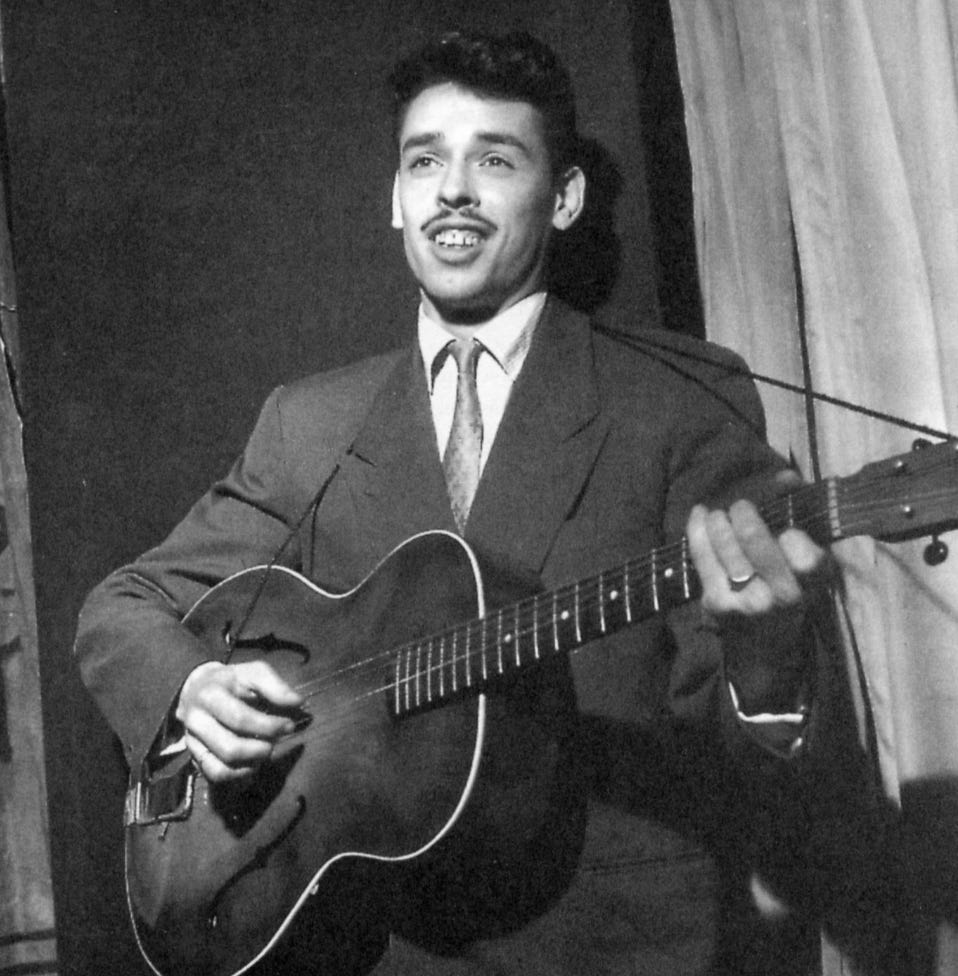
There is little in Jacques Brel’s early biography that would enable us to predict the eventual discovery of his own courage. Born in a provincial Belgian city in 1929 to a French-speaking father and a Flemish mother (whose language will occasionally surface in Brel’s oeuvre, as in “Marieke” (1961)), the young Brel would distinguish himself mostly in the local soccer club and in Catholic charity work. His early employment in the family business, something to do with the manufacture of cardboard boxes, would seem as if designed by the fates to keep him in a life of everyday plain speech and unpoetic transaction. He got married and became a father early, as Flems unthinkingly do — according to the lyrics of “Les Flamandes” (1958).
And then in his mid-twenties he exploded. I don’t mean only that he exploded onto the scene; I mean he exploded in song, and he exploded, too, through artistic transfiguration —as medieval logicians are said to “explode” their premises through contradiction— the ordinary prosaic world that had been expected to contain him.
II.
Brel’s career begins at a moment of significant musical explosiveness in the Anglophone world as well, and our critical assessment of him requires at least some concern to determine whether these simultaneous instances of it may be traced back to the same cause.
It has sometimes seemed to me, indeed, that Brel must have played an outsized role in delaying any real successful implantation of rock and roll in the Francophone world, that he was sucking up all the energy rock and roll would have needed for itself. By the mid-1950s youth culture in the Anglosphere and its vassal territories had suppressed any enduring echo of parental sensibilities, in favor of a new musical style and cultural attitude that disdained the past altogether — not just the crooners and other species of musical ancestor from the entre-deux-guerres, but the culture that sprang up from within the war itself, with its songs of partisanship, resistance, and solidarity. The youth sang nonsense words instead, like “tutti frutti” (nonsense, at least, relative to their own linguistic community), and of automobiles and fucking and hula-hoops and anything really but the war. In Francophone Europe by contrast both pre-war music-hall style and wartime lyrical leitmotifs lingered on almost monopolistically for another solid decade — because the war was still so present, and because its poets were just so good.
Brel seldom sings of the war directly, which ended when he was 16. But his texts constantly return us to the landscapes and sentiments that could only make sense against the background of that trauma. “Fernand” (1965) tells the story of a friend who has died, and of the feeling of unreality hanging over his funeral procession through Paris. The song has little in the way of arrangement or orchestration, but is pure bardic storytelling locked into some kind of opioid-painkilling groove, told from the point of view of someone inhabiting les bas-fonds of Paris, such as you might also have found in Zola’s L’Assommoir (1876). The narrative is too allusive and non-committal to tell you precisely when it is taking place, but the song’s rawest lines at least suggest that we are under occupation:
Dire qu’on traverse Paris
Dans le tout p’tit matin
Dire qu’on traverse Paris
Et qu’on dirait Berlin.
One year earlier, in 1964, the mononymous chanteuse Barbara, of Ukrainian Jewish origin, had her great hit “Göttingen”, whose lyrics celebrate the ancient unity of French and German climate, folklore, royal dynasties, poetic sensibility — even evoking the spirit of the Brothers Grimm, she even sings that it was in Göttingen that the phrase Il était une fois [“Once upon a time”] was born. This song has often been credited with ushering in a new era of post-war reconciliation — the cultural vanguard of the political project of the EU.
In 1964 the English-speaking world by contrast had little time for songs of romantic reconciliation with the Germans. The Germans had been defeated, and the appropriate response to defeat is not fraternal but paternal; not reconciliation but reconstruction; not rediscovery of shared history, but imposition of a new history under a new empire. The Marshall Plan’s cultural wing would feature Elvis in uniform, kitsch caricature of Fräulein in Biergärten, and Wayne Newton singing what sounded for all the world like donka shane (the Germany of the American imagination has always been Bavaria, with its relative cultural warmth and its deviant umlauts — it has not been the spiritual Germany of the “Flatlanders”, as Hans Castorp describes his own subnationality). French popular culture, plainly, was doing something much more serious. It was processing historical trauma, a vicious wound from its most dear twin nation, even as the Americans were processing the same historical events through a lens of triumph. I’ve come to think in this respect that in post-war chanson you can hear, if you listen, France’s concern to preserve its ancient continental identity against the encroachment of the American-led Atlantic order.
III.
In this regard the minor explosion of rock français in the early 1960s, so often interpreted as a cultural effervescence hailing the arrival of the trente glorieuses, is little more than a side story, characterized for the most part by derivativeness and mediocrity. The more important story is not the adoption of a new global musical style, but the survival of an entirely indigenous one, chanson, as the great vernacular musical form of post-war France.
The portions of post-war Europe under de-dicto or de-facto American occupation —Germany and England most notably under those two headings— served as crucial early vectors for the global spread of rock and roll, while the post-war history of France shows us something like an alternate universe, of a few lost-in-translation attempts at recreating the rock spirit, but mostly of a much more robust survival of pre-war and interwar musical forms and performance styles that in occupied Europe might appropriately be marked, like the books that disappeared from German libraries under Allied bombardment, with the label Kriegsverlust.
It is in this sense much more de Gaulle, whose name itself tells you of what Patria he is, than any individual artist, not even Jacques Brel, who kept rock and roll fully from taking root. Yet it is unlikely that this mostly unconscious policy of cultural protectionism could have worked for as long as it did if there had not been, again, a sufficient number of artists working in the old genres, with sufficient emotional intensity, and often with sufficient transgressive power, with sufficient sweat, to ensure that rock and roll should hardly be missed.
In Germany, long before the wandering Japanese busker Damo Suzuki teamed up with the Stockhausen-disciple Holger Czukay to birth Krautrock out of the ruins of the Axis, Little Richard and the Beatles were on heavy rotation through the occupation nightclub circuit. The most evil and sublime concert recording in rock and roll history, even to this day, was made in Hamburg, when Jerry Lee Lewis played there at the Star Club in 1964. His backing band were the Nashville Teens, of England, naturally, a country that by that year had already completely indigenized this American art form and injected it with its own sort of national genius. “Indie rock” was already incubating in the residential colleges of Oxford and Cambridge, where a new species of long-haired eggheads was busily studying the lyrics of Robert Johnson and Ma Rainey with something of the same spirit in which one might, in those same halls, centuries before, have studied John Dee on the down-low.
A casual glance might suggest similar developments taking place in France. Sylvie Vartan was doing a French version of “Twiste et chante” by 1963, just two years after Phil Medley wrote it and one year after the Beatles made it into a cultural touchstone. Vartan’s future husband Johnny Hallyday, improbably thrust into the roll of “French Elvis”, had been active in that country almost as early as Cliff Richard in the UK. The yéyé girls, including Vartan as well as Françoise Hardy, France Gall, and others, were reported by 1963 to be taking over popular culture from the oldhead rive-gauche stars of chanson, notably Brel and Georges Brassens. Serge Gainsbourg (b. 1928), who belonged to this earlier generation but unlike the others entertained until his ignoble end a fantasy of himself as sufficiently in shape —artistically, sexually— to keep up with the changing times, was singing by 1964 of his intention to chercher ma Lolita / Chez les yéyé.
But the yéyé phenomenon is much more a cargo-cult imitation of outre-Manche style than a sign of rock’s successful French enracinement. As a commercial genre, it shared more in the nature of American bubblegum than of, say, UK skiffle. When nominally rock-oriented French musicians finally begin to do anything original or pioneering, such as Magma, formed in 1969, this is typically by drawing on older theatrical and avant-garde and sci-fi tradition, and altogether shedding any hint of a debt to the blues, which, if we agree with Keith Richards, must always remain a sine-qua-non of rock as such.
For the most part, the spirit of rock failed even to penetrate the student protests of May, 1968, whose French soundtrack was principally built up around jazz. This music had been fully, and ingeniously, indigenized already in the interwar period with the birth of “gypsy jazz” — which indeed, in the person of Django Reinhardt, is among the greatest contributions to global popular music of the entire 20th century. It had all come together for Django when he got his hands on some early Louis Armstrong recordings, circa 1928, and after that successive waves of American jazz influence —as for example of hard bop, when Louis Malle selected Miles Davis to create the soundtrack for Ascenseur pour l’échafaud (1958)—, found an easy path to naturalization in France without any of the lost-in-translation clumsiness that would long complicate the importation of rock and roll. When in 1971 French music critics Philippe Carles and Jean-Louis Comolli published their influential book, Free Jazz/Black Power, they were only making explicit what was already an established social fact: that the French counterculture had room for jazz, while rock was destined to remain mostly an arm of the capitalist culture industry that the student left was committed to opposing. As such the superficial signifiers of rock were to remain mostly anchored, in France, to the circuit of the television variety shows, glossy and overproduced and denuded of the revolutionary political charge they carried, or were believed to carry, throughout the Anglosphere.
While Cliff Richard naturally and fittingly retreated in cultural significance after Beatlemania, and even more so after the advent of psychedelia, in France the likes of Johnny Hallyday only grew more culturally entrenched. With an aesthetic essentially the same as the décor you might find inside that French restaurant chain called “Indiana”, with its old Standard Oil pumps and its scenes of Native chiefs in full headgear, with tales of vacations riding around the American Southwest on his Harley, Hallyday can be said to have participated in the American art form he so loved, or on which his fame so depended, only in the most unforgivingly Baudrillardian sense of participation. He liked to tell the reporters from Paris Match how much he valued the anonymous freedom of his American sojourns. But there’s a very good reason why no one knew who he was there: he made no real contribution at all to the musical tradition that came from there, and that entirely made his simulacral career.
It is easy to slot Hallyday as a cultural cheeseball and to think no more of him, but even critically favored folk-rock figures on the French scene typically manage to get by on repeated invocations of a no less simulacral America. Surely one of the worst songs ever recorded is Francis Cabrel’s “Cent ans de plus” (1999). Musically in a direct line of derivation from Paul Simon’s Graceland (1986), this song’s lyrics are a litany of empty shout-outs to American blues masters: Son House et Charlie Patton / Howlin’ Wolf et Blind Lemon Jefferson, etc. Harold Bloom reminds us that the anxiety of influence is positively constitutive of strong poetry. You must not only name your forebears; you must wrestle with them. But Cabrel has no anxiety of influence, because he knows that practically no one truly native to the tradition to which he has set himself up as a satellite is ever going to hear him.
From the beginning, then, the stars of French blues, rock, and folk had roughly the same relationship to the American musicians inspiring them that American “continental” philosophers on the SPEP circuit, all lanyarded up at some conference in a Sheraton in Milwaukee, have to the Parisian intellectual class — a relationship best summed up by the word “unidirectional”.
IV.
But let us save our liveliest scorn for Gainsbourg, that cretin. Let us try not to relitigate his moral character, pushed beyond redemption, in our view, the day in 1986 when he appeared alongside Whitney Houston on a French talk show, and muttered to our queen, in his lizard-English, before a live audience: “I want to fuck you.” Whitney, remarkably, retained her composure, while the host Michel Drucker did nothing at all to put the disintegrating old lecher in his place — but at least we have this enduring document to remind us of who he was, of how he could only conduct himself in the presence of Black American musical royalty, of how he really related to that tradition. He behaves somewhat better in a memorable 1983 duet with the great Screamin’ Jay Hawkins, on the latter’s “novelty” composition, “Constipation Blues”, though the truth is he adds little more, artistically, than a running side-commentary in French on Screamin’ Jay’s lyrics, evidently pleased with himself for understanding what the song is all about (Il veut faire caca mais il peut pas, etc.).
But if Gainsbourg is of interest to us here, this is only, again, to the extent that he is the one prominent figure from Brel’s generation seriously to attempt to change with the times and, by the end of the 1960s, to follow the new aspiration of Anglosphere rock towards relatively higher registers of artistic seriousness, in particular in the ambitious narrative form of the concept album.
His efforts here largely misfire, and tend to move up and down on a scale with “meandering” and “unlistenable” at its endpoints. Nor does the artistically ambitious vision liberate these efforts from the same cargo-cult-like stance towards rock and roll that we had previously, with yéyé and related trifles, been able to write off to the commercial imperatives driving the show. The tape-loop-like vocal sample on “Bonnie and Clyde” (1967), for example, seems a mockery of the studio experimentation the Beatles had innovated over the previous few years. L’Histoire de Melody Nelson (1971) has been hailed as Gainsbourg’s conceptual masterpiece, and it is indeed critically noteworthy, but mostly as marking out the limits of any attempted evolution from chanson into the same registers of high-art expressivity that Pink Floyd, say, were much better positioned to explore from an initial starting point in psychedelia. I personally consider L’Homme à tête de chou (1976) to be Gainsbourg’s greatest contribution in this vein, while everything after that, notably 1984’s Love on the Beat, is almost laughably bad, overstuffed with bilingual Americana-themed wordplay —“Harley Davidson of a bitch”, etc.— that is, quite frankly, just awful, no better than the bottom-end restaurateurs of Paris calling themselves by names such as “Chicken’s King” or “Facefood”.
As far as I have been able to determine, Jacques Brel never sang so much as a single word in English, and at the very moment Gainsbourg was veering off into some kind of French inflection of global avant-pop, the Belgian singer was doubling down on the most sumptuous, treacly, string-heavy ballads of the sort that the Anglosphere’s youth counterculture was by now primed to dismiss as “easy listening”. To my mind Brel’s “Chanson des vieux amants” of 1967 is one of his most gorgeous accomplishments, and it seems to come from a parallel universe where rock and roll never happened. Musically it follows in the orchestral-pop spirit of Nelson Riddle or the 101 Strings Orchestra, yet the depth of expressivity and feeling in it are as great as anything comparable in the rock revolution’s most bathetic excavations of raw human experience. Lyrically, Brel continues to rely on repetitions of the French passé simple (Bien sûr nous eûmes des orages) that had all but disappeared from everyday speech. It is impossible to imagine Françoise Hardy, with her minor tales of what les garçons et les filles de mon âge were getting up to, ever resorting to an eut or a fut.
By remaining true to older and “squarer” musical forms, Brel managed to keep up with the times in a way an anxious and self-hating borrower like Gainsbourg never could. The “Chanson des vieux amants”, alongside the following year’s “J’arrive” and the early “Ne me quitte pas” (1959), are in my view the crowning achievements of Brel’s career, and among the most enduring and significant contributions to 20th-century songwriting at a global scale. The latter of these has of course been ingeniously covered by many English-language artists, not least, in some kind of French and with nearly as much feeling as Brel’s original, by Nina Simone. Significantly, when Brel himself performs it in Dutch, as “Laat me niet alleen”, it is difficult to discern the same depth of feeling. To whatever extent Brel’s artistry is shaped by his own fractured ethnolinguistic identity, it is plain that French is the exclusive langue d’expression, one might say the medium, of his art.
V.
It is of course no less artificial, no less unfair, to contrast Brel and Gainsbourg than to do the same with the Stones and the Beatles, or with Test Dept and Einstürzende Neubauten, or any other pair of fully autonomous artistic endeavors that happen to get locked into twinned orbits by dint of circumstance and by media spin. As always, other figures —third particles as it were— complicate the picture, notably the Monegasque singer Léo Ferré (b. 1916).
Surely the most countercultural of all the older chansonniers, Ferré seems to have suffered from the absence of a musical form that might permit him to convey an accurate report of his own life-philosophy. A committed anarchist, in the late 1960s Ferré adopted a female chimpanzee by the name of Pépée, and insisted on treating her as a full equal within the Ferré household. The only real obstacle to interspecies domestic tranquility among primates, he believed, was bourgeois statist ideology. His own daughter was compelled to speak of Pépée as a sister, and when friends and family complained about the chimp’s repeated acts of aggression —biting visitors, tearing their clothes off, sexually assaulting them—, he would hear none of it.
Once, when Ferré was on tour, Pépée had been out on a ramble in the forest with his wife Madeleine and some friends. Pépée fell from a tree and broke her hip, and grew unusually aggressive to anyone who approached her. Madeleine convinced one of the neighbors, who owned a hunting rifle, to put the chimp out of her misery. This decision on Madeleine’s part was the beginning of a long and rancunious divorce. More importantly for our purposes, Pépée’s death inspired what must truly be the worst song of the 20th century, “Pépée” (1969). And unlike Cabrel’s bad song briefly evoked above, “Pépée” is bad in a way that simply requires you to hear it at least once. Here it is:
There are, admittedly, some satisfying lines, especially this jovial dig against a certain flap-eared contemporary:
T’avais les oreilles de Gainsbourg
Mais toi t’avais pas besoin d’scotch
Pour les replier la nuit
Tandis que lui ... ben oui !
Still, one expects some resolution that simply never comes, some acknowledgment that an artist is entering into largely uncharted territory in turning his songwriting talents, such as they are, to eulogizing a chimpanzee, and to that extent one simply has to step out of one’s own raw emotions in order to communicate something to an intended audience. But there does not seem to be an intended audience at all, and as the song grinds on and Ferré sinks into the bitter deep emotion in repetition of the final line, On couche toujours avec des morts, you cannot fail to understand that he is sincerely torn apart by Pépée’s death, but that he entirely lacks the artistic ability that would be necessary to sublimate his mourning into anything worthy of being shared. To listen to “Pépée” is no more an aesthetic experience, properly understood, than to sit awkwardly next to Ferré as he sobs on a public bench.
One also can’t help but suspect that other musical traditions might be at least somewhat better suited to facilitate the exploration of such rare extremes of human experience as this, and that Ferré, in his own way, like Gainsbourg, is bumping up against the limits of chanson. And one returns with great relief to Georges Brassens’ perfect contribution to the genre, “Le Gorille” (1952), a comic and poignant tale of a fictional ape that has escaped from the zoo and gone on a rampage of sexual assault. Brassens understands what Ferré has forgotten: that a chansonnier is a storyteller, not a reality-monger.
VI.
It was storytelling, the ancient lot of the bard, that lay at the heart of the chanson tradition (a typical scholarly work on chanson begins its historical survey in the 9th century or earlier). Stories do confront reality — indeed much of this confrontation in post-war chanson was with the very grimmest of realities, out of which France had only just emerged, as in Marcel Mouloudji’s deeply moving version of “La Complainte du partisan” (1954), better known to most of us through Leonard Cohen’s cover from 1969. But this is reality sublimated; this is history processed through art and in that way made livable.
Rock and roll, which emerged in a spirit of youthful refusal to do the work of historical processing at all, correspondingly abandoned, as far too cumbersome, the old bardic art of narration. When it grew up a bit, after it dropped acid and after it noticed that “post-war” did not at all mean that war had become a thing of the past, it often took upon itself the somber duty of exposing reality for what it is — but now, having already detached itself from long narrative tradition, often struggled to do so with any more artistic success than Ferré’s tribute to his dearly departed Pépée.
I have said that the life of the artist has as much to do with courage as with talent. A third particle in the mix here is of course luck — happening upon the art form that proves itself up to the task of conveying one’s inner sensibility, or, perhaps even more importantly, living in a society that values the art form to which one is innately best suited.
Jacques Brel had all three of these. The talent in his case is simply a given. The biographical circumstances that eventually permitted his courage to manifest itself are for their part mostly a mystery — to know them would be to know what obsessive fantasies were coursing through the young man’s mind as he went about his days in the Catholic charities or the cardboard-box factory.
But the luck of the whole thing, that’s the open record of history — the same history that made Brel’s adoptive France a site of resistance to the emerging post-war Atlantic order, where much older songlines could still be heard to order the world differently. In particular, one could still make out a shared Franco-German cultural patrimony, the common ancestry not just of “nos rois de France” with various Helgas and Hanses, as Barbara sang in “Göttingen”, but of the tales, too, of the Grimms and La Fontaine.
These songlines really only survived another ten years or so, and we begin to hear the failure of their signal in the likes of Gainsbourg and Ferré already by the end of the 1960s. As with so much else —the internet, Uber, the financialization of higher education—, France consistently shows up to the disruptions of modernity a decade or so late. Sometimes its cultural protectionism is nothing more than an inconvenience. In the case of post-war chanson, however, it was nothing less than a grace period.
Complete Spotify playlist for this essay beneath the paywall!