

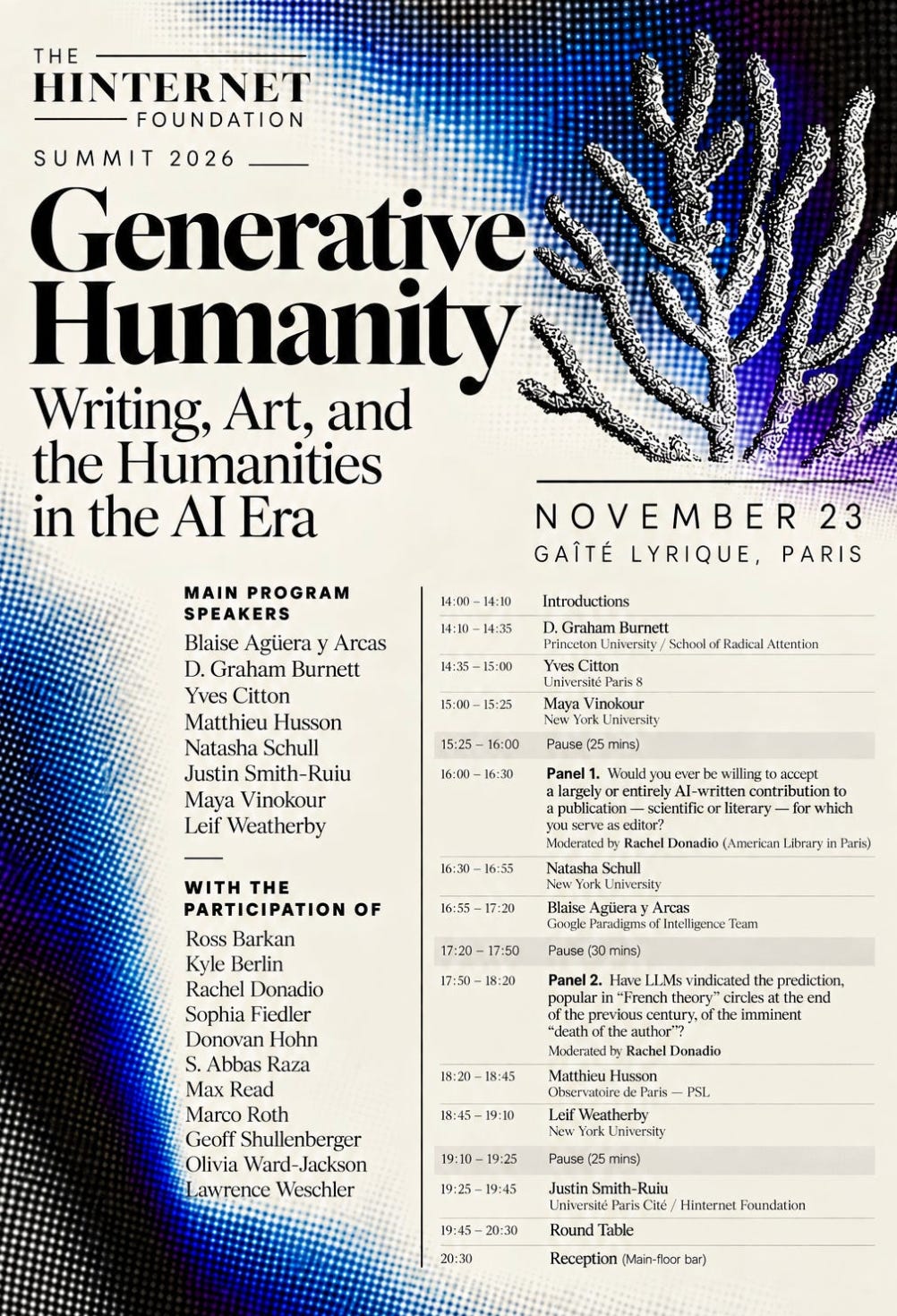
Today’s piece anticipates some of the reflections I will be sharing at the Inaugural Hinternet Foundation Summit, at the Gaîté Lyrique in Paris, this coming Monday, November 23. In the lead-up to that event we will be featuring a number of additional essays and livestreams, including one with Leif Weatherby on Monday, November 16 (tomorrow), and another with Blaise Agüera y Arcas on Thursday, November 19. All of this, including today’s piece, will be for paid-subscribers only, so you are encouraged to upgrade now (at a 50% discount for the first year!). And you are also encouraged to register for the Summit if you have not done so already.
For the past few years I have repeatedly characterized the state of university-based humanities research and education as “late-Soviet” (I believe I first borrowed this line from Stefan Collini, but may be misremembering). The actual period of reference, in my living memory, extends, let us say, from the Reykjavík Summit of October, 1986, to the official dissolution of the USSR on Boxing Day, 1991. When I have previously invoked the comparison, I have imagined that we were living roughly in the equivalent of 1987, when the system had already been greatly hollowed out, and virtually no one continued to believe in its official mission, but a typical apparatchik could still be expected reliably to show up at work for yet another day of make-believe. The present semester, Fall 2026, feels decidedly more like the late-late-Soviet period, after the fall of the Berlin Wall in November, 1989. Now we wake up each day wondering, with very good reason, whether this will be the day we can finally stop pretending.
The justice of this historical comparison is certainly compounded here in France, where classes have been suspended for two months now, as student strikes have kept the classroom buildings blocked with piles of trash-bins and discarded rental bikes, and fresh-faced student sentinels, holding mop handles like spears, now demand of anyone who attempts to enter first to state their business. I will not offer an analysis of the current French situation here, other than to say that the Hexagon is not an island, and that whatever is happening here is quite obviously not unconnected to the massive challenges facing traditional institutions of higher education more or less everywhere in the world.
Let me explain…