

Originally published at Romanticon.
1.
One of the loveliest documented moments of the 1966 Newport Folk Festival features Bukka White and Howlin’ Wolf in a rare improvised performance. The beauty of it might be thought, on an initial viewing, to be compromised by the presence of a white fellow on the stage, one who will no doubt read for some as “dorky”, gesticulating exuberantly, strumming some indeterminate instrument but adding little. One might assume this man had been among the organizers of the event, perhaps some Harvard ethnomusicologist or the like. The angle and distance and quality of the recording reveal little of his class habitus, or of the quality of his dental care. All we can really make out is his “race”, and this is enough to mark him, in our contemporary world’s taxonomy of musical traditions, as quite out of place. Even I, who am arguably quite such a “white ou” myself, found his display somewhat unseemly at first, like the blond dreadlocks of the self-identified Rastafarian skater of your worst high-school memories, like the hackey-sackers in Sex Wax shirts I had to chase from the parking lot when, in the summer of 1989, I found myself briefly employed as security guard at an N.W.A. concert.
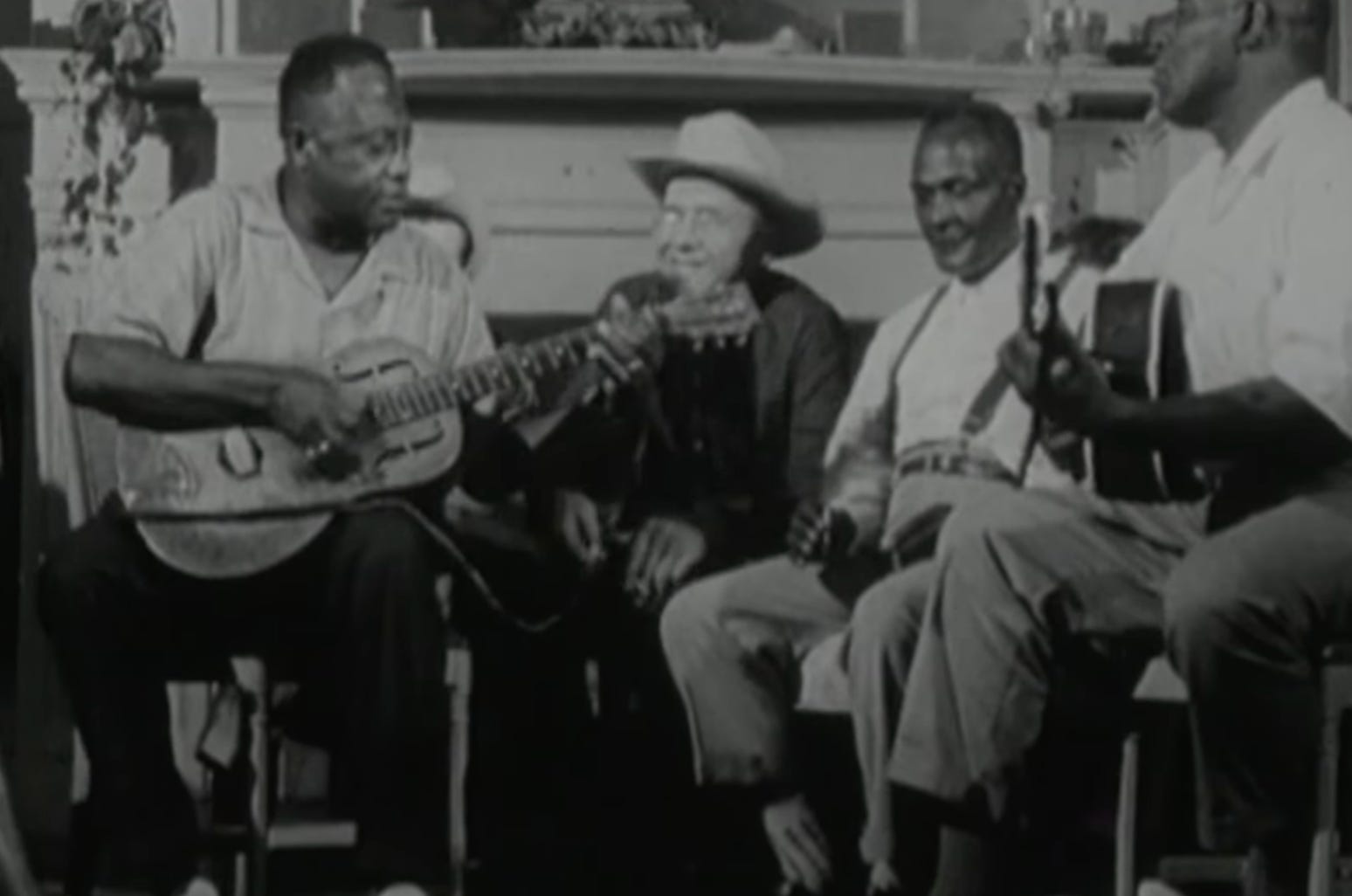
But look closer, and some further salient features will come into view. His instrument is an autoharp, for one thing, and his teeth are something awful. He is Kilby Snow (1905-1980), Appalachian folk musician, autoharp prodigy, and in every conceivable respect “the real deal”. In a remarkable 1970 interview and performance alongside Mike Seeger, Snow gives a masterful demonstration of the unexpected range of his chosen instrument, and placidly admits that his own autoharp, embossed with his name alongside an American eagle motif, had been purchased from Montgomery Ward and had served him just fine throughout his long career. He describes his initial encounters with the autoharp exactly in the same terms as Sam Chatmon elsewhere describes his, in discussion with Alan Lomax, with the guitar: both begin around the age of four, when they are too small yet to lift their new musical prostheses and so approach them as stationary, the way an adult approaches a piano.
The more we hear Snow, both playing and speaking, the better we understand the nature of his exuberance in playing alongside these two towering blues musicians. He is experiencing the primary human emotion of joy, because he is in his element, doing his thing, as an American musician.
Sometimes I worry that I am too hung up on this point, or that my exaltation of an ideal of racial harmony as exemplified through shared musical experience is in the end its own sort of dorky and sentimental exuberance. And I have over the past few years often struggled to understand what has brought me so far down this briar path of American folkways — I, who earlier in life heard, or convinced myself I heard, so much to think about in dodecaphony and serialism and music for airports and mallsoft and whatever the hell else just as long as it doesn’t look back to the past with simpering sentiment.
I have been going down this path at the same time as I’ve been immersing myself in Siberian oral epic tradition, and reading widely about this tradition’s parallels in the Balkans, in West Africa, and indeed Ancient Greece. On a typical day, you might well find me translating Sakha oral epic with Carter Family rarities playing in the background, Mother Maybelle switching between guitar and autoharp, the latter perhaps also of Montgomery Ward. And over time it has come to seem to me that this pairing, which some might judge prima facie as incongruous, indeed more incongruous than the sight of a white fellow on stage with Bukka White and Howlin’ Wolf, is in fact anything but. When I am reading Olonkho and listening to the Carter Family, I am typically experiencing the primary human emotion of joy, because I am in my element, doing my thing, as a lover of oral literature.
“Oral literature” is a contested designation in the scholarship,1 but I suspect that is mostly because scholars are professionally obligated to find things to contest. Literature, I think, in truth, following out an insight that my great hero G. W. Leibniz had already in 1704,2 has always been oral by default, while it is only in a few aberrant strains of it that we find so much prestige attached to its secondary textual traces.
The oral literature of America in particular begins with the transplantation of Anglo-Celtic and West African varietals into new soil, followed by some centuries of cross-fertility, and a succession of what Darwin called “sports”, when the growth of some living thing takes an unexpected new turn for reasons having to do with nothing we can make out other than its own internal idiosyncrasy. America, I am confident saying, has been unusually productive of musical sports.
The geographical region most conducive to their production, significantly, is nearly perfectly coextensive with the boundaries of there former Confederate States, with hill regions and riverine flood plains the most productive of all. The reigning political order in this region sought to keep a tidy garden of pure strains, and to pitch out the weeds that showed any hints of hybridism. But nature always comes roaring back, as the aphorist said, and it is a grave mistake to suppose that the political history of America is its only history. You can hear a different history in its music. I have come to believe that this other history is a more promising one for thinking about American collective identity and its possible futures.
I’ve also come to believe that this history has been actively suppressed over the past half-century. The common tradition of American musical culture was, more precisely, systematically broken down and replaced by the new contextless commercial culture that swept in along with a whole suite of other changes in the period of the Nixon Shock often cited as the beginning of the neoliberal order.
I am old enough to have caught the faint traces of the older order, in such material as thrift-shop vinyl, but also through its still-living vehicles — elderly rural relatives who carried in them the songs that were transmitted to them by their parents and grandparents. It is this intergenerational transmission that is so to speak the lifeblood of the older order. I stood by as it died out. I could hear the elders, but by the time I came into the world the supreme value placed on cultivating individual taste made it impossible for me properly to learn from them.
When I picked up a Burl Ives or Carl Sandburg record from Goodwill (which I bought mostly in the hope of extracting “samples” from them, to be used ironically on public-access radio or in the then-thriving tape-exchange networks), it was one and the same technology that both enabled me to hear these good conservationist bards at all and that ensured the eventual effacement from historical memory of what they were trying to conserve. Recording technology, to be sure, made wonderful things possible. The recursive abstraction of jazz with each new wave of artists studying the work of the last, breaking it down and penetrating deeper into its essence (or, if you don’t like that kind of Thomistic talk, then, if you prefer, deconstructing it), was able to occur at all only because these artists could study their predecessors in a way no musicians before the 20th century could. New technology propelled at least one recording genre from libertine entertainment in the Depression era into maximally cerebral high art, working out the full potentials of modal composition only hinted at by Debussy and others in let us say the “problematizing” phase of high European tradition, in the earliest post-war years.
But what was the powerful motor of a genre defined by progressivity and abstraction, with hard bop evolving by the end of the 1950s into something like the aural counterpart to abstract expressionism, was detrimental to those genres that, as distinct from post-war jazz, could not fully get on board with modernity. There were efforts, of course. New Deal initiatives channeled public money, in part under pressure of example from similar initiatives in the socialist bloc, into the documentation, recording, and broadcasting of “the people’s” voices. These same voices would be rediscovered, showcased, and celebrated again with the folk revival of the 1960s, but by now the primary meaning of “popular”, which for most of its history was really just the adjectival form of “the people”, will have been replaced by a different and almost opposite sense, for which the corresponding noun is not “people” but “pop”. This is the sense that now makes it seem natural to describe some corporate K-Pop entity, for example, as “popular”, even if it has been entirely confected by top-down commercial interests with no concern at all for vernacular tradition.
Let us disambiguate these senses, in what follows, by using “popular†” for the older sense, with the cross superscript commonly added to the names of the deceased, and “popular*”, with the asterisk of illegitimacy.
2.
I have already identified one feature of popular† musical tradition: that its lifeblood is in the intergenerational transmission of songs and other motifs. Another is that popular† tradition, unlike popular* tradition, is no less concerned with death and loss than it is with sex and desire.
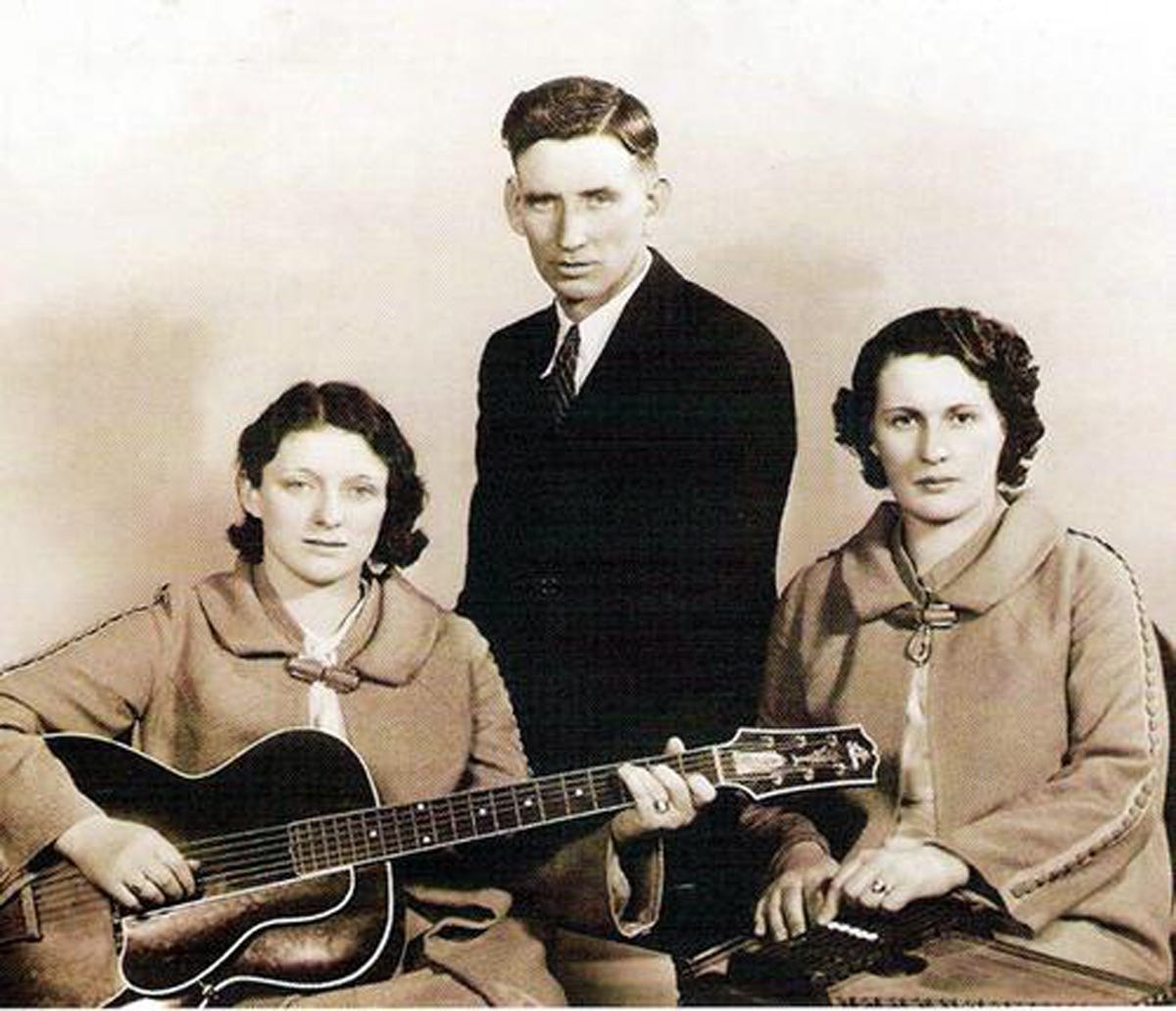
Consider in this connection these two exemplary renditions of the 1907 hymn, “Will the Circle Be Unbroken?”, the one by the Carter Family (1935),3 the other by the Staple Singers (1960). You must listen to both of these before we continue; doing so is part of the reading.
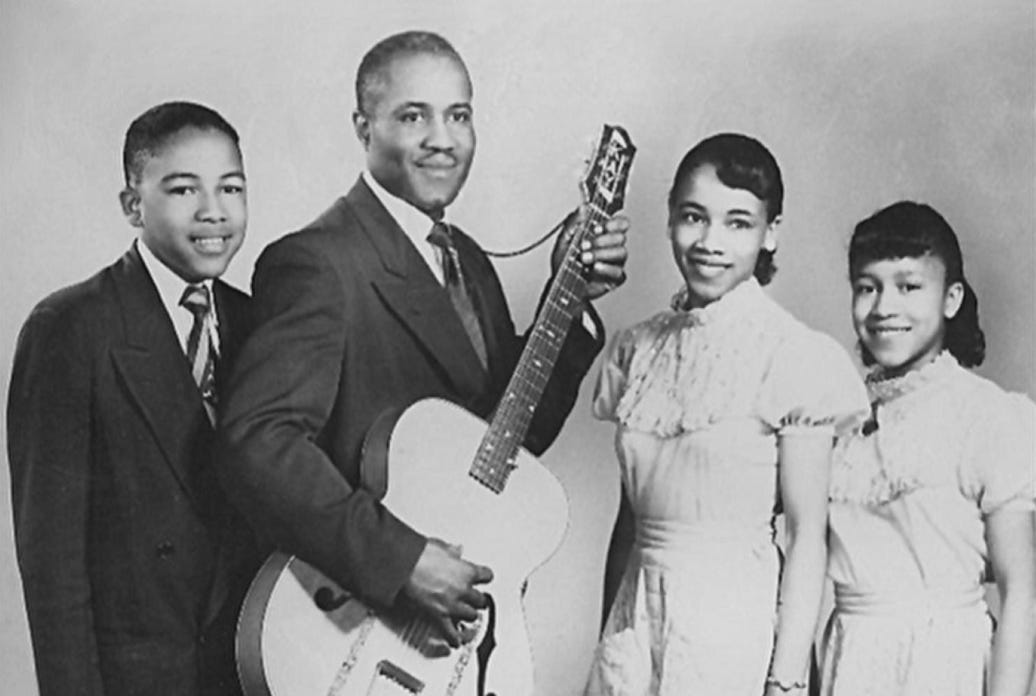
The song, sung in the first person, tells the story of a son or daughter accompanying a mother’s coffin to the graveyard, and it is sung with just as much sensuality —or whatever the thanatic equivalent is of what we call sensuality in the realm of the erotic— as Barry White ever conjured in his many celebrations of “making love”. There are noteworthy differences between the two versions. The Carters sing it straighter, and draw its greatest beauty out of Maybelle and Sara’s harmonies. The Staples weave around in the rhythm, play with time — perhaps one of the most exquisite micro-moments in the history of recorded music is Pops Staples’ second intonation of the word undertaker at around 1’05’’. This difference is often cited as the specific differentium of Black and white musical traditions in America. It is said that you would have noticed it if, on one and the same Sunday circa 1870, you heard the performance of “Amazing Grace” at an AME church in the rural South, followed by a performance of the same song at a white Baptist congregation later the same day. This is all true enough, but too much emphasis on such stylistic differences can obscure the historical significance of the prior existence of a shared treasury of American songlines that serves as the basis for all such variations in style.
I have already identified two signatures of vernacular musical tradition that are likely universal: first, that it is transmitted orally across the generations, and second, that it concerns itself with death as much as with sex, which is to say that it considers the full frame of human experience, rather than just the experiences from which it is easiest to extract a profit. In American vernacular tradition, in turn, we can identify a third feature: that it is fundamentally Christian, or at least it is indexed to Christianity in a sustained alternation between sin and redemption. When it is not Christian, it knows it is not. Many of the great early rock stars —Jerry Lee Lewis and Little Richard, notably—, alternated between phases of lascivious excess and penitent regret. And the inescapability of the church, for them, was always the hidden force that made their engagement with the secular themes of carnal love and desire so compelling. Their art is the expression of what St. Thomas would call “disordered desire”. But having never forgotten altogether about God, even if their backs are currently turned on him, they are able to express an abiding awareness that the depths of desire are infinite.
Early Staples songs are overwhelmingly preoccupied with a cluster of theological leitmotifs common in Black evangelical Christianity — the promise in Revelation, for example, at least on one interpretation, that in the afterlife we will each be fitted with a crown (Revelation 2:10). Most often the thematic focus of the lyrics is on extreme end-of-life scenarios, just before transit to a Heaven that is consistently represented as a real place, at the moment of both one’s greatest suffering and one’s sharpest experience of the Christian virtue of hope. The effect is something analogous to the contrast of black and bright gold in Byzantine icon painting.
Pops’ repetitive, minimalist phrasing and innovative tremolo effects on his Fender Telecaster are the very essence of rock-and-roll: dark, nasty, disconsoling. But unlike the Satanic turn in that tradition beginning in the mid-1960s, which Hendrix declared sonically with the tritone, and then the Stones and Black Sabbath and many more to come made explicit in lyrical content and marketing strategy, Pops gets nasty only to drive home exactly what it is our salvation, about which daughter Mavis is simultaneously singing, is salvation from. Just try to listen to “Low Is the Way” (1957) —again, doing so is non-optional—, and then to describe it without recourse to such familiar evaluative terms as “hardcore” or “bad-ass” (the latter now rather compromised by neoliberal girl-boss feminism).
Listening to the Staples’ recordings from the 1950s drives home a crucially important historical fact: that some of the earliest rock music was Christian rock. And this was nothing like the rear-guard, derivative Christian rock that we know from the period following the suppression of vernacular tradition —Petra, say, or Stryper—, which could never quite resolve itself into a coherent aesthetic or moral stance, but only used some laughable semblance of coolness instrumentally to make palatable what it implicitly acknowledged to be the fundamentally uncool message of Christian faith.
You will find Christian hymns interspersed with secular numbers throughout mid-20th-century showcases of white American musical talent, such as this 1952 episode of the Kate Smith Evening Hour featuring Hank Williams (in this case watching is optional, but strongly encouraged — among other things you will see the most passionate expression of secular love, real or feigned, in the eyes of young Anita Carter throughout her duet with Hank beginning around 5’00’’). And you will likewise find hymns in mid-century showcases of Black American musical talent, as at the end of this remarkable episode of The !!! Beat from 1966, a Dallas-based show I have previously praised, and could not possibly praise enough — it is pure American popular† genius at its greatest.
By contrast, you will not be hearing any hymns on Soul Train a decade later, or on Solid Gold a decade after that. And you definitely won’t be hearing any on America’s Got Talent, that crass display of empty mataiotechnics (as Quintilian described the skills of a traveling entertainer who delighted crowds by throwing a chick pea through the eye of a needle from a great distance4), which only manages to hold its audience’s attention by holding the camera less on the performers than on the empty-headed judges’ endless performance of dumbstruck jaw-drops. Christian themes will survive well after the suppression of vernacularity in country venues, but now only as identitarian reaction rather than as the spontaneous expression of a popular† life-world.
And here we see the true nature of the victory of the proto-algorithmic recording industry in the neoliberal era: that it succeeded in resegregating by market forces what the Civil Rights era had desegregated by political activism and progressive legislation, and thus in reentrenching, at the level of culture, a perception of stark natural differences between different groups of Americans that earlier had to be maintained by state power. This reentrenchment worked in part through the ideology of what we might call chronological chauvinism: the peculiar idea that people in the past, simply because they were living in the past, could only have been more closed in their hearts than we are today. We point to the fundamentally unjust legal and political regime under which they lived and died, and imagine that we are pointing at them individually. But they could just as easily, if we were to revive them and to show them a glimpse of the future, point to our musical regime and declare: vos quoque!
3.
Because commercial forces can’t stand for anything to remain in existence that is not as stupid as they are, one common technique for suppressing expressions of artistic integrity is to ruin them for all time by adapting them to the ends of advertising. I still can’t hear “Good Vibrations” (1966), that ingenious pocket symphony, without imagining that someone is trying to sell me Sunkist. And if you have only heard one Staple Singers song in your life, you probably only know them as the provisioners of a jingle for late-1990s television ads hawking Chevy fucking Malibus.
“I’ll Take You There” was a 1972 Stax Records hit, and as such it lies almost at the historical end of the arc of the Staple Singers that I would like to trace and to interpret here. Three years later, the true historical end, we have “Let’s Do It Again”, composed, significantly, by Curtis Mayfield. This was the last hit for the Staples, and made it to the top of the Hot Soul Singles charts for at least a few weeks.
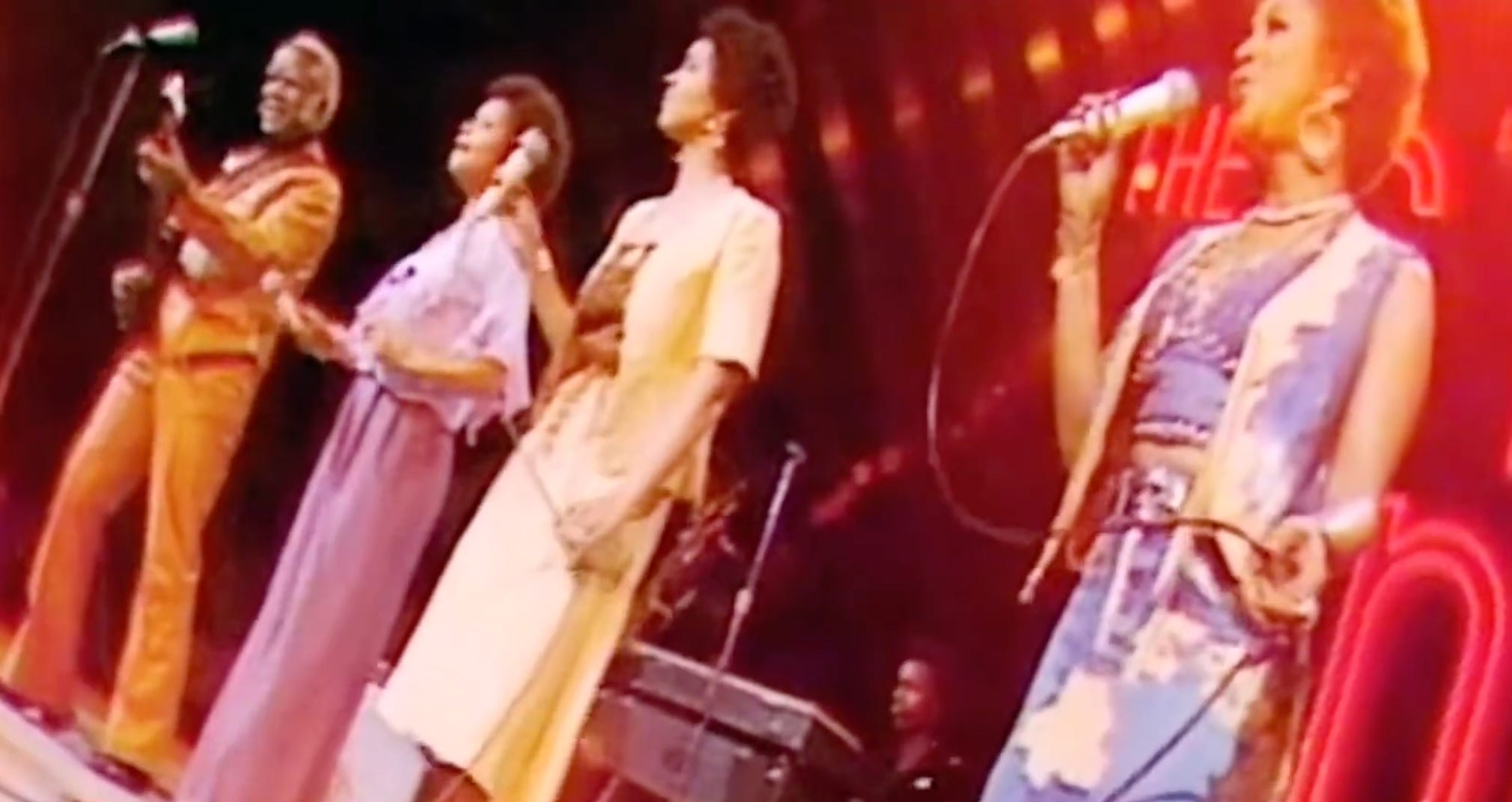
There is an illuminating performance of this song from 1976 that seems to me to tell the full story of the late 20th century. Grey-sideburned Pops and denim-clad Mavis appear naturally adaptable, and more or less amenable to any new exercise in musical expression, or at least any that is rated somewhere lower than PG-13. But keep an eye out for the lesser Staples! Just look at poor Yvonne, all endimanchée in her yellow church dress. She is plainly only up there out of family solidarity, and on her own never would have survived the coerced secular turn that the new economic-cultural order had brought with it. Yvonne might just be my favorite Staple.
“Let’s Do It Again” is a fine-enough gospel-inflected soul song. But it’s not hardcore like “Low Is the Way” had been. I like my music hardcore. That’s why I think Stryper are fucking dorks, and why I think early Staples are a pure expression of American popular† genius.
If we continue to follow the arc of the Staples’ career backwards in time, we next arrive at “Respect Yourself” of 1971, likewise reduced to slightly irksome earworm as a result of its several commercial adaptations. The song itself is very much of its Sesame Street moment, an affirmation of the dignity and worth of all people, and of Black children in particular. Kind of corny, kind of touching, and resolutely secular in content (other than a modest call from Pops towards the beginning for toleration, on the part of non-believers, of the efforts of door-to-door evangelizers), “Respect Yourself” might still be plausibly interpreted as the fulfillment of at least part of the Christian social mission as the Staples understand it.
This hit follows a decade or so of significant involvement in the Civil Rights movement, the peak of which is surely the Staples’ 1965 album, Freedom Highway, named for the Selma-to-Montgomery voting-rights march of that same year. To map the distance in spirit between this overtly political intervention and the feel-good individualism of “Respect Yourself” just six years later is in some sense to witness a success story — by the end of the 1960s Civil Rights had passed into law, and after that much of the remaining work to be done focused on bringing about the inner transformations that might more fully enable members of previously excluded groups fully to realize the possibilities of their newfound formal equality. But this decadal shift is also the one that saw so many former Maoists and Weathermen drifting into crystal-gazing and Primal Scream therapy, and to some extent we can see the Staples’ transition as their own inflection of this same general reorientation towards the atomic individual as the locus of change. MLK is by now, notably, dead, and his posthumous legacy, too, is beginning a parallel process of de-Christianization, as a condition of his inclusion in the national Pantheon.
We thus have, if we turn this backwards journey back around and respect the arrow of time like we’re supposed to, four broad metamorphic stages: the raw gospel of the late 1950s, followed by a vision of Civil Rights still rooted in the ideals of faith-based community, followed by a largely secularized affirmation of individual dignity and self-worth, followed by full participation, with varying degrees of enthusiasm and reservation, in the post-1971 system of secular commercial entertainment. (We could add later phases as well for the individual Staples, not least the evolution of Mavis into her current role, at the age of 86, as generous-hearted and ever-adaptable grande dame of American music, beaming with Christian virtue so plain and evident that it has no need to explain itself).
It was in large part the religious impulse that quickened the Civil Rights movement into motion. It was in turn a great tragedy that the movement’s formal success in part made possible the conditions for a new cultural-economic order that was able, so to speak, to let its guard down. There is a natural motion across these four phases of the Staples’ career, where each phase can be seen to contain the seeds of the one that follows it, even if the motion from phase 1 to phase 4 brings us effectively from one aesthetic-moral universe to its opposite.
The genius anyhow of the Staples, the work that fully justifies their place in the American musical Pantheon, that by his own recollection was powerful enough to wake Bob Dylan up to the full mystery of life, are the recordings made between 1956 and 1959 and released in the latter year on the album Uncloudy Day. Almost all of the songs here are about death, and apocalypse, and retribution, and redemption. Several of them are the common property of American popular† tradition, shared generously and without jealousy across racial lines. The title song itself, “Uncloudy Day”, recorded in 1956, is to my mind the Staples’ most sublime achievement, showcasing Pops’ remarkable restraint on the guitar, Mavis’s voice at its most transcendent, telling of the promise of everlasting life in a city that is veritably made of gold. Here it is (listening, this time, is emphatically non-optional):
4.
None of this is to say of course that the United States is or ought to be Christian by definition, or that one must be Christian to participate fully in its collective identity. The founding documents are broadly of an Enlightenment deist stamp, and tens of millions of that country’s citizens are of other faiths. The modern liberal guarantee of a neutral public sphere must be preserved if anything at all is to be preserved. But this does not mean that the role of Christian communities in shaping American cultural life in particular needs to be suppressed or forgotten, nor that it has not been a grave political mistake to equate such communitarian belonging with identitarian reaction, and in consequence to seek to push these communities to the margins of political life. If you don’t want to understand or to honor the communitarian pride that a Merle Haggard finds in being an Okie from Muskogee (1969), then sooner or later you end up with the jingoistic national pride, and the politics of mass ressentiment behind it, that a Lee Greenwood finds in being what he calls “an American” (1984).
Things were not always this way. Throughout the mid-20th century, notably, the greatest efforts to chronicle, to document, and to celebrate American popular† traditions were driven by New Dealers, labor activists, socialist-leaning ethnomusicologists, and Bohemians of various stripes. There is much to learn from their work, and the present moment is abundant with lessons as to what happens when we decline to do so. The most important lesson, I think, is this: that one must either honor vernacular tradition and intergenerational continuity, or leave it to those who would seek to mandate that honor by state coercion to do so.
