The UK launch of The Oort Cloud Review is happening TOMORROW, 11 November, at the Camden Art Centre in London, at 7pm, featuring Sam Kriss, Sam Jennings, Justin Smith-Ruiu, and maybe Mary Cadwalladr. Admission is free but you must pre-register! Copies of the OCR will be for sale at a discount. See you there!
Though this surely will not remain true for long, The Hinternet is not yet such a streamlined and professional operation as categorically to refuse to run the work of some of the many people in its orbit for no better reason than to do them “a friendly”. Such is the case, we admit, for the present contribution from JSR’s old friend, Radu Ţăranu, whom we are publishing today over HLG’s initially strenuous objections.
JSR first met Radu in Paris in the summer of 2001, when our Founding Editor was there on a summer travel fellowship from Miami University of Ohio, trying mostly unsuccessfully to penetrate the circles of the Paris Cartesians. He met Radu at the Bibliothèque Nationale de France, François Mitterand, where the young Romanian scholar had arrived some days before after 40 hours on a Hungarian Ikarus bus from his hometown of Cluj-Napoca, with mici and mămăligă cu brânză and tomatoes packed by his mother in repurposed plastic margarine containers, and with two enormous empty suitcases to be stuffed with photocopies of as many manuscripts and first editions and works of secondary literature pertaining to the Renaissance German magus Heinrich Cornelius Agrippa as could be called up from the BNF’s subterranean deposits, which materials were to serve as the primary research corpus for his dissertation in progress on The Subtle Body and the Lived Body: A Phenomenological Interpretation of Agrippa’s Occult Philosophy, and then to return again, on another Ikarus bus, this time without mom’s home-cooking, but with a 40-hour supply of Belin-brand Chipsters, LU-brand Petits Écoliers, and Leader Price Emmental from Franprix.
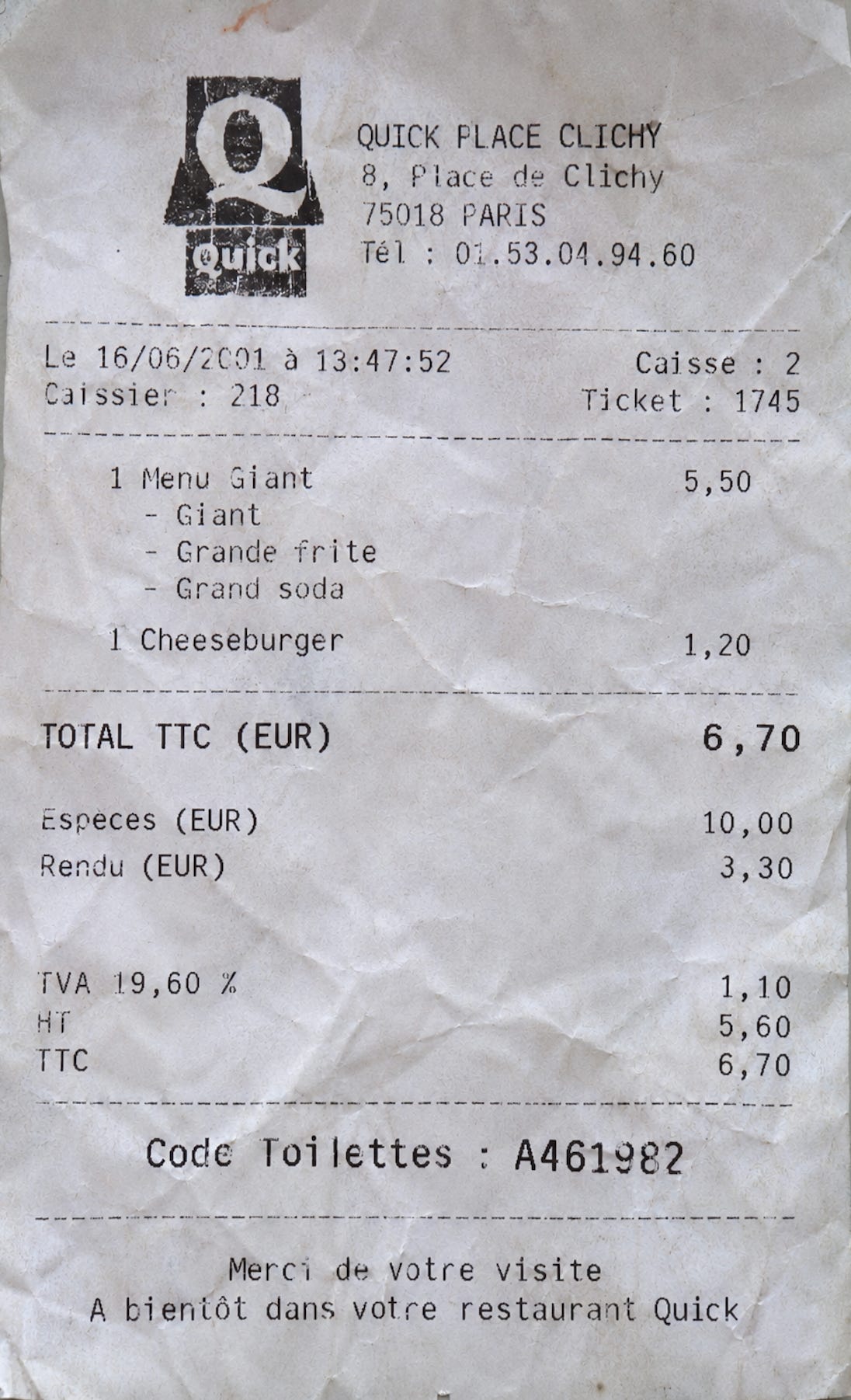
JSR and Radu spent some memorable days together, during that strange pre-9/11 summer (both of them agreed there was “something in the air”). Indeed our founding editor was present, or at least waiting patiently nearby, when Radu had his first and only known sexual encounter, with an Icelandic doctoral student he had met some days earlier in the reading room of the St. Geneviève Library who had been working on Georges Dumézil’s analysis of the Poetic Edda, in the bathroom of the Quick burger restaurant at the Place de Clichy. (It was only on the eighth try that the code for the bathroom door managed to work; nor did anything else, it could be inferred, go much more smoothly after that.)
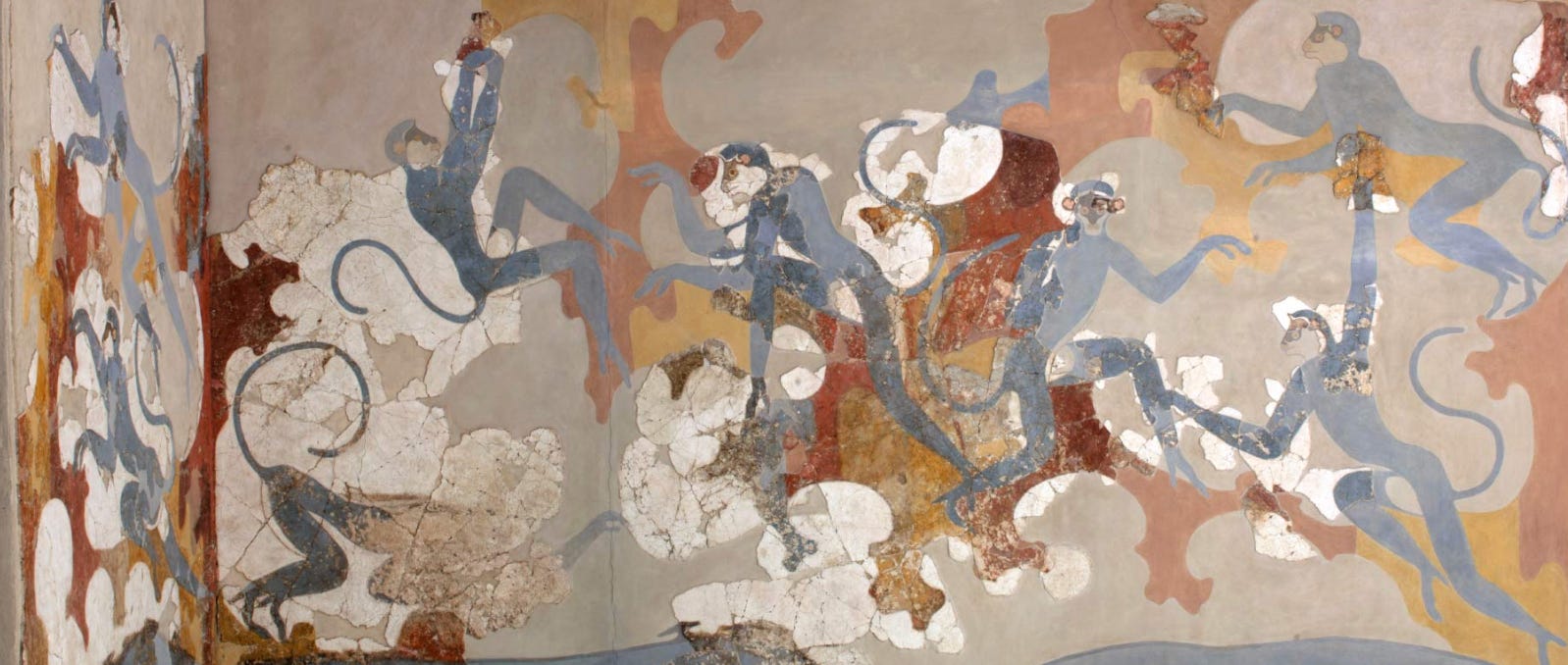
These days we’re not sure what Radu does, exactly. We know he had some kind of breakdown while waiting for a return flight to Athens from the island of Santorini, where he had been in the summer of 2008 to study the sacred blue monkeys depicted in the Akrotiri frescoes, only to find himself surrounded by a group of youthful island revelers in the departures zone, still charged up with holiday spirit, singing and dancing to the Cheeky Girls’ 2004 Euro-pop hit, “Cheeky Song (Touch My Bum)”, whose video was playing on the multiple, inescapable screens installed throughout the airport. It is said he grew visibly agitated and began reciting from Book IX of Paradise Lost:
           So all the day they spent in mirth and dance,
           And sweet repast, for which the Earth was giv’n;
           Such pleasure they took in the present, little thought
           Of what was coming on them,
before tearing three of the monitors from their bolted frames, only then to break down sobbing on the floor. He was never quite the same after that.
Today Radu lives alone in cramped social housing in the rue Edgar Poë on the northern slope of the Butte Bergeyre in the 19e arrondissement, maintains a lively trade in mid-priced rare books on eBay, and an even livelier presence in online chat forums dedicated to the world-historical significance of the philosophy of Nick Land. It is in light of this evident neo-reactionary sensibility that Hélène sought to nix today’s piece. “And if he so much as mentions that horrible Iron Guardist Mircea Eliade,” Hélène warned, “I swear I’m going to scrap the whole thing.” JSR for his part pleaded: “I’m sorry, but friendship trumps political considerations. Always. It is when we’ve forgotten that that we truly will have been defeated.”
A compromise was eventually worked out, whereby we are running Radu’s piece, which we have been instructed not to compare in any way to the phlegmatic aphorisms of Emil Cioran, but only on the condition that it passes Hélène’s “smell test”: no incitements to violence, at a minimum, but beyond that no sustained engagement with any idea or preoccupation that might plausibly be read as “post-liberal”. “We’ve got prospective donors monitoring our every move,” she reminds us. —The Editors
✧ ✧ ✧
If the only thing my grandmother, a typist for the municipal records office at Alba Iulia, had known in 1958 about how I, her grandson, would end up living his life in 2026, was the number of words I’d be typing on an average day, she would have said: “There is no way anyone could type that much, unless someone’s holding a gun to his head!” And yet I am not, myself, a “typist”. How can that be?
✧ ✧ ✧
Imagine it’s 2104. Two decades prior nanorobot trackers leaked from their R&D lab into a nearby stream, and soon penetrated every living cell of every plant, animal, fungus, bacterium, protist…, so that today every tiniest alteration in every living being is registered and instantaneously uploaded to the cloud, or more precisely to the Gassendi data centers packed into the lunar crater bearing that name. And since 2089 the Ruler has made it all “open-access”, so that now we are free to move into what are commonly called the “points of view” of every cell in nature, to transmigrate into a nonillion or so different perspectives, sensing the world as they do, reading, as some avid transmigrators have taken to saying, all their dim little minds… I know I know, I’m sorry. I know I shouldn’t have transmigrated into you again. I know there’s a restraining order. I mean technically I only transmigrated into the point of view of one of the subordinate entities making up your left knee, not into the chief executive entity that we all know alone deserves, in metaphysical rigor, to be called you. No but I know legally speaking your knee beings are you too. I really shouldn’t have done it. Technology just makes it so easy now and really I wasn’t out to make any trouble I just wanted to see how things look from there, to get out of my own head a bit. I’m really sorry please don’t submit a complaint…
✧ ✧ ✧
I find social interaction in France painfully officious, ceremonious, empty and cold, and over the years I have retreated from as much of it as possible. It is the democratized and thus phantomized form of what once was the daily ballet of the royal court,1 the mécanique de la Cour, as Saint-Simon called it, which manifested itself not in lowly subjection to “manners”, as it does for the bourgeoisie, but in participation in the very choreography that keeps the sociocosmos moving. The phantom vestiges of ancien régime hierarchy that survived the Revolution, in patterns of everyday life and social interaction, have always appeared to me as small reminders of the incompletion of France’s aspiration to Republican equality. And they have always seemed most incongruous in the dilapidated public institutional spaces of the Republic, notably universities, where so little that is noble —in the dual sense of that word— remains.
✧ ✧ ✧
Note to self: you can get away with more if you can convince people it’s literature.
✧ ✧ ✧
When you jokingly complain that 1980s pop lyrics occupy too much “space” in your mind and in your memory, do you ever stop to think about the real trauma of loss this joking covers up? Don’t you see how strong the human need is, neurological and spiritual at once, to share in a living song culture, such that when recording and broadcast technologies interrupt such a culture’s continuity, and instead deliver us alienated sonic artifacts, our evolved wiring still has us latching onto these artifacts, even at their very stupidest, and letting them simulate in our brains some faint semblance of what it feels to join in a ritual-celebratory sing-along?
Early broadcasting technology already brought it about that the participants in vernacular musical traditions could communicate across great distances with one another. Early recording technology in turn already made it possible for these same musicians not only to compete with one another, but to approach their work less as bards or channelers and more as composers, in breaking down the recordings of others and building their elements back up in new ways. This explains the rapid progress in complexity and virtuosity following the arrival of collectible and infinitely replayable disks.
One must limit oneself to music recorded before 1928 or so if one wishes to have some idea of what vernacular song traditions sounded like when music still hovered in this world only for the duration of its performance. Most such early recordings showcase a music that is just as simple and modest as can be. But just put a microphone on that, shout “Record!”, and within a few decades the resulting artifacts will have evolved new Paganinis.
If we know well that such virtuosity existed in classical music before the era of recording, because we have scores that do in some sense “record” it as sheet music, and if we know that the first recorded vernacular music does not display much of it, then can’t we conclude that what has happened in the era of recorded music is that the vernaculars begin to understand themselves somewhat in the same terms as the classical tradition already had for a long while, as advancing in a conversation, rather than as cycling through recitation of what the ancestors knew? That is, did not sound recording, in making it possible to record all those elements of music performance that evade recording in sheet music, now make vernacular musicians able generatively to compete with their contemporaries in a way that mirrored the elite competition we except to find in the conservatories and academies?
If so, this is perhaps something between a corollary and an equivalent way of saying that the 20th century is the moment in history when mass culture becomes culture as such, and high culture becomes an affectation.2
✧ ✧ ✧
Like it or not, Christianity is an extreme, world-denying, apocalyptic cult. If you don’t believe me, read the Gospels. In this light the early evolution of the Church, into an institution that banks on its own enduring power into the future, is itself a “liberalization” in much the same way post-Reformation secularization was a liberalization relative to the hardened dogmas that that enduring power had imposed. The Church had been a solution to the problem of the impossibility of any enduring polity actually living the imperatives of the Gospels —hating your family, hating this life, no longer bothering with such distractions as marriage on the presumption that the end is nigh—, and over time found its way even to an accommodation of marriage and child-rearing at the heart of its sacraments; then secularization comes as a solution, at least as many have supposed, to the problem of the untenability of the Church’s control over our bodies once we entered the modern era and came to live according to the rhythms of global trade more than of the seasons, the rhythms of buying and selling more than of growing and felling. So in a way to be a Christian, at least a Catholic or Orthodox Christian, is of necessity to be a medievalist, in spirit if not in actual expertise.3
What, am I not supposed to say that? You think it means I prefer feudalism and am delighted to see its return? Not at all. I’m only explaining the particular needs of the soul under different historical regimes, and I’m trying to be honest about the regime we find ourselves under today.
✧ ✧ ✧
Whether or not there is a lost continent, perhaps some receding peak of the Mid-Atlantic range, we must recognize that Plato is remarkably well-informed about the geography of the world beyond the Pillars of Heracles. I anyhow do not have much to say about the significance of the myth of Atlantis in the Timaeus, though I am struck by a much less discussed remark prefatory to it, at 22b in the same text, where Plato causes Critias to cause an unnamed Egyptian priest to say to the wisest of the Seven Sages:
ὦ Σόλων, Σόλων, Ἕλληνες ἀεὶ παῖδές ἐστε, γέρων δὲ Ἕλλην οὐκ ἔστιν. ἀκούσας οὖν, πῶς τί τοῦτο λέγεις; φάναι. νέοι ἐστέ, εἰπεῖν, τὰς ψυχὰς πάντες· οὐδεμίαν γὰρ ἐν αὐταῖς ἔχετε δι᾽ ἀρχαίαν ἀκοὴν παλαιὰν δόξαν οὐδὲ μάθημα χρόνῳ πολιὸν οὐδέν.
“Solon, Solon, you Greeks are always children, and there’s no such thing as an old Greek!” Now when he heard this, Solon said: “What do you mean by that?” “You’re young,” he declared, “young in soul, all of you; for in those souls you don’t have a single old opinion derived from ancient hearsay or any study hoary with time.”
Our translator, Peter Kalkavage, renders ἀρχαίαν ἀκοὴν as “ancient hearsay”. Liddell and Scott’s Greek-English Lexicon gives for ἀκοή “hearing”, “the sense of hearing”; “that which is heard”, and thus “report”, “rumour”, “tidings”, “oral instruction”, and, finally, “tradition.” The reason an English translator would default to the least exalted of these several meanings is, I believe, the same as the reason the Egyptian priest tells Solon that the Greeks are a nation of children. We, too, like the Greeks, have lost the ability to “listen”.
For as long as it was the primary mode of transmission, ἀκοή could enjoy an epistemological authority that subsequent revolutions in our knowledge practices would only obscure, beginning already with written records and, somewhat later, with argumentative treatises such as we find in the philosophical tradition. From the moment of literacy’s arrival, “the heard” would begin its gradual degeneration into mere “hearsay”, into myth and fable, and other popular cultural forms unworthy of the name of knowledge.
The so-called śruti texts of Sanskrit tradition, notably the Vedas,4 are typically described as being “heard” texts in the sense of having been “dictated” or “revealed” from a divine source, rather than being composed by human effort. But I suspect there’s a more archaic sense of śruti too, one that resonates with the sense intended by the Egyptian priest. Before they were texts the most ancient monuments of human cultural knowledge were recitations, heard and not read. They were poetic rather than argumentative or deliberative, and they were experienced as bearing eternal truth, rather than as timely interventions in ongoing worldly discussions. In this way, far from preserving knowledge across the generations, the rise of textual culture and of papyri and books and other technologies of literacy is itself largely responsible for our alienation from the past. We are supposed to love old books, but old books are like old newspapers — not “hoary with time”, but for the most part jaundiced and mildewed and irrelevant.
And now this millennia-old process has brought us LLMs, and a most surprising paradox: we now have, in Jaron Lanier’s words, a “superlibrary where all the books are so well cross-referenced that they can be automatically recombined into new books that seem as if they always belonged there.” And yet is it not clear that we are, more than ever, children, inhabitants of a vapid and eternal present, where nothing hoary with time is valued, and all that is “heard” in the Egyptian’s sense is written off as hearsay?5
—RŢ, Butte Bergeyre
HLG editorial comment: “He’s not starting to pine for the ancien régime already, ishe?”
HLG: “He’s sounding like Mary!”
HLG: “See, I told you. He’s starting to go there. He’s trying to be normal but he can’t go five minutes without lapsing into that neo-monarchist rêverie of his.”
HLG: “He’s about to mention Eliade, I can feel it. I swear if he does the whole thing is off!”
HLG: “Alright, he didn’t mention him. I guess this passes the smell test. Barely.
✧ ✧ ✧
The Hinternet needs your support! Upgrade to a paid subscription now!
Upcoming Events
November 11. Oort Cloud Review launch event, Camden Art Centre, London, 7pm. REGISTER NOW!
November 23. Hinternet Foundation Inaugural Summit, La Gaîté Lyrique, Paris, 2pm-10pm. REGISTER NOW!
Hinternet Foundation Online Courses
November 3-December 15. “History and Philosophy of Astrobiology”. IN PROGRESS!
October 1-November 12. “Clavis: How the Voynich Manuscript Tells the Story of the Modern World.” IN PROGRESS!
August 7-August 22. Hinternet Foundation Inaugural Summer School: “Whither the Humanities?”