Before we begin, may we first ask you please to upgrade to a paid subscription? The Hinternet is an entirely subscriber-funded publication, and we need your support to keep it going. We’re offering a limited-time special rate of 50% off for the first year. Thank you!
Today we have just a few pieces of information we think you will wish to hear. Our fall events schedule is unusually dense. Let’s look at it backwards.
Here is the program for the Hinternet Foundation’s Inaugural Summit, which will take place at La Gaîté Lyrique in Paris (« J’ai une idée, je loue la Gaîté, nous claquons Paris » —Zola, Nana (1880); it really is a bit like that).
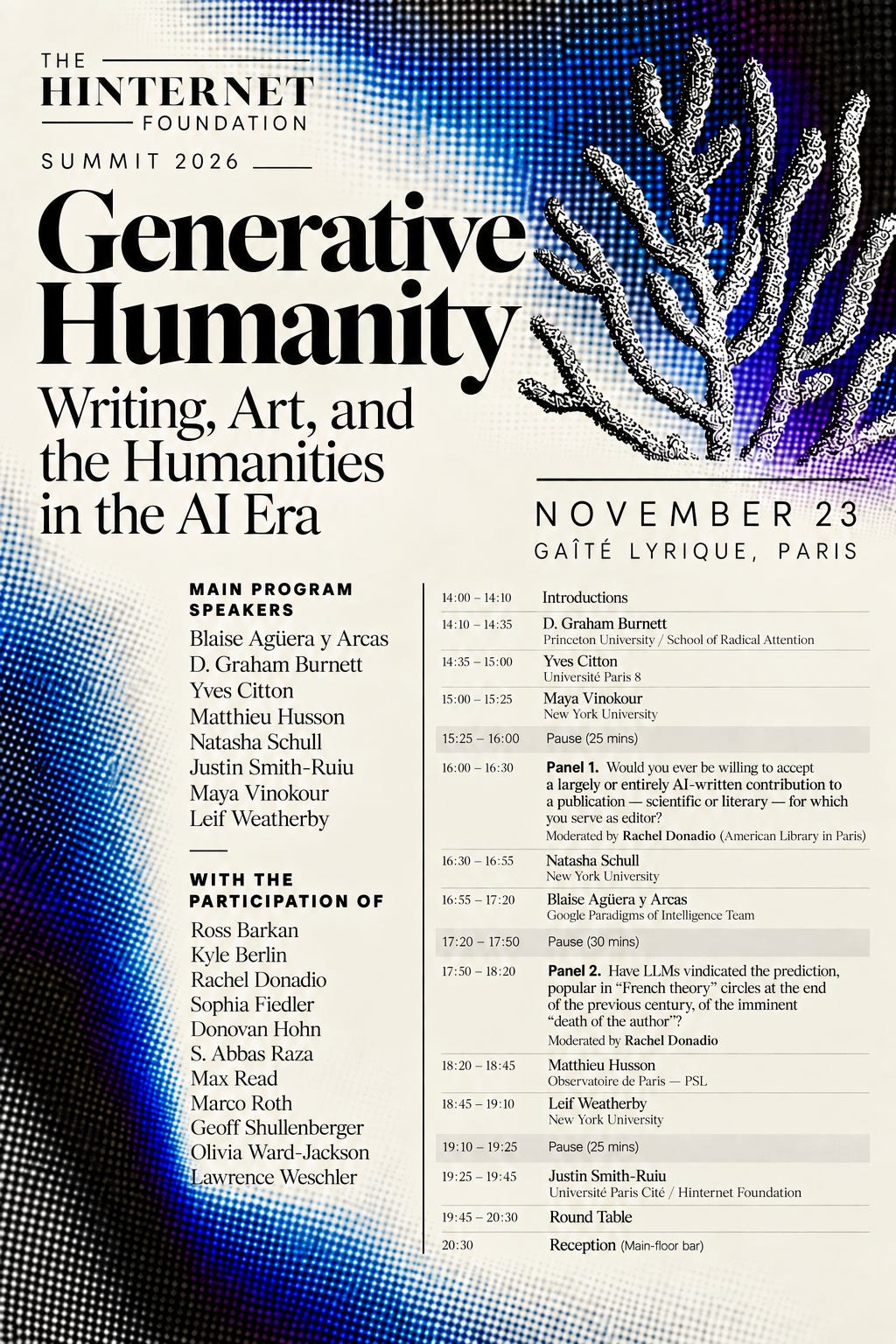
The main-program speakers have been asked to reflect on the following “Guiding Questions”, and to allow these reflections to help shape their remarks at the Summit:
1. What do we lose, if anything, to mechanized language? For millennia, writing has been understood as rendering something of human interiority into external signs. What happens when meaningful language can no longer be presumed to have distinctly human agency at or near their source? How in particular does this impact our understanding of the proper scope of humanistic inquiry, which has since its beginnings advanced primarily through the study of written texts? Might it now be freed to rediscover forms of judgment, experience, and creation that traditional scholarly practices have obscured? What, in the end, is left for the humanist to do?
2. Could AI bring down the walls between the humanities, the sciences, and the creative arts? Modern intellectual life has increasingly divided humanistic interpretation, scientific discovery, and artistic creation, while making ever-narrower specialization the price of expertise, and thus in turn of professional success. By extending what one person can read, learn, calculate, model, and make within a single lifetime, could AI reopen the possibility of genuine polymathy? Might its deepest consequence be not the automation of existing disciplines, but the emergence of forms of inquiry for which our present disciplinary map no longer makes sense?
3. Could the new science of intelligence make humanism obsolete? Humanism has accorded special significance to language, reason, imagination, interpretation, and creation. Yet AI, neuroscience, and evolutionary biology increasingly invite us to understand intelligence as far more general: emerging from biological evolution, distributed across organisms and environments, and perhaps continuous with nonhuman forms of computation. Could these developments expose our remaining attachment to humanistic inquiry as sentimental, parochial, or obsolete? Or could humanism survive the abandonment of human exceptionalism—and if so, what would it become?
We’re going to close pre-registration for the event very soon, so please register right away if you intend to come.
On November 11 there will be an Oort Cloud Review launch event at the Camden Arts Centre in London. It will take place in the evening, likely at 18:00. We are told that certain new documents, related to the early activities of the Heliopause Research Directorate, will be shown to the public for the first time. We are otherwis excited to have this opportunity to showcase our collaborative work on this project in the UK, which has long held the record for highest number of Hinternet readers per capita, and which is likely the only place on earth where we might expect some significant body of readers not only to purchase, nor only to peruse, but to understand The Oort Cloud Review. More on this event as the date approaches!
Incidentally, we are still looking for venues to host launch events in the US Northeast in late October. Ideally we would hold one in Cambridge, Mass., on October 18, and in New York any date from October 22 to 26. We enjoy talking about our work in the elitest of spaces and in the louchest of dens, and everywhere in between, really. So let us know if you are in either of these places and would like to host us. If not, then your one chance this fall may be London! (We’re also locking in dates for a Paris launch event, and a few in California later in winter.)

On October 21 JSR will be in dialogue with Noah Feldman at Harvard Law School:
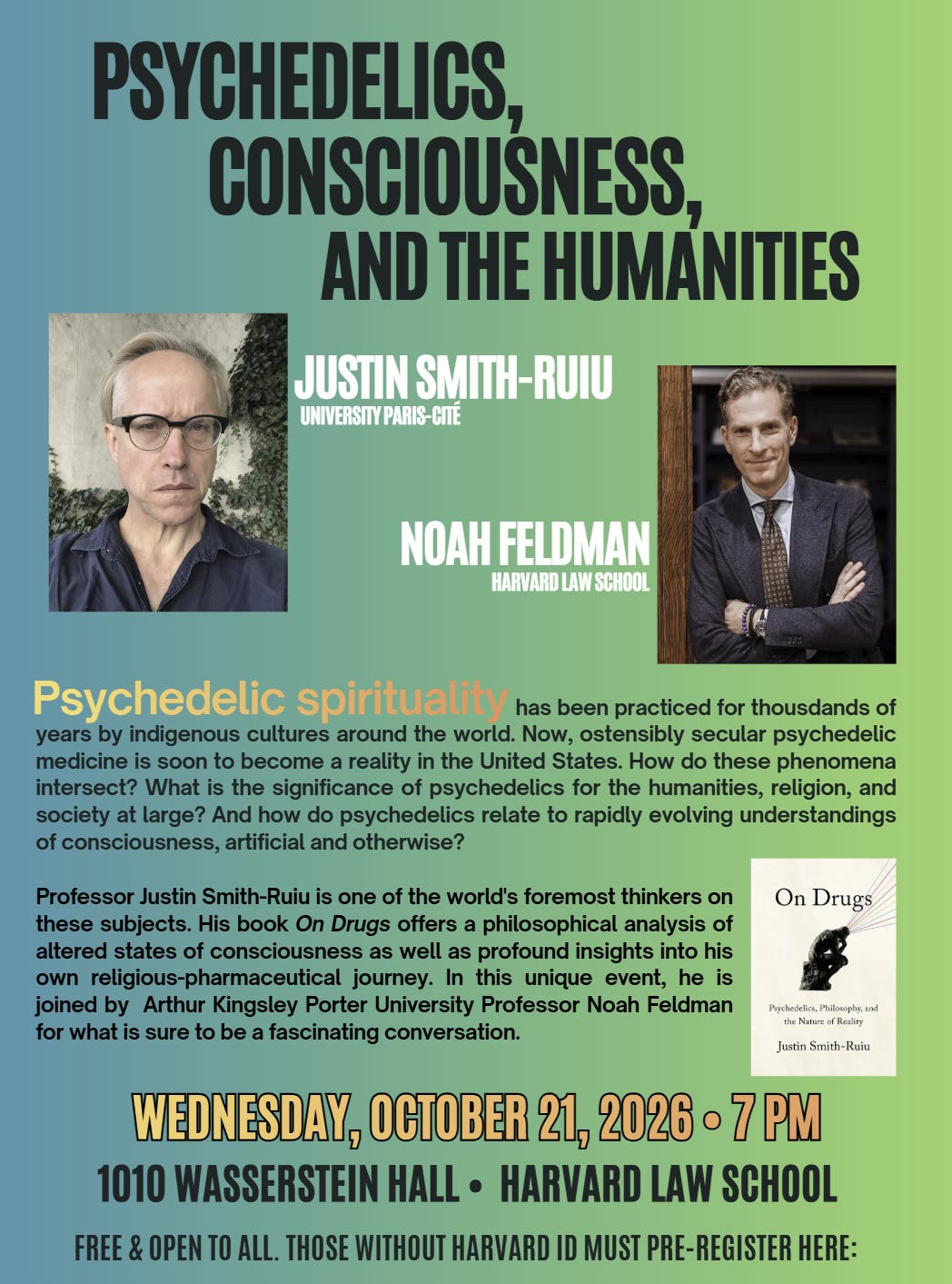
The day before, October 20, there will be a symposium on the “Psychedelic Humanities”, likewise at the Law School, though if we understand correctly this will be a closed-door affair. The public event, anyhow, will surely transmit something of what goes on behind those closed doors, while also being engaging and fun. Noah and JSR, by quite different paths, have arrived at a number of convergent convictions about the limits of knowledge and the role of spirituality in a well-lived life. It will be something to hear them address these convictions, and likely many other questions besides, in tandem.
Incidentally, On Drugs has been out for a year now. If you haven’t read it yet, why not order a copy now?

The Hinternet Foundation’s first fall course, “Clavis: How the Voynich Manuscript Tells the Story of the Modern World, is starting tomorrow, October 1! Here’s the course outline, and here’s a “trailer” livestream JSR did for it a few weeks back.
We’re sorry you missed the application round for that one, but don’t worry. Beginning in November we will be offering a second fall course, co-taught by JSR and Max Wade, on “The History and Philosophy of Astrobiology”, from Plutarch through the present day. The course dates are once weekly, Tuesday, November 3 — Tuesday, December 15, at 10:00 LA / 13:00 NY / 18:00 London / 19:00 Paris. You can find here an old syllabus we wrote up on this topic some years ago, which will be adapted from its current 12-week format to the Foundation’s standard 7-week format, while retaining most of the same readings and topics:

More on this very soon.
Before you go, please don’t forget to upgrade to a paid subscription. Truly, The Hinternet needs your support! Most of our work is paywalled, and you can access all of it now for just 3$ per month!