

I was going to write a piece on the occasion of Dolly Parton’s death, but JSR sent me these words of his own and asked whether we might simply run them instead. I am the music critic here, but I suppose he’s got his droit de seigneur, as it were, so I’ll just hand it over to him. —MC
Dabney Coleman bound and gagged and stuffed in a broom closet, getting his comeuppance as the male pig boss in 9 to 5 (1980), put there by a trio of plucky secretaries — that is a vision that will never fade from my mind. Our mom, at the time a family-law attorney helping low-income rural women to free themselves of abusive marriages, took us to see it in the theater, in the aim of teaching us something about whatever wave of feminism Hollywood imagined it was honoring.
What I mainly took away however was a lesson pertaining to the other side of my family, my dad’s side, where, on potluck visits to Grandpa Von and Grandma Bertie, I sometimes noticed, on reruns of Hee-Haw, a blonde woman with an exceptionally angelic voice. Coming as she did from the cultural universe of the Smith family, talking with an accent not so different from Bertie’s Arkansan one, I was, I see now, surprised and confused to find her, in her turn on the big-screen, playing as an equal alongside Jane Fonda, whom I already understood to belong to some kind of American nobility, and alongside Lily Tomlin, whom I had more trouble reading, but took for some kind of New Yorker or Canadian, or some sort of “ethnic white”, or anyhow someone entirely outside the social calculus I needed to learn to navigate in the mixed social world of two of the most significant populations to have arrived in California’s Central Valley during the great Depression-era migrations — the Scandinavians who arrived there along a route carved from Minnesota through Montana, who were my mother’s people; and the Okies and Arkies who carved a more southerly path, and were my father’s. 9 to 5 then was for me not so much a lesson about gender as about class, not the revenge of the secretaries, but the revenge of the yokels. If Dolly could play alongside such urbane co-stars, if she could display no less game and confidence there than she did sharing a studio stage with Minnie Pearl —price-tag hanging from her straw-hat in a gesture of comic self-Orientalizing, or at least some sort of white-trash equivalent of minstrelsy—, then really anything was possible.
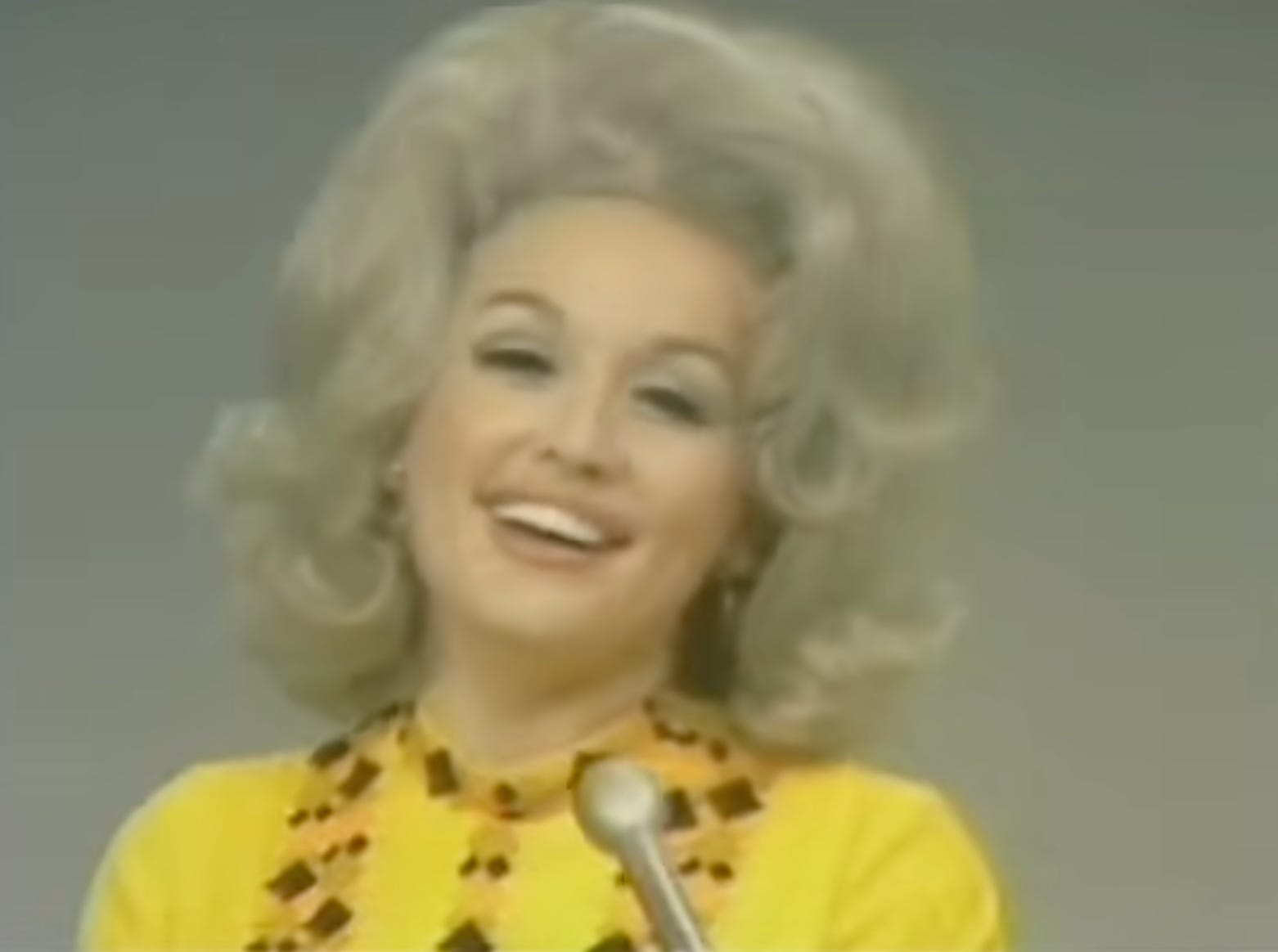
Two years later, for my tenth birthday, I was treated to a Kenny Rogers concert. I was there to hear “The Gambler”, and perhaps secondarily “Ruby (Don’t Take Your Love to Town)” (which I barely understood at the time, but which, upon more recent critical reappraisal, I find to be surprisingly searing and raw). I was there to be reminded, Ecclesiastes-style, of the wisdom of knowing when to hold ‘em, when to fold ‘em, etc., but just a few numbers in, unannounced, who comes out but Dolly, for a duet, wearing a green sequined dress. At the time, though this will surely be downplayed in the coming wave of eulogies, you basically never heard mention of this astoundingly talented singer without some accompanying allusion, also, to the size of her breasts. This was her signature, her epitome. And so when she came out to do her thing with Kenny the crowd whooped and hollered in a way that indeed conveyed significant appreciation for her talent and appearance in general, but that also seemed to carry, properly translated, the semantic charge of words like “knockers” or “jugs” or any number of other such dialectal gems no one I have frequented for the past several decades would ever dare to utter. I sank down in my seat. This was not how I had hoped to spend my tenth birthday. Still, I suppose this too, like Dolly’s movie role two years prior, did teach a lesson. Among other things, I understood, and have always understood since, that like it or not one must honor the ceremonial role of the grande dame.
I have known that Dolly was ill, and I expected The Hinternet was going to need to come through for her with an appropriate Vale. I had assumed it would be Mary to see to this, but then when I read the news it instantly became clear to me that the accompaniment she has provided all these years is just too personal for me to turn it over to our resident Welsh music critic. Mary has evoked Dolly’s legacy in her own writing at The Hinternet more than once (e.g., this fine piece), and has rightly emphasized the singer’s vital role as a conduit of the earliest traditions of country music in the recording era. She was almost certainly the last of the country stars to have taken up and continued the yodel, which Jimmie Rodgers himself likely learned from his years on the Southern vaudeville circuit, where a well-channeled ethnic caricature —even when it was just the abstract figure of one so distant as a Swiss mountaineer— was always sure to please the crowd. For many performers the yodel evolved, after the Singing Brakeman died of TB in 1933, into a mere vocal stunt, and often returned explicitly in its associated lyrical references to its original Alpine home — consider Rosalie Allen’s 1947 novelty song, “He Taught Me How to Yodel”, as exemplary of this tendency. But consider by contrast Dolly’s phenomenal performance of “Mule Skinner Blues” (a much-covered American classic — here for example are the Cramps giving it a shot), on an episode of the great Porter Wagoner Show from 19701:
Dolly is in her element here, joyous, with her own kind, and at ease in just the same way she will someday be alongside the co-star who, at this same earlier moment, was trying out her role as a friend of the Viet Cong (“I’m not Fonda Hanoi Jane”, said at least a few of the bumperstickers in the parking lot that night, no doubt, at the Kenny Rogers concert). But more than this, Dolly is channeling something — not just Jimmie Rodgers, but a whole American essence, whose beauty and density perhaps reached their greatest pinnacle on Porter Wagoner’s stage.
This way of being American was already under threat then — notably by Nixon’s shock doctrine, and the cynical commercial forces this unleashed, which would transform country music by the end of the coming decade into so much crass, stupid, white-identitarian pop (even if, somehow, through all this long era of decline, Dolly managed to grow old with an aura of radiant goodness, and to consolidate year by year the undisputed status of supreme country royalty). Now, with the exception of Willie Nelson, who represents a somewhat different and more outlying lineage of that old American essence, the signal still heard so clearly in Dolly’s channeling has gone silent. This was a channeling not only of the earliest country recording artists, but ultimately of the form of life of the actual muleskinners and other legendary rural types whose lives early country music rendered into song.
The idea that this is what a popular musical tradition ought to be doing at all —singing the ancestors back into being— is unlikely to make a comeback anytime soon… but at least I’ve got the immortal young Dolly, hosted by the great and affable Porter, archived precariously, for as long as market forces allow, on YouTube.
—JSR
The Nashville recording studio of The Porter Wagoner Show plays at least some small role, incidentally, in the plot of The Oort Cloud Review, now available for pre-order.



Justin, I love you for this. And we must.
Dolly! I am not usamerican, but I have always hoped that Dolly and the great traditions and innovations in your music somehow represented the true usa, while the slimy, scuzzy politics of our times do not. Wishful thinking, I guess. Thanks for the Muleskinner Blues - just great.