

We are, we hate to have to acknowledge, on something like a reduced summer writing schedule. Our Founding Editor is traveling, and our other regular contributors are currently either missing, or in the “deep-freeze” (to use the common parlance of our editorial offices here in Quimper), or indeed, in one of their cases, dead.
That’s alright. We don’t have much to say anyhow, at least not much that we might reasonably expect to fit with the rhythms of the present moment. We acknowledge that we do love the Odyssey, very much. But we rush to add that whatever good reason there might be to discuss it now was no less good, say, three years ago, when the rhythms of the moment required one to concern oneself with what was then called Barbenheimer. We sat that one out too.
We might also add that if you are interested in the “Homer” who first wrote down the Greek text of the Odyssey, you have every reason to be equally interested in the “Homer” who precedes him by at least a few centuries, and who, singly or collectively, stands at the beginning of the oral-epic tradition in which the Odyssey was long sung unaccompanied, uncrutched as it were, by any text.
As JSR explains, writing in The Happy Reader in 2023:
We generally take the prose novel to be the most paradigmatic expression of the literary arts, even if we grant poetry a special place alongside prose, in part in view of its seniority. Poetry came before prose, but how long before? We have the great works of Homer from the eighth century BCE and not many surviving traces before that. But what if the works of Homer are themselves just the late-arriving transcriptions of a tradition that existed already for centuries as a strictly oral art-form? But if poems were oral traditions before they were written down, how would we know?
There are tremendous differences from one culture to another, and exceptions to every generalisation, yet nonetheless we may say on the whole that cultures without written literature place a higher value on memorisation than literate or textual cultures. What is sometimes controversially called ‘oral literature’ — the vast bodies of epic poetry that various cultures around the world have transmitted across the generations without ever writing them down, without ever ‘recording’ them anywhere but in the minds and on the tongues of their children — includes numerous features that only make sense if you understand them as part of the technical apparatus of constructing a vast mental corpus with no textual counterpart. Notably, heavy reliance on alliteration and epithets — oft-repeated short phrases that express a characteristic feature of the person or thing in question — is a common feature of oral epic traditions throughout the world.
Such epics were not in the first place composed with any intention of seeing them translated into textual form. And so, often, when they finally are written down they continue to bear the marks of their earlier life as an oral art-form. We have witnessed this process of textualisation of many oral epic traditions in the modern period. The Sundiata epic of the Malinke people, describing heavily mythologised historical events that took place in the Mali Empire in the thirteenth century, was transcribed first into Arabic, and then, by the end of the nineteenth century, was published in French editions compiled by colonial administrators. The Olonkho tradition of the Sakha or Yakut people of north-eastern Siberia only began to be recorded in the early twentieth century, when Polish and Russian ethnologists, and a good number of penal colonists turned ethnologist as a way to bide their time, began to notice the extraordinary feats of memory and recitative endurance of which a certain class of Sakha bards, the olonkhosuttar, were capable. And around the same time a similar tradition in the Balkans was beginning to attract the same sort of outside interest: that of the so-called guslari, or Bosniak bards, who sing epic tales while playing on the single-stringed gusle. Though in this case the most significant researcher of the tradition was not a colonial administrator or a penal colonist, but one Milman Parry — the same man we have already observed bidding farewell to his family — a Harvard classicist turned ethnomusicologist, travelling on a grant from the Rockefeller Foundation. Although oral narrative traditions have many traits in common wherever they are found, circumstance brought Parry to the Balkans, and not to Siberia, or West Africa, or anywhere else human beings have held society and the generations together by telling epic tales — which is to say, more or less everywhere.
The guslari and the olonkhosuttar, and their counterparts throughout the world, are, in terms of social hierarchy, rather lowly characters — typically elderly, toothless, with wispy silver hair and ragged clothing; just looking at pictures of them one senses one can smell their breath. They often do not have particularly beautiful voices. There is little in their performance that seems, on the face of it, to be held in common with the lofty and high-status epic-poetic traditions that have been passed down to us in written form from classical Greek and Roman antiquity. And yet, if you look at your transcription closely, you might notice that the features of today’s Bosniak or Sakha or Malinke epic share at least certain elementary formulae with those most monumental contributions to the history of Western literature – The Odyssey and The Iliad of Homer.
The author, or authors, of these latter texts is surely lost forever in the dark abyss of time. We cannot know who Homer was, or who the many generations of Homers were whom we collectively call by that name. But if we want to get some idea of what it may have been like to be there at ‘Western’ literature’s genesis, we could probably do no better than to visit a Balkan bard and listen to his hours-long wedding song. This was Milman Parry’s central insight.
Born in 1902, Parry received his first degrees at Berkeley. In 1924 he moved from there to study in the philology faculty at the Sorbonne, where four years later he completed a doctoral dissertation entitled L’épithète traditionnelle dans Homère. Here he began to articulate what would come to be known as the ‘Oral Formulaic Hypothesis’, a then-controversial theory of the oral origins of Homeric epic. Before Parry, it was generally supposed that there was a single historical figure, a man named Homer, who was a great poet, and who composed The Odyssey and The Iliad more or less in the form we have them today. But Parry’s theory suggests that the familiar epithets so many of us know — ‘rosy-fingered dawn’, ‘many-counselled Odysseus’, ‘the wine-dark sea’, the last of which would be satirised by James Joyce as ‘the snotgreen sea, the scrotumtightening sea’ — can only make sense if we understand them as part of the scaffolding of a vast art of memory – and, not just of memory, but, as we’ll see soon, an art of creativity as well. The epithets are there not just to ornament, but to help the bard who must master the formal elements required for the marathons of recitation that are his life’s calling. And if Homer’s works were originally bodies of oral poetry that were transmitted among bards through a complicated arsenal of mnemonic techniques, this almost certainly compels us to suppose that the written work we know today came into existence considerably later than the oral tradition from which the written work derives.
Little in Parry’s French classical education under the direction of the great linguist Antoine Meillet, himself a student of the structural linguist Ferdinand de Saussure, could have helped us to predict how his career would develop from there. Once back in the United States, Parry obtained a post in the classics department at Harvard, and became acquainted there with the Slavic Studies scholar Albert Lord (1912–91). A decade Parry’s junior, Lord was already far along in his research on the oral poetic tradition of the Balkan guslari, who into the twentieth century were spinning out poems with many thousands of lines telling the epic history of the 1389 Battle of Kosovo, and of the great showdown at that site between the Ottoman Sultan Murad I and the Serbian Prince Lazar. From 1933 to 1935 Lord and Parry spent the greater part of two years travelling through Serbia and Montenegro, to the remotest rural locations they could find, where epic tradition still survived largely uncorrupted. Their greatest discovery was of a humble guslar by the name of Avdo Međedović (1875–1955), a Slavicised Albanian Muslim whose recitation of a 12,000-line poem entitled The Wedding of Smailagić Meho would come to serve as the centrepiece of their collection.
Parry and Lord were pioneers in the use of phonographic recording devices in the field, thus paving the way for subsequent generations of ethnomusicologists such as Mieczyslaw Kolinski in Poland, and Alan Lomax and Charles Seeger (father of Pete) in the United States. Lomax and Seeger in particular were interested in folk-musical traditions as the lifeblood of culture passed down across the generations through techniques deeper than language. They saw the study of these traditions as a key part of the project of bringing to light the true parity of all human cultures, as against the hierarchised ladder of relatively more and less advanced cultures that had predominated since the Enlightenment. But Parry is largely unique in seeking to establish the equality of literary forms, textual and oral, ‘high’ and ‘low’, in a long-sweeping historical perspective that includes the canonical works of the ‘Western’ canon alongside the living traditions of oral recitation.
In these living traditions, it is not quite correct to see works as fixed sequences of lines that are memorised word for word. Rather, although the story is known in advance, as are the formal constraints on how it may be told, nonetheless the singular works are to a certain extent ‘spontaneously generated’ each time a bard sets about reciting them — much like the ‘freedom within constraints’ that is often invoked to characterise improvisation in both the jazz and the Indian raga traditions. The formulae in the Oral Formulaic Hypothesis are therefore not so much scaffold as building blocks, adjustable pieces that can be rearranged and built upon each time anew. Transcription or phonographic recording freezes one such version in time, and typically turns it into the canonical and ‘correct’ version, but when it gets frozen, and in which particular arrangement, is a highly contingent matter. As Lord would later put it, ‘[A]n oral poem is not composed for but in performance’; and this must have been the case as much for Homer as for the living, breathing bards whose art the pair of researchers were busy laying down on wax. As Parry wrote excitedly after hearing one of Međedović’s recitations: ‘[One] has the overwhelming sense that he is, in some way, hearing Homer.’
In other news, we remind you that the fourth of our Summer Hinternet Livestream Literature Salons will be taking place tomorrow evening, Wednesday, July 22, at 20:00 Paris / 19:00 London / 14:00 NY / 11:00 SF. It is for paid subscribers only. We encourage you to subscribe now to get 50% off the subscription price for one year.
Tomorrow’s salon will focus on Madame de Sévigné’s correspondence, Saint-Simon’s diaries, and perhaps other ancien-régime non-fiction influences on Proust’s In Search of Lost Time. We will also explore some dimensions of Madame’s sensibility in light of Norbert Elias’s famous argument in The Civilizing Process (1939) regarding modernity’s sublimation of barbarism into what we now easily recognize as aristocratic manners.
One letter in particular, to Philippe-Emmanuel de Coulanges (1633–1716), will be the focus of extensive discussion. We will share JSR’s English translation here, followed by the French original:
Paris, Monday, 15 December [1670].
I am about to tell you the most astonishing thing, the most surprising, the most marvelous, the most miraculous, the most triumphant, the most staggering, the most unheard-of, the most singular, the most extraordinary, the most unbelievable, the most unforeseen, the greatest, the smallest, the rarest, the commonest, the most dazzling, up until now the most closely guarded, the most brilliant, the most worthy of envy; in short, a thing of which only a single example is to be found in ages past, and even that example is not quite to the point; a thing that we could never believe in Paris (how could anyone believe it in Lyon?); a thing that makes the whole world cry for mercy; a thing that fills Mme de Rohan and Mme de Hauterive with joy; a thing, finally, that is to take place on Sunday, at the sight of which those who witness it will think they are seeing things; a thing that is to happen on Sunday, and that perhaps will no longer be true by Monday. I cannot bring myself to tell you. Guess it; I’ll give you three tries. Have you thrown your tongue to the dogs? Very well! Then I must tell you: M. de Lauzun is to be married on Sunday at the Louvre – guess to whom? I’ll give you four tries, I’ll give you ten, I’ll give you a hundred. Mme de Coulanges says: “Now that is very difficult to guess; it is Mlle de La Vallière.” “Not at all, Madame.” “Then it is Mlle de Retz?” “Not at all; you are quite the provincial.” “Really, we are complete fools,” you say, “is it Mlle Colbert?” “Still less.” “It is surely Mlle de Créquy?” “You’re nowhere near it. Well then, I must finally tell you: he is marrying, on Sunday, at the Louvre, with the King’s permission, Mademoiselle… Mademoiselle de... Mademoiselle... guess the name: he is marrying Mademoiselle, upon my word! Upon my faith! Upon my solemn oath! Mademoiselle, la Grande Mademoiselle; Mademoiselle, daughter of the late Monsieur; Mademoiselle, granddaughter of Henri IV; Mademoiselle d’Eu; Mademoiselle de Dombes; Mademoiselle de Montpensier; Mademoiselle d’Orléans; Mademoiselle, the King’s first cousin; Mademoiselle destined for the throne; Mademoiselle, the only match in France worthy of Monsieur. There is a fine subject for discussion. If you cry out, if you are beside yourself, if you say that we have lied, that it is false, that someone is making a fool of you, that this is a great jest, that it is altogether too absurd to imagine; if, finally, you heap insults upon us, we shall think you perfectly right; we did exactly the same ourselves.
Farewell; the [other] letters carried by this post will show you whether we are telling the truth or not.
À Paris, lundi 15 décembre [1670].
Je m’en vais vous mander la chose la plus étonnante, la plus surprenante, la plus merveilleuse, la plus miraculeuse, la plus triomphante, la plus étourdissante, la plus inouïe, la plus singulière, la plus extraordinaire, la plus incroyable, la plus imprévue, la plus grande, la plus petite, la plus rare, la plus commune, la plus éclatante, la plus secrète jusqu’aujourd’hui, la plus brillante, la plus digne d’envie; enfin une chose dont on ne trouve qu’un exemple dans les siècles passés, encore cet exemple n’est-il pas juste; une chose que nous ne saurions croire à Paris (comment la pourrait-on croire à Lyon?); une chose qui fait crier miséricorde à tout le monde; une chose qui comble de joie Mme de Rohan et Mme de Hauterive; une chose enfin qui se fera dimanche, où ceux qui la verront croiront avoir la berlue; une chose qui se fera dimanche, et qui ne sera peut-être pas faite lundi. Je ne puis me résoudre à la dire. Devinez-la; je vous le donne en trois. Jetez-vous votre langue aux chiens? Eh bien! il faut donc vous la dire: M. de Lauzun épouse dimanche au Louvre, devinez qui? Je vous le donne en quatre, je vous le donne en dix; je vous le donne en cent. Mme de Coulanges dit: Voilà qui est bien difficile à deviner; c’est Mlle de La Vallière. — Point du tout, Madame. — C’est donc Mlle de Retz? — Point du tout, vous êtes bien provinciale. — Vraiment nous sommes bien bêtes, dites-vous, <c’est Mlle Colbert? — Encore moins. —> C’est assurément Mlle de Créquy? — Vous n’y êtes pas. Il faut donc à la fin vous le dire: il épouse, <dimanche, au Louvre,> avec la permission du Roi, Mademoiselle, Mademoiselle de... Mademoiselle... devinez le nom: il épouse Mademoiselle, ma foi! par ma foi! ma foi jurée! Mademoiselle, la Grande Mademoiselle; Mademoiselle, fille de feu Monsieur; Mademoiselle, petite-fille de Henri IV; mademoiselle d’Eu, mademoiselle de Dombes, mademoiselle de Montpensier, mademoiselle d’Orléans; Mademoiselle, cousine germaine du Roi; Mademoiselle, destinée au trône; Mademoiselle, le seul parti de France qui fût digne de Monsieur. Voilà un beau sujet de discourir. Si vous criez, si vous êtes hors de vous-même, si vous dites que nous avons menti, que cela est faux, qu’on se moque de vous, que voilà une belle raillerie, que cela est bien fade à imaginer; si enfin vous nous dites des injures, nous trouverons que vous avez raison; nous en avons fait autant que vous.
Adieu; les lettres qui seront portées par cet ordinaire vous feront voir si nous disons vrai ou non.
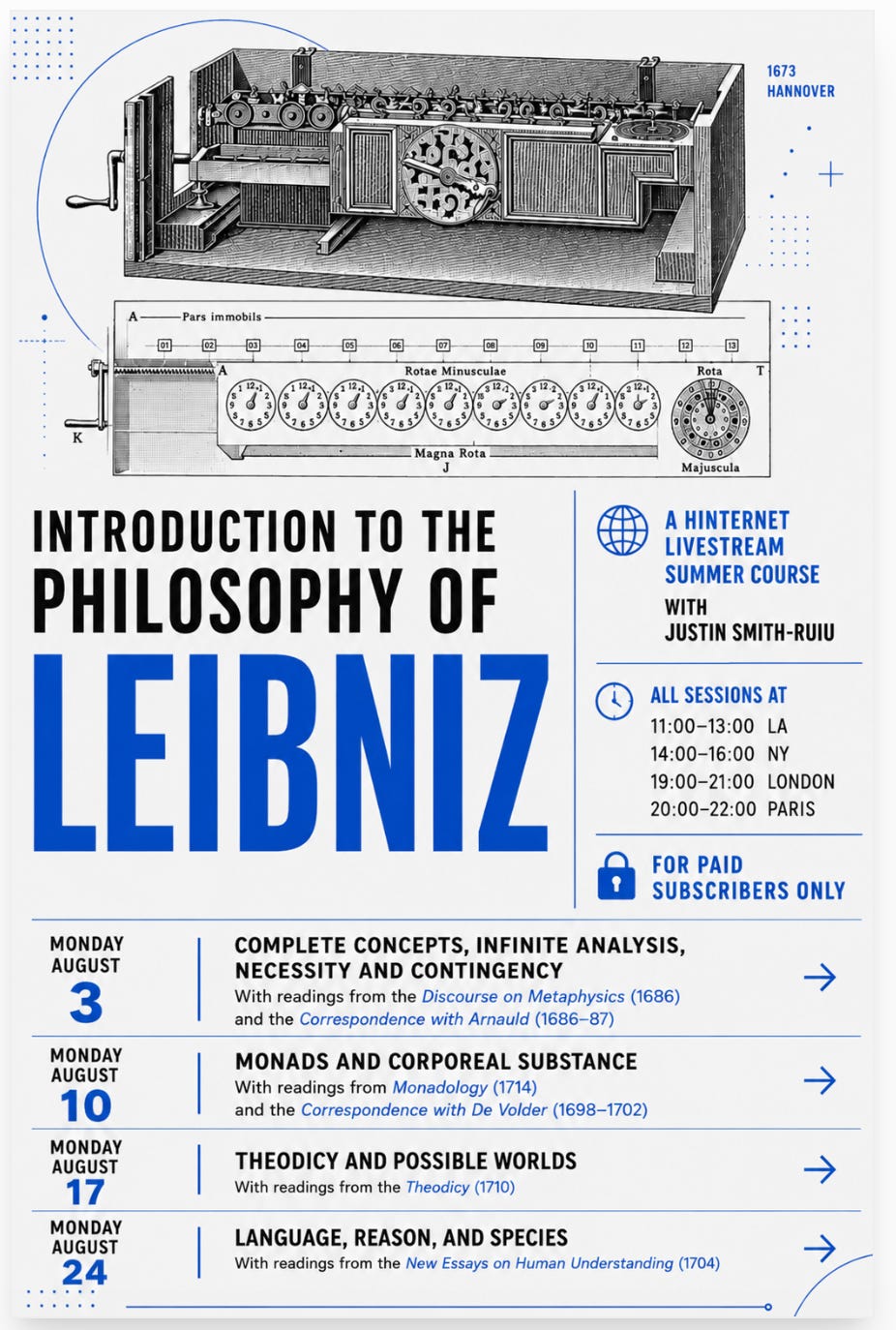
Finally, as if you did not already have enough reasons to upgrade to a paid subscription, we remind you that beginning in August JSR will be hosting another series of livestreams, this one relatively more formal and course-like than the current salons frequented by our juilletistes, on a certain German philosopher of some importance to him. Here’s the schedule; we hope to see you there!
NOTE NEW DATES FOR LEIBNIZ COURSE (Previously scheduled on Thursdays in August, now on MONDAYS)!


Where can we find the livestream recording from last week on Motuo?