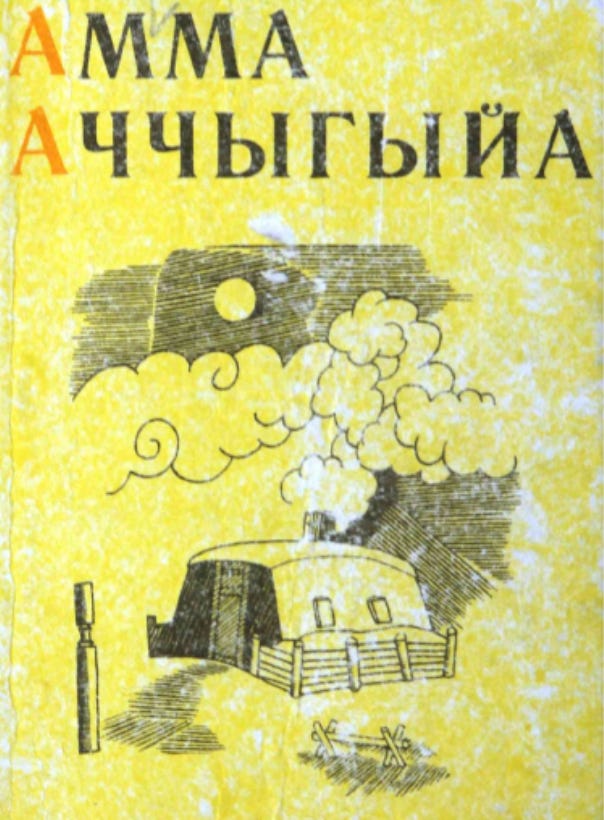
Amma Achchygyïa is the pen name of the Sakha-language Soviet writer Nikolaï Mordinov (1906-1994). A poet, critic, and novelist, Achchygyïa was also the translator into Sakha of Tolstoy and Chekhov, among other Russian-language authors.
As some readers will know, I have co-translated, along with Liubomira Romanova, significant portions of Olonkho, the Sakha-language oral epic tradition that began to be transcribed in the late 19th century. These translations will appear, at some point, in the World Literature in Translation series of the University of California Press. “Motuo”, first published in 1928, is my first complete translation of a work of modern Sakha literature, as well as my first solo translation. The effort behind it might not show, but these nine pages have taken me several months, often advancing with no more than one sentence per day.
In all my previous translation projects, mostly of philosophical works into English from Latin, French, and German (as well as some literary translation from Russian), I generally had a sense of translation as, in the end, a sort of science — a set of algorithmic rules whereby, if one knows the grammar and the vocabulary, one also knows what must follow. But one must leave all that behind with Sakha, and concede that it is an art. The grammar is just too different ever to allow one to conclude that the “correct” rendering in English has been found.
I’ll have more to write about this story at some point. I would call it mostly a work of sentimental realism with some hints of Chekhovian influence, following stylistic rules laid out by apparatchiks in Moscow, but, happily, without any tedious ideological messaging. I did a livestream about the work in July, when I was perhaps somewhat more convinced of its high literary value than I am now. What I still love about the story is how rich it is in cultural details — going to live with neighbors during the famine, the old woman worried about being bullied by the neighbor’s wife, and so on. The gender ideology of it all is particularly interesting as well. With all this cultural background presupposed, it was often a tremendous challenge to figure out what was in fact going on, and I’m still not sure, in some spots, that I’ve entirely understood. I’ll follow up with some more extensive commentary at some point, and perhaps some of the remaining mysteries in the text will become clear to me over time, as I continue practicing Sakha translation.
Finally, let me note that LLMs are basically of no help here, as you can see for yourself if you like. I did it all myself — which in this case is not necessarily a virtue, but simply a necessity. For a while I had thought that the LLMs simply hadn’t got around to mastering this “small” language yet, and that they surely would in time. Something Lisa Fagin Davis told my Voynich Manuscript students recently about machine-aided Voynich research caused me to rethink that. LLMs are called Large Language Models for a reason, and it could well be that for Sakha as for many other languages of the world there simply is not a sufficiently large corpus to train the machines on so that they will ever be able reliably to predict what comes next. This is in one sense a tremendous disadvantage for the subaltern languages (i.e., the great majority of languages) in the emerging information-technology landscape. It is also a great opportunity for those who want to practice the art of translation. There is still a lot of human translation left to be done. —JSR
Motuo
(The Story of an Old Man)
When I was a seventeen-year-old boy with five grades of schooling behind me, I myself taught school for a winter.
They provided a diminutive old house further on from the “real” school, and assigned me to the second grade. And so I set up my hearth and home there.
Once, during a bitter winter freeze with thick fog, I closed the stove’s flue very early and the fumes went to my head. So I wrapped a towel around it and, after opening wide the classroom door, I sat down to give my children their dictation exercise.
Just as I opened the exterior door covered in animal hide, the freezing fog swirled. Matryona came in.
I leapt up without finishing my sentence.
Stepping into the frame of the door, Matryona reached both her hands behind her and pulled it shut tight. Then, with a quick movement of the back of her hand, she quietly spread out her ice-white Arctic-fox hat and wiped the frost from it. Glancing toward the class with her limpid jet-black eyes drawn into relief by her long eyelashes flecked with frost, her face widening, still flushed red by the cold, she stood there with her fresh young lips pressed together, smiling timidly.
All this happened deftly, delicately, and, after but little time at all, with a certain natural ease.
Not knowing how to be or what to do, I grew flustered. I stammered out two or three words of my dictation. Then it dawned on me I should end my class early. If I continue teaching so absent-mindedly, I thought, she’ll go away thinking I don’t know what I’m doing.
So then, after muttering something thoughtless, “hang on” or “sit tight”, I went out of the classroom.
At the end of the corridor, bent over a table, she seemed to be tracing something with the tip of a matchstick. I quietly approached. “Speak, Matryona Romanovna.”
She sighed, suddenly straightened up, and rubbed the spot where she had been tracing with her palm. Then, gaining her composure, she quietly moved from the table, putting the match back into its box.
“No. You speak.”
“No.”
“What happened to your head? You look frightening…”
She had come from home. Perhaps she was on her way to visit her older sister, who lived a verst from the schoolhouse.
“What are you doing here?” I asked bluntly.
She stood up silently, and calmly said:
“Is this place off-limits? … I wanted to see your school.” Pausing suddenly, she stood examining me with her pitch-black eyes, then said with an indignant voice: “I came to see you… Yourself… Now remove that towel!”
I pulled the towel from my head at once.
“The fumes went to my head. It was hurting terribly. It felt like I was going to die. If I died would you feel sorry for me?”
“Who knows… Probably…” Without finishing her thought she stopped and stood listening to the children chattering in the classroom. Then she said: “No, you know what? Feeling sorry for a dead person... That’s not going to save him…”
Then she stood with her eyes downcast, as if forlorn.
“Motuo!” I could suddenly hear myself saying in a playful spirit.
“What?!” she shot back quickly. But then the name registered, she remembered, and smiled as she said: “I’m not Motuo anymore. It’s been Motu-ruo-na for two or three years… Now get back to your teaching…”
Not yet broken in by the high culture of sharing greetings upon seeing someone and farewells upon parting, or of offering a guest a seat, I began to shuffle off to my class.
“I took this…”
I turned and looked: she was standing there and holding up, with the tips of her delicate fingers, a matchbox with an image of a lark fluttering its wings and singing.
“Well take it… It’s a gift from me, Motuo-Moturuona!”
I went into my classroom. Matryona passed casually through the open doorway, casting a sidelong glance at the pupils. The cold fog came swirling in as the hide-covered door silently gave way...
Reticence and depth of feeling cannot spring from different sources. Still, a very troubled person or a very happy one is in no position to hold forth with any clarity. It has now been a full twenty years since I laid eyes on this Motuo girl — Matryona Semyonovna. I haven’t forgotten. But have I told it to you yet in a way that you will not soon forget? Well, no, apparently.
When recalling what happened twenty long years ago, telling stories of the paths gone down in life, does it sound so different from the stories others tell? How could it?
Whether I can explain it, I don’t know. I’ll tell the story to the best of my ability; you just listen.
For the first time that day my heart began to long from its depths for happiness. I became overjoyed, excited, longing for something. I wished to become more broad-minded and purer of heart. That’s when you begin to grow. Never being satisfied with yourself, never resting content. Love and care for yourself, but don’t settle into who you are, keep striving towards what’s ahead for you, reaching new heights...
Well, I can’t say.
That day, Motuo became a scintillating flame, beckoning me to her, making me not want to let go.
I lay thinking about her until the sky began to brighten, then rose happy in the thought that she was somewhere close, very close to here.
How is that?
Allow me to speak without polishing my words; you just listen…
I.
The Kedelji alaas and the Baatty hill are separated by a narrow, wind-battered, ridge whose crest is crowned with tall trees. On entering this narrow forest, neither the hill nor the alaas can be seen. But if you continue a little further the mountains suddenly open out before you. Towards the East is the Baatty hill, and towards the West, the Kedelji alaas.
This is what I did every day of my childhood. Every day. Still, whether it was the hill or the alaas that suddenly opened out before me, I was always struck with happy awe. I would run down the ridge with my hands outstretched. To go running about there somehow made me feel like I could magically take to the sky, hovering there over the alaas and the hill. As if I could magically fly…
It’s like that with everything. The happiness you have so ardently desired your whole life seems to be right here, very close by. At this very moment you are ready to say the most needful words, the words that give strength to those who have been worn down by life, the words that bring joy to the despondent. At this very moment you are ready to trace the most delicate of lines, a line that makes inanimate wood, iron, and stone glimmer as if alive, that captivates everyone and beckons them toward joy. So then…
Sometimes I imagined myself digging out the dividing ridge with a great big iron shovel and tossing the earth far away. I imagined myself joining the great alaas together with the great hill, opening up a single vast expanse…
On the side of the ridge towards Baatty, in a very narrow, sloping spot, there stand very close to one another the winter and summer houses of Roman Semyonov. In the winter they put the frozen milk and the prepared grain in the summer house. In the summer they boil the milk, prepare the grain, and dress animal hides in the winter house. Roman’s family keeps strictly to itself, with no coming and going. No one knows how many stacks of hay they made this year, how many bales tied; and what about their slaughter stock, and how many milk cows?
In a year of hunger and famine my grandmother went “to speak with” Roman’s wife. She took my brother with her, a boy of four or five.
Though I missed my brother and grandmother terribly, being at that age quite afraid to stay with strangers, I did not have to wait long. Soon my grandmother came hurrying back, all worked up, to fetch me.
It was a moonlit evening. Repeatedly kicking with her soft leather boots, which had frozen so that they now glided like skis, clomping up the ridge, my grandmother began to mutter under her breath:
“Forgotten his grandmother already. There’s no end of worry with this child. Already fading from my eyes.”
When she caught sight of me, I was flustered by what she had said, as if her worry was justified, and in order not to cry I went and kicked the crumbled frozen horse droppings in the road, sending them rolling off into the distance.
“In another ten years they’ll have grown up. I’ll be in the ground by then, no doubt. It would be a mercy to die while still on one’s feet. I’m already disappearing from their sight. And now I’ll be shut away here. God’s not letting me go.”
“We’re actually going to have our own plot, and now she’s begging God to take her away? Of all things!”
Although I said this very defiantly, in a shrill tone, I was myself defeated. In order to calm down, I went to take a look around the place.
The hoary branches of the frozen trees were sending the light shimmering spectacularly, as if hanging in the middle of a church.
Baatty hill, as always, suddenly appeared, expansive. Sparks from the stoves of the household to which we were headed flared up before us.
Off in the distance, in a far corner of the valley, the smoke of two or three households stretched straight up to the sky. A few black and grey horses stomped their hooves as they stood eating at the haystacks and ivy. On closer inspection, there appeared to be many of them. The white horses appeared faintly yellowish against the snow.
“No cutting the grass or gathering firewood, no hunting, this old woman is going to have a plot? I’m just going to sit at home, surely… His wife is going to torment me.”
“Well then I’ll show her!”
“How’s that?”
“I’ll give her what she deserves!”
“Oy, you are an idiot! Is he going to sit at home all day watching over us? After he leaves for work, is his wife not going to make my life hell?”
“Well then I’ll show her hell. I’m going to be there too.”
Striking a threatening pose towards my imaginary wife, rubbing my sleeve against my thigh to work my hand free, holding up my fist as if ready to strike a blow, I began to walk about like a brute with my belly protruding.
“What a calamity! Forget about it, don’t upset your dear one on account of some devilish old lady, friend… It will make your children cry… They’ll take their mother’s side…”
As I think of “my children”, compassion, love, and my grandmother’s warm presence gradually soften my heart… My dear one, I suppose, the dear mother of my good children, will be sweet and tender of character, bringing joy with her radiant smile.
My grandmother straightens her worn-out scarf and wipes her nose and lips; her troubled thoughts briefly clear away, and she laughs joyfully, the acrid smell of leaf tobacco all the while tickling my nostrils; then she stops to kiss and embrace me.
Then we get moving again. A spotted dog with floppy ears runs towards us on the road, scurrying along on its little paws, and suddenly stops with one of its legs lifted.
Taking a piece of wood from the ground, I run towards the dog. It squeals and jumps back. Stumbling on the sloping incline, I go on running at full speed.
My grandmother continues saying something.
The dog, leaping onto the hard-packed snow of the yard, suddenly begins barking frantically.
Now I am the one who jumps back. My grandmother, always there for me at critical moments, comes running up all flustered.
The dog, returning to habit, growls again and runs off toward the stacked hay, shaking its long matted coat.
On entering the house, I pause apprehensively in the doorway. And just then, from out of a dark corner comes the tender-hearted voice of my little brother, saying, “Bro-o-ther!” All the people inside the house come to greet us, invoking the good spirits and asking for their blessing.
“Ooh, so he’s come too? Why, if he isn’t at his grandma’s side at every moment. She brought him along in the end! Only recently he was just this big, and now he’s quite the little man, carrying himself like a grown-up.”
In a late-night game of atakh oron on my grandmother’s bed, as we sit playing and laughing while my brother hides from us, a little boy of three or four comes to the projecting edge of the curtain and stands there smiling as he stares at me with his wide eyes. When we laugh, he laughs too, showing a straight row of teeth. Coughing deliberately, he kicks tentatively at the curtain with his foot. My brother and I, reunited after difficult separation, pay him no mind. Looking upward just so, the child suddenly cries out “Ga-la-ba bal-sha-ya!”[1] in a very high-pitched voice and runs off to the left with his head thrown back.
“Motuo, girl!” they said. “There she goes speaking Russian again.”
“Ah, well then, it’s a girl,” my brother whispered.
They had wanted a boy forever, but their boys kept dying suddenly, so in their desperation they began raising the smallest of their three girls, Motuo, as a boy.
And what a lovely person, Motuo! On her day of baptism she was christened as Matryona. From the next day she became Motuo. They had shaved her perfectly round head bald, bundled her up thick like a boy, with wide limpid eyes and crooked brows: a boy! Only her high voice and her restrained laughter distinguished her from a boy in any way. By the next day she had become our friend.
I remained in that family with my grandmother, and went to school with the middle daughter, Sanya.
Our teacher had recently married Mariya, the eldest of the three daughters. On Saturdays they came bobbing up on a spirited bay horse that looked like a lion, stayed the night, and left again.
The tall, thin, pale woman, never saying a word that leaves an impression on the mind, talking a great deal, laughing and joking, was forgotten as soon as she left. She was constantly saying: “Oh my, what people!” “Such a piece of work!” “Oy, what’s this then?”, or, jumping up on a chair in front of her husband, she’d say: “Oh, look, if I were this tall you’d look up to me!”
Sanya was one year older than I, a terribly skinny, long-limbed girl, supple as a willow. She was a person of few words, peaceable, like a child, never indulging herself in fantasies or making any fuss. Her beautiful slightly sloping eyes smiling warmly, she would jut forward her lower jaw with its uneven teeth, her long face growing longer still as she let out a sudden short laugh: “hy-hyk!” Standing with one foot planted firmly, we used to drag the other foot around in a circle, making an “ice-hole” in the snow; then, spreading out our arms, we would fall into the snow and leave an imprint of our bodies. Sometimes the boys accompanying us teased her flirtatiously. If we got the better of them we shoved them into the snow. If they got the better of us, Sanya took offense at some little thing and began to cry. Then the boys would run off. As they ran Sanya laughed: “Hy-hyk, the poor fools believed it! As if I’d cry at you over a little thing like that!”
I was a mischief-maker, always imagining things that aren’t real and dreaming up fantasies of all kinds. She swiftly nipped this talk in the bud, with the truth of everyday life.
“Sanya,” I’d say, “when you’re ready to get married someday, I’ll be there for you.”
“Pah! What nonsense you’re talking. That’s the last thing I need, my boy!”
“Look, Sanya, if we had wings, we could just flap all the way to school.”
“Won’t your hands get tired? Better just to walk calmly…”
“They say in the South there are sleds that move on their own without being pulled by horses. We’d be racing in one of those…”
“How many years are you going to spend clearing the forest, my boy? … Your road won’t be ready until ten years after we’ve finished school.”
Our conversations went on like this, unable to develop any further, until they suddenly ran dry.
But Motuo was full of things to say. She liked to tell stories and to converse. And she especially loved to look at books. Every evening she was eager to find a way to get her hands on my one old worn-out book and have a look at it. The moment I got distracted while reading my lesson, she took my book and sat down to look at it, mumbling to herself the while. Or she tucked it under her arm and quietly sidled off to the left. If you asked her sweetly she brought it back to you without hesitation. If you snatched it back angrily, she took offense and gave you a piece of her mind. “Even so, you could at least share your book with me, couldn’t you!”
At that I could not fail to give in. Rather than just showing her my book, I explained to her what it said. Indeed my explanations went well beyond what it said. The ducks, the hares, the butterflies: they were all speaking now, experiencing joy, enduring hardships, coming to each other’s aid.
I don’t know why I became so attached, but for many years I loved that child, Motuo, thinking well of her and regarding her with affection.
II.
Days and years passed. Motuo grew up good and strong. From the closely shaven head of her childhood, there now grew abundant waves of long hair, which she combed into a part as it hung down, then wove into luxuriant braids. After finishing the fourth grade she remained for some years at home.
She was no longer Motuo. Now she was Moturuona.
In the summer we crossed paths in the forest where the alaas and the hill meet. We did not greet each other, we did not speak, but averted our eyes and continued on our respective ways.
Five or six of us boys had been going raucously through the deadwood forest, where clusters of blackcurrant bushes had sprung up and spread on the edge of the Kedelji alaas, when we came upon a group of girls out picking. One of the girls had spilled her blackcurrants, and they were all bustling about to collect them.
“May we help you pick them up?” we said.
“We can manage just fine.”
“We could start over again and pick enough fresh currants to fill your container.”
“We can manage just fine. ‘Fill your container’, indeed. Get out of here!”
One light-footed, bold girl showed particular resolve.
Moturuona sat on a felled larch, silently resting her chin in her hand. Her thick eyebrows, which almost came together in the middle, suddenly quivered, and her black eyes like ripe blackcurrants playfully smiled through the beams of light. The bold girl managed to sit there holding in her laughter while signaling to us not to say a word.
We went noisily on our way.
On the path between the alaas and the hill, in the middle of a broad hayfield, at the edge of a clearing where the grain has turned yellowish-brown — wherever you come across her, it is like this…
The boy and girl who had played together when they were little, in that dim distant settlement, stopped speaking to one another once they passed the age of ten.
Vile rumors would no doubt spread about “the girl who wrestles on an equal footing with the boys”, “the girl who laughs heartily along with the boys”. How much less would it be fitting to stop and talk if it were in the middle of the forest valley that they happened to run into one another?!
When by chance I ran into Motuo —who, having become Moturuona, now had to hide her perfectly lovely little smile— I recalled the little girl with the closely shaven, neatly rounded head, dressed in boy’s clothes and with a boy’s manner. And the first words she spoke to me! “Ga-la-ba bal-sha-ya!” And then when she took offense and said, “Even so, you could at least share your book with me, couldn’t you?!”
When I ran into her, I wanted to position myself squarely across her path and… and, as all the young larches of the forest rejoiced, I wanted my words, coming up straight from the bottom of my heart, to make her sway along:
“Ga-la-ba bal-sha-ya! Motuo-Moturuona, my baby bird! You could at least speak with me, couldn’t you? …” Could I ever say this?! Having become a young man, now it is somehow horrid for me to speak with a young woman…
III.
Then she came to my school to pay me a visit.
From that day everything around me was better, more beautiful. The children I was teaching, my narrow room, my warm stove, the snow outside, the sun in the sky — all of it shone brightly, came alive, became beautiful…
A few days later, having rested at home on Sunday and risen early the next morning, I set off to school, singing whatever song came to my lips, and as I went along, driving briskly and approaching my school, I caught up with a boy from the class and sat him down in my sled.
“What’s going on, friend?”
“Nothing. Just that Moturuona died last night.”
“Motuo, you say, boy?”
I was completely stunned, choking on the frosty morning air.
“She fell ill, having caught it from her older sister. She lay suffering with pneumonia for three nights.”
* * *
That summer, the day before I was to leave for the city to study, I dropped in at their house. The family had gone off to work. Only Motuo’s grandmother was there, an old woman sitting and crying alone, holding the matchbox with a lark fluttering its wings and singing.
“Who’s that coming in? … My child. Motuo took my hand in the middle of the night and... and, at the first dawn of light… she was taken from this world.”
Truly, it was as if she’d just gone out to herd the cows or to pick blackcurrants, and might come back in at that very moment with her beaming smile.
I sat and waited.
Motuo did not come.
Then, with the old lady sitting next to me, slumped over in half-sleep or in grief, I quietly stepped outside.
Since that evening a full twenty years have passed. For the sake of beautiful modest girls who have not been taken from this world at the first dawn of light, never to return, I have traveled far and wide, rejoicing and working alongside many people building happy lives.
If somehow, somehow, you could again meet the modest girl who has gone from this world, beckoning you like a bright flickering flame, you might caringly, warmly enclose her soft delicate-fingered hand between your palms, and speak amicably and modestly according to the counsel of your heart.
Perhaps if she had not passed by her sister, if she had not returned home, you would have gone down the long path of life together, hand in hand, my young friend…
МОТУО
(Кырдьаҕас киһи кэпсээнэ)
Мин, биэс кылаас үөрэхтээх уон сэттэлээх уол, биир кыһын учуутал буолбуттаах этим.
«Ыйаахтаах» оскуолаттан тэйиччи быыкайык эргэ дьиэнэ биэрдилэр, иккис кылааһы анаатылар. Туспа буруо таһааран, ыал буоллум.
Биирдэ, кыһыҥҥы түптэлэс тымныыга, оһохпун олус эрдэ сабаммын, угаардаан, төбөбүн былаатынан бобо тардынан, кылааһым аанын тэлэччи аһан баран, оҕолорбор диктант суруйтара олордум.
Арай тирии бүрүөлээх тас аан аһыллан, тымныы тумана өрүкүс гына түстэ. Матрена кыыс киирэн кэллэ.
Мин, этэн испит тылбын ситэрбэккэ, кэлэҕэйдээбитинэн ойон турдум.
Матрена аан холуодатыгар үктэнэн туран, икки илиитин кэннинэн уунан, халҕаны чиҥэтэ тардан кэбистэ. Онтон кырса тыһа муус маҥан бэргэһэтин илиитин көхсүнэн оргууй силэйэ охсон, кырыатын сотунна. Кырыа кыырпаҕа сыстыбыт уһун кыламаннарынан кэрэлэммит ып-ыраас ыас-хара харахтарынан кылаас диэки көрөөт, тымныыга ордук хойдо тэтэрбит сирэйэ кэтирээн, оҕолуу чэбдик уостарын ньимиччи туттан, килбиктик мичээрдээбитинэн ааһа турда.
Ити барыта сүрдээх сымсатык, нарыннык этиэх бэтэрээ өттүнэн дөбөҥнүк буолла.
Мин хайдах буоларбын, тугу гынарбын билбэккэ, булкулуннум. Диктаным икки-үс тылын сыыһа-халты этитэлээтим. Уруокпун бүтэрэ охсуохпун — сибилигин саҥардыы саҕалаабытым. Кыһамматах учуутал быһыытынан үөрэтэ олоруохпун — кини баран хаалыыһык, сатаан үөрэтиэ да суохпун быһыылаах. Хайыырбар сөбүй?..
Онтон — «бэйи эрэ» диэн дуу, «олоро түһүҥ» диэн дуу, — тугу эрэ быһаарыыта суох ботугураан баран, кылаастан тахсан бардым.
Көрүдүөр түгэҕэр баар остуолга төҥкөйөн, испиискэ маһын төбөтүнэн тугу эрэ суруйа турар эбит. Оргууй чугаһаан кэллим.
— Кэпсээ, Матрена Романовна.
Кини соһуйан, эмискэччи көнө түстэ, суруйа турбут сирин ытыһынан саба баттыы оҕуста. Онтон дьэ уоскуйан, остуолтан оргууй халбарыйда, испиискэтин хаатыгар төттөрү уган кэбистэ.
— Суох… Эн кэпсиэ.
— Суох.
— Төбөҥ туох буолла? Хата, киһини куттаатыҥ…
Кини дьиэтиттэн кэлбит. Оскуолаттан биэрэстэ олохтоох эдьиийигэр баран иһэр эбит.
— Манна тоҕо сырыттыҥ? — диэн толоостук ыйытар дууһа буоллум.
Кини саҥата суох турбахтаан баран, оргууй эттэ:
— Манна киһи сылдьыбат сирэ үһү дуо?.. Эн оскуолаҕын көрөн бараары. — Тохтуу түһэн, ыас харанан мэндээриччи одуулаһан турбахтаата уонна абаламмыт куолаһынан эбэн эттэ: — Эйигин көрөн бараары… Эн бэйэлээҕи… Былааккын бырах!
Өс киирбэх былааппын төбөбүттэн сулбу тардан ыллым.
— Угаардан, төбөм алыс ыарыйда дии. Өлөөрү гынным быһыылаах. Өллөхпүнэ аһыныаҥ дуо?
— Ким билэр… Бука… — Ситэ эппэккэ тохтуу түһэн, кылааска олорор оҕолор күүгэннэрин иһиллээн турбахтаата. Онтон эттэ: — Ол эрээри, өлбүт киһини аһынан да диэн. Кини онтон син абыраммат…
Ол кэннэ хайдах эрэ санаарҕаабыттыы умса көрөн турда.
— Мотуо!.. — диэн тэбэнэттээхтик эмискэччи ыҥырбыппын кулгааҕым истэн хаалла.
Кини сүр түргэнник: «Тугуй?» — диэбитинэн көрө түстэ, онтон өйдөнөн, мичээрдээтэ уонна эттэ:
— Мин аны Мотуо буолбатахпын ээ. Моту-руо-на бултум икки-үс сыл буолла… Чэ, бар кылааскар…
Көрүстэххэ дорооболоһор, арахсарга бырастыылаһар, ыалдьыты олордор сүдү культура сыста илик киһитэ — мин кылааһым диэки талырдыы турдум.
— Маны мин ыллым…
Эргиллэн көрбүтүм: кини намчы тарбахтарын төбөлөрүнэн ыллаан тарыкыныы сылдьар күөрэгэй чыычаах ойуулаах испиискэ хаатын күөрэччи тутан турар эбит!
— Чэ, ыл… Бэлэхтиибин, Мотуо-Мотуруонаа!..
Кылааспар киирдим. Матрена аһаҕас аанына кылаас диэки сиэлийэ көрөн мэндээрис гыннаран ааста. Тымныы тумана өрүкүс гынан киирдэ, тирии бүрүөлээх аан тыаһа суохтук былынна…
Этэр тыл эриэккэһэ уонна сүрэх иэйиитин эрчимэ тус-туспа төрүттээх буолуохтарын сатаммат. Ол эрээри олус кыыһырбыт эбэтэр олус үөрбүь киһи сатаан ыпсарыылаахтык эгэлгэлээн эппэт эбээт. Ити Мотуо кыыс, Матрена Семеновна, миэхэ көстө түһэн ааспыта 20 төгүрүк сылын быйыл туолла. Умнубаппын ээ ону мин. Оттон эн өйгөр бүгүн-сарсын умнуллубат гына кэпсээтим дуо мин? Суох дии, бадаҕа…
Сүүрбэ сылтан уһуннук өйдөөн сылдьар суолларын кэпсиир буоланнар, атыттар кэпсээннэрэ ордук тупсаҕай буолар дуо? Ити хайдаҕый?
Чэ, хайдаҕын-туоҕун мин быһааран таһаарарм биллибэт. Мин сатыырбынан кэпсиим, эн иһит…
Ол күн мин сүрэҕим аан маҥнай чахчы уһуктан, дьолго дьулуспутунан барда быһыылаах этэ. Тоҕо эрэ олус үөрдүм, өрүкүйдүм, туохха эрэ дьулустум. Бэйэбиттэн ордук, ордук киэҥ өйдөөх, ыраас сүрэхтээх буолуохпун баҕардым. Үүнэриҥ төрдө ол ээ. Бэйэҕин астыммат, бэйэҕинэн дуоһуйбат буолуу. Бэйэҕин таптаа, харыстаа, ол эрээри бэйэҕинэн муҥурданыма, инниҥ диэки дьулуруйан, өрө дабайдар дабайан ис…
Чэ, сатаан этиэ суохпун.
Ол күн Мотуо, сырдык тырым уот буолан, миигин сайыһыннара угуйан барда.
Халлаан сырдыар диэри кинини саныы сыттым, ханна эрэ манна чугас, сүрдээх чугас, кини баарыгар үөрбүтүнэн турдум.
Хайдах-хайдах этэй?
Мин ууһумсуйбакка кэпсиим, эн иһит…
I.
Кэдэлдьи алаас уонна Баатты хочото чараас тыаллах үрдүк арҕас халдьаайынан быысаһаллар. Ол чараас тыаҕа киирдэххэ, хочолоох алаас иккиэн көстүбэттэр. Аҕыйахтык атыллыыргын кытта хайалар да эмискэччи нэлэс гына түһэр. Илин диэки — Баатты хочото, арҕаа диэки — Кэдэлдьи алааһа.
Мин оҕо эрдэхпинэ күн аайы онон сылдьар эти. Күн аайы. Ол эрээри, хочо дуу, алаас дуу иннибэр эмискэччи кэлэс гына түстэхтэринэ, мэлдьи үөрүүлээхтик соһуйар буоларым. Илиибин быластаабытынан халдьаайыны таҥнары сүүрэр этим. Ол сүүрэн иһэн хайдах эрэ саталлаахтык өрө ыстанан кэбиспит киһи, алааһы-хочону үрдүнэн элиэтии көтөн талбаара туруох курдук этэ. Саталлаахтык эрэ өрө ыстаммыт киһи…
Туохха барытыгар да оннук дии. Эн дьулуһар дьолуҥ сааһыҥ тухары саманна, сүрдээх чугас баарга дылы. Сибилигин этиэххэ айылааххын саамай наадалаах тылы, саас-үйэ тухары сылайбыты эрчимирдэр, хомойбуту үөрдэр тылы. Сибилигин тардыахха айылааххын нарынтан нарын сурадаһыны, тыына суох маһы, тимири, тааһы тыыннаах курдуку тырымнатан, бар дьону умсугутар, дьолго угуйар сурадаһыны. Чэ, бэйи…
Эбэтэр ол билии халдьаайыны сүдү улахан тимир күрдьэҕинэн лөглү баһыталаан, ырыых-ыраах илгимэхтээн кэбиспит киһи дии саныырым. Улуу алааһы кытта улуу хочону холбоон, киэҥ куйаар оҥорон нэлэһиппит киһи дии саныырым…
Арҕас халдьаайы Баатты диэки эҥэригэр сүрдээх кыараҕас, иҥнэри сиргэ Роман Семенов кыстыктаах сайылыга тэллэх баттаһа тураллар. Кыһыныгар сайылык дьиэҕэ тоҥмут үүтү астаммыт бурдугу уураллар. Сайыныгар кыстык дьиэҕэ үүт кыынньараллар, бурдук астыыллар, тирии имитэллэр. Романнаах сүрдээх бүтэҥи олохтоох, кэлбэт-барбат ыал. Кинилэр быйыл хас бугулу оттообуттара, төһө түүтэҕи быспыттара, туох идэһэлээхтэрэ, хас ыанньыктаахтара биллибэт.
Биир сут-кураан сыл мин эбэм эмээхсин Романнаахха «кэпсэттэ». Бырааппын, түөртээх-биэстээх уолу, илдьэ барда.
Бырааппын, эбэбин ахтыы бөҕөнү ахтабын да, сааспар сылдьыбатаха ыалбыттан толлон, өргө диэри баарбакка сырыттым. Онтон эбэм бэйэтэ өрө күүдэпчилэнэн кэлэн илдьэ барда.
Ыйдаҥа киэһэ. Хайыһар курдук өрө мэтэрийэ тоҥмут этэрбэстэринэн сыыйыта тэбиэлээн халдьаайыны дабайан саллырҕайдаан иһэн, эбэм уоһун кытта быллыгырыыр:
— Эбэтин билиҥҥиттэн умнубут. Эрэйбин ылбахтаабыт оҕо. Харахпар көстүбэт буолан эрэр…
Кини хараҕар көһүннэхпинэ, эрэйэ боруостанар курдук саныырыттан ыгылыйабын, ытаамаары, суолга сылгы тоҥ киитэ бытарыйа сытарын ыраах үҥкүрүтэ тэбиэлиибин.
— Хаһан кинилэр улаатыахтарыгар диэри уон көс. Онуоха диэри миигинник баҕас буору кытта буор да буолаа инибини. Тура сылдьан өлөн хаалбыт киһи абыраныа этэ. Харахпыттан мэлийэн эрэбин. Букатын сабыллан хаалыам баар дии. Таҥара онно тиэрдибэтэр…
— Биһиги сирдээн сылдьыахпыт буоллаҕа дии! Аны өлөрүн таҥараттан көрдөстө. Эҥин-араас буолан!..
Мин наһаа «кырыктаахтык» чардыргыырга дылыбын да, бэйэм ордук хотторбун. Уоскуйаары, ол-бу диэки эргиччи көрүөлүүбүн.
Кырыа сүүмэҕирэ олорбут тоҥ мастар лабаалара таҥара дьиэтин ортотугар ыйанан турар люстра курдук тырымнаһа оонньууллар.
Баатты хочото, куолутунан, эмискэччи нэлэс гынна. Биһиги баран иһэр ыалбыт оһохторун кыыма аттыбытыгар кытыаста түстэ.
Ыраах-ыраах, хочо улаҕаларыгар, иккилии-үстүү ыаллар буруолара халлааҥҥа субуруһаллар. Кэбиһиилээх оттор, үөт талахтар тулаларыгар биир эмэ хара, көҕөччөр сылгылар табыйан аһыы сылдьаллар. Өйдөөн көрдөххө, элбэхтэр эбит. Маҥан сылгылар хаарга биллэ-биллибэттик араҕастыйан эрэ көстөллөр эбит.
— Оттообокко-мастаабакка, бултаабакка-алтаабакка ол кырдьаҕас эмээхсини сирдээн сылдьыахтара үһү дуу? Дьиэҕэ олоруом буоллаҕа дии… Ойохторо мөҕөн муҥҥуохтара буолуо.
— Оттон муҥнаан көрдүн эрэ!
— Хайыаҥый?
— Тоһун биэриэм ээ!
— Тыый, бу акаарытын! Кини мэлдьи дьиэҕэ кэтээн олоруо үһү дуо? Үлэлии барбытын кэннэ ойоҕо, өсөһөн миигин дьэ ордук сордообот дуо?
— Оттон сордоон көрдүн эрэ! Мин да баар буолуом!..
Кэнэҕэски ойохпор суоһурҕанан, үтүлүкпүн өттүкпэр сууралаамахтаан, илиибин сутуруктуу туттан баран, кырыктаахтык хааман «дыыдалдьытан» иһэбин.
— Бу үлүгэри!.. Кэбис, абааһы эмээхсин аайы доҕоргун атаҕастаама, доҕор… Оҕолоруҥ ытаһыахтара ээ… Ийэлэрин көмүскээннэр…
Мин «оҕолорбун» саныырбын кытта аһыныы, таптыы, эйэ сылаас тыына сүрэхпэр суоһаабытынан барар… Сымнаҕыыс-сымнаҕас майгыннаах, үөрэн мичилийэ сылдьар киһи буолуо буоллаҕа дии мин доҕорум, мин үчүгэйкээн оҕолорум ийэлэрэ барахсан…
Эбэм илбиркэй былаатын көннөрүнэр, муннун-уоһун соттор, быстахтык мунчаарбыт санаата көнө охсон, үөрэр-күлэр, сэбирдэх табах аһыы сытынан таныыбын кычыгылата-кычыгылата, тохтоон туран сыллыыр-ууруур.
Онтон эмиэ хамсаабыт. Налбыгыр кулгаахтаах эриэн ыт оҕото, суол устун утары сиэлэн нэктэрийэн иһэн, аҥар атаҕын өрө көтөхпүтүнэн тохтуу түһэр.
Мин, сиртэн мас ылбыта буолан баран, ыкка утары сүүрэбин. Кини, ыйылыы түһээт, төттөрү ыстанар. Халдьаайы ньылатынан тэмтэрийэн, сүүрдэр сүүрэ турабын.
Эбэм тугу эрэ саҥара хаалар.
Ытым, ыал чигдитигэр ыстанан киирэр да, соһумардык үрэн ньаргыйа түһэр.
Аны төттөрү ыстанааччы мин буолабын. Мүлчүргэннээх кэмнэргэ мэлдьи баар буолар үгэстээх киһи эбэм саба сүүрэн күөдэллэнэн кэлэр.
Сиэрин эрэ ситэрэн ырдьыгынаабыта буола-буола, ыт кыбыылаах от диэки илбириҥниир.
Дьиэҕэ киирэн иһэн, ааҥҥа чугурус гынабын. Ону тэҥинэн аан диэки хараҥа муннуктан быраатым уйаҕас саҥата «уба-ыый!» диир. Дьиэ иһинээҕи дьон бары айхаллыы тоһуйаллар.
— Оо, бу киһи дьэ кэллэ дуу? Эбэтигэр өрүү сылдьыбат ээ. Дьэ тутан аҕалла дии. Саҥардыы бачча этэ, обургу киһи буолан тоотойон эрэр дии…
Ыкса киэһэ атах ороҥҥо, эбэм оронугар, быраатым биһиги кистээн күлэн сыһыгыраһа-сыһыгыраһа, оонньуу олордохпутуна, үстээх-түөртээх кыра уолчаан быыс тумсугар кэлэн киэҥ харахтарынан миигин одуулаһан мылаллан турда… Биһиги күллэхпитинэ, кини эмиэ күлэн, тииһэ ытыгырыыр. Соруйан сөтөллүбүтэ буолар, атаҕынан быыһы тэбэн көрөр. Биһиги, бэйэбит ахтыһан баран көрсүбүт дьон, киниэхэ кыһаммаппыт. Өргө диэри ол курдук туран баран, оҕо сүрдээх хатаннык күөрэччи: «Га-ла-ба баль-ша-я!» — диэн хаһыытыы түһээт, хаҥас диэки сүүрэн мороһуйан хаалла.
— Хотуой, Мотуо! Эмиэ сымыйанан нууччалаабыта буолла, — дэһистилэр.
— Кыыс ээ итиҥкэҥ, — диэн ботугураата быраатым.
Саастарым тухары уол оҕоҕо баҕараллара, уол оҕолоро утары өлө турар буоланнар, абаккаларыгар, үс кыыстаахтарыттан кыраларын, Мотуону, уол оҕо оҥорон сылдьаллар эбит.
Дьэ, кэрэ киһи Мотуо! Сүрэхтэммит күнүгэр эрэ Матрена буолбут эбит. Нөҥүө күнүттэн ыла Мотуо буолбут. Лэри-лэкэгэр төбөтүн киччэччи кырыйбыттар, уол оҕолуу боспоччу таҥыннарбыттар, ып-ыраас киэҥ харахтардаах, хоп-хойуу токур хаастаах. Уол оҕо! Арай күөрэччи чаҕаарыйан саҥарара, быыһыгыраччы күлэрэ хайдах эрэ уолтан атыҥҥа дылы. Сарсыҥҥытыттан ыла кини биһикки атастыы буоллубут.
Мин ол ыалга эбэбин кытта олорон хааллым, орто кыыстарын Саняны кытта оскуолаҕа сылдьар буоллум.
Улахан кыыстарын Марияны саҥардыы биһиги учууталбыт ойох ылбыт. Субуоталарга хахайга маарынныыр дохсун тураҕас атынан сохсоҕолдьутан кэлэн, хонон бараллар.
Уһун синньигэс кубаҕай дьахтар туох да өйгө хатаран хаалар бэлиэ тылы саҥарбат, бэрт үксү саҥарар, күлэр-салар да, утарын умнуллан иһэр. Сотору-сотору: «Оо, дьэ, дьон бөҕөлөр!», «Киһи бөҕө!», «Тыый, ол хайдах?» — диэмэхтиир эбэтэр эрин иннигэр турар олох маска ыстанан тахсан баран: «Оо, көр, мин бачча буолларбын, эн миигин хантайан көрүөҥ этэ», — диир.
Саня миигиттэн биир сыл аҕа, сүрдээх хатыҥыр, уһун уҥуохтаах, иирэ талах курдук кыыс. Кини аҕыйах саҥалаах, көрсүө, оҕо курдук, арааһы фантазиялаабат, айдаарбат киһи. Ыйаастыгас соҕус кэрэ харахтара эйэҕэстик мичээрдииллэр, дэхситэ суох тиистэрдээх аллараа сыҥааҕын энньэччи туттан, ньолбоҕор сирэйэ өссө уһуу түһээт, кылгастык «һы-һык» диэн күлэн кэбиһэр. Аҥар атахпытын биир сиргэ үктээн туран, биир атахпытын соһо тардан эргичийэн хаарга «ойбон» оҥоробут, илиибитин быластаан баран хаарга охтон киэп түһэринэбит. Ардыгар аргыстаһан иһэр уолаттар дьиибэлииллэр. Кыайыах буоллахпытына, хаарга түҥнэритэ анньыталыыбыт. Кыайтарыах буоллахпытына, Саня бэрт кыраттан сылтаан ытаабытынан барар. Оччоҕо уолаттар сырсан хаалаллар. Баралларын кытта Саня күлэр: «Һы-һык, сордоохтор кырдьыктаннылар ээ. Ити аайы эһиэхэ ытаабакка».
Мин мэникпин, баар суоллааҕар суоҕу улгумнук саныыбын, араастан фантазиялыыбын. Ону кини күннээҕи олох кырдьыгынан, аҕыйах тылынан сабыта быраҕаттаан кэбиһэр.
— Саня, эн кэнники эргэ бардаххына, мин эйиэхэ сылдьар буолуом, — диибин.
— Па! Күтүр, эҥин-эҥини саҥаран. Ол эмиэ тугум эрэй, нохоо!..
— Көр эрэ, Саня, биһиги кынаттаахпыт буоллар, оскуолаҕа дөбөҥнүк тайан тиийиэхпит этэ.
— Илииҥ сылайыа суоҕа дуу? Аргыый хаампыт ордук ини…
— Ата суох бэйэтэ сүүрэр сыарҕа соҕуруу дойдуга баар үһү ээ, Саня. Оннугунан сырылаппыт киһи…
— Хас сыл солуугун, нохоо?.. Биһиги оскуолабытын бүтээрпит кэннэ уон сыл буолан баран бүтүөҕэ ол суолуҥ…
Ити курдук кэпсээтибит кыайан сайдыбакка, симэлийэ турар.
Оттон Мотуо үгүс тыллаах. Кэпсиэн, кэпсэтиэн баҕарар. Кинигэни көрөрүн олус таптыыр. Киэһэ аайы мин соҕотох илбиркэй кинигэбин хайдах эмэ мүлчү туттаран көрө охсор дьулуурдаах. Уруок ааҕарым быыһыгар аралдьыйдарбын эрэ, кини хайыы-үйэҕэ кинигэбин ыла охсон аахпыта буолан ботугуруу-ботугуруу көрө олорор буолар. Эбэтэр хонноҕун анныгар кистии кыбынан, кырыытынан оргууй сыҕарыҥнаан, хаҥас диэки баран эрэр буолар. Сымнаҕастык көрдөөтөххүнэ, улгумнук аҕалан туттаран кэбиһэр. Кыыһыран мүлчү тардан ыллаххына, хоргутан, арааһы саҥарар. «Ама да эн бэйэлээх буолтуҥ иһин, сатаатар кинигэҕин көрдөрө түһэриҥ баҕалаах!»
Оччоҕо мин тулуйбаппын. Кинигэбин көрдөрүөхтээҕэр буолуох, бэйэм быһааран биэрэбин. Хата, мин быһаарыым алыс кэҥиир. Кустар, куобахтар, үрүмэччилэр — бары кэпсэтэллэр, үөрэллэр-көтөллөр, хардарыта аһыныһаллар, көмүскэһэллэр.
Туохтан ордук ылларбыппын билбэппин, Мотуону мин үгүс сылларга үчүгэйдик саныыр, эйэҕэстик көрөр гына оҕорҕоотум.
II.
Дьыллар хонуктар ааһан истилэр. Мотуо улаатан дьоройон истэ. Оҕо эрдэҕинээҕи киччэччи кыргыылаах төбөбүттэн өлгөм суһуох долгуннура үүнэн түспүтүн хайа тараанан мөлбөччү өрүнэн кэбистэ. Түөрт кылаастаах оскуоланы бүтэрэн баран, хас да сыл дьиэтигэр олордо.
Мотуота уурайан, аны Мотуруона буолан хаалла.
Сайын алаастаах хочо билии ойууругар көрсө түһэбит. Дорооболоспоппут, кэпсэппэппит, киэр хайысыһан аасыһан хаалабыт.
Кэдэлдьи алаас эҥэригэр моонньоҕон угун бөлөхтөрө өрөһөлөнө үүммүт куруҥ тыатынан биһиги, биэс-алта уол, күйгүөрэн иһэммит, моонньоҕоннуу сылдьар кыргыттарга тиийэн кэлэбит. Биир кыыс моонньоҕонун тоҕо түспүт, ону итигэстээн буллугунаһаллар.
— Биһиги итигэстэһэбит дуо? — дэһэбит.
— Итигэстээн абыраамаҥ.
— Ити кэриэтэ саҥа үргээн иһитии толорон биэриэххэ.
— Үргээн абыраамаҥ. «Толорон биэриэххэ» буола-буола. Бара туруҥ!
Биир дьылыстаммыт хоодуот кыыс ордук дьорҕойор.
Мотуруона охтубут тиит үрдүгэр саҥата суох сыҥаах баттанан олорор. Силбэһэ сыспыт хойуу хаастара күөгэс гынан хамсыыллар, буспут моонньоҕон курдук хара харахтара мичээрдээх сардаҥаларынан оонньууллар. Сытыы кыыс биһигини «тыла суох» ыыталыырыттан кини күлэрин туттуна сатыы олорор.
Биһиги ааһан аймалаһа турабыт.
Алаас-хочо быыһынааҕы ыллык суолга, киэҥ ходуһа ортотугар, саһарчы буспут бурдуктаах солооһун кытыытыгар — ханна да көрүс — ити курдук…
Оччотооҕу боруҥуй, ыраах нэһилиэккэ кыраларыгар бииргэ оонньообут уоллаах кыыс, уоннарын туолаат, кэпсэппэт буолан хаалаллара.
«Уолаттары кытта тэҥҥэ тустар кыыс», «уолаттарга чачыгыраччы күлэр кыыс» диэн сидьиҥ-ньуччураан сэһэн тарҕаммытынан барыа буоллаҕа дии. Эгэ тыаҕа-толооҥҥо иккиэйэҕин көрсөн баран тохтуу түһэн кэпсэтэр кэлиэ дуо?!
Кэрэттэн кэрэ мичигин кистиир кыһалҕаҕа сылдьар Мотуруона буолбут Мотуону көрсө түстэхпинэ, мин киччэччи кыргыллыбыт лэкэгэр төбөлөөх, уол оҕолуу таҥастаах, уол оҕолуу быһыылаах-тутуулаах кыра кыыһы өйдүүбүн. Кини миэхэ аан маҥнай эппит тыла! «Га-ла-ба баль-ша-я!» — диэн этэ. Онтон: «Ама да эн бэйэлээх буолтуҥ иһин, сатаатар кинигэҕин көрдөрө түһэриҥ баҕалаах!» — диэн хоргутар буолбута…
Көрсүһэ түһээт, суолугар туора турунан кэбиһиэхпин баҕарабын уонна… уонна, ойуур титириктэрэ бука бары үөрэн сэгэлдьиһэ түһүөхтэригэр диэри түөһүм түгэҕиттэн сүр чуордук этиэхпин баҕарабын:
«Га-ла-ба баль-ша-я! Мотуо-Мотуруона, чыычааҕым оҕотоо! Ама да эн бэйэлээх буолтуҥ иһин, сатаатар кэпсэтэ түһэриҥ баҕалаах…» Инньэ диирим кэлиэ дуо?! Эдэр уол буолан баран, эдэр кыыһы кытта кэпсэтиэм дуо, «сүрэ бэрт» буоллаҕа дии…
III.
Онтон ити кэлэн мин оскуолабар, миэхэ сылдьан ааста.
Бу күнтэн ыла мин тулабар туох барыта тубуста, киэркэйдэ. Үөрэтэр оҕолорум, кыараҕас хоһум, иттэр оһоҕум, таһырдьа хаар, халлааҥҥа күн — бука барыта ордук сырдаата, сэргэхсийдэ, киэркэйдэ…
Аҕыйах хонугунан баскыһыанньаҕа дьиэбэр өрөөн баран, эрдэ сарсыарда туран оскуолабар бардым, уоспар туох көтөн түспүтүнэн ыллыы-ыллыы, сылыбыраччы айаннатан оскуолабар чугаһаан иһэммин, биир үөрэх уолун ситэн сыарҕабар олортум.
— Кэпсээниҥ, доҕоор?
— Суох. Арай бөлүүн Мотуруона кыыс өлбүт…
— Мотуо дуо, нохоо?!
Сарсыардааҥҥы дьыбардаах сылгыҥҥа чачайа харан хааллым…
— Эдьиийин аахтан ыалдьан тиийбит. Үс хонукка сэбиргэх дьаҥыгар ыалдьан сыппыт…
* * *
Ол сайыныгар, сарсын сарсыарда куоракка үөрэнэ бараары сылдьан, кинилэр дьиэлэригэр ойон киирбитим. Дьон үлэҕэ барбыттар. Арай Мотуо эбэтэ, кырдьаҕас эмээхсин, ыллаан тарыкыныы сылдьар күөрэгэй чыычаахтаах испиискэ хаатын туппутунан, соҕотоҕун ытыы олорор эбит.
— Ким киирдиҥ бу?.. Мин оҕом. Мотуо түүн үөһүн саҕана маны илиибэр кэбиспитэ уонна… уонна сарсыарданан, халлаан саҥардыы сырдаан эрдэҕинэ… баран хаалбыта…
Кырдьык, ынах хомуйа дуу, моонньоҕоннуу дуу барбыта буолуо, мичилийэ көрбүтүнэн сибилигин киирэн кэлиэ диэх курдук этэ…
Мин көһүтэн олорбутум.
Мотуо кэлбэтэҕэ.
Онтон, нухарыйан дуу, муҥатыйан дуу, бүк түһэн олорор кырдьаҕас эмээхсини аттынан оргууй үктэнэн таһырдьа тахсан барбытым…
Ол киэһэттэн бэттэх сүүрбэ төгүрүк сыл ааста. Халлаан саҥардыы сырдаан эрдэҕинэ кэрэ, сэмэй кыыс оҕолор кэлбэт гына «баран хаалбат» буолалларын туһугар дьоллоох олоҕу тутар үгүс дьону кытта үөрэнэн, үлэлээн, мин киэҥ сирдэринэн сырыттым…
Хайдах эрэ, хайдах эрэ, сырдык тырым уот курдук, эйигин сайыһыннара угуйан барбыт сэмэй кыыс оҕону иккиһин көрсө түстэргин эрэ, кини намчы тарбахтардаах нарын илиитин икки ытыскынан сэрэхтээхтик, сылаастык күөйэ тутан ылаар уонна сүрэҕиҥ сүбэтинэн кинини кытта эйэҕэстик, сэмэйдик кэпсэппитинэн бараар…
Баҕар кини, эдьиийигэр да ааспакка, дьиэтигэр да төннүбэккэ, эһиги бииргэ үөрэн-хомойон, олох уһун суолун устун сиэттиспитинэн бардар бара туруоххут, мин эдэр доҕоруом…
[1] I.e., Голова большая, “big head” in Russian.
The Hinternet needs your support! Upgrade to a paid subscription now!
Upcoming Events
October 21. “Psychedelics, Consciousness, and the Humanities,” Justin Smith-Ruiu in conversation with Noah Feldman, Wasserstein Hall, Harvard Law School, 7pm.
October 22. Oort Cloud Review launch event, KGB Bar, New York City.
November 11. Oort Cloud Review launch event, Camden Art Centre, London, 7pm. REGISTER NOW!
November 23. Hinternet Foundation Inaugural Summit, La Gaîté Lyrique, Paris, 2pm-10pm. REGISTER NOW!
Hinternet Foundation Online Courses
November 3-December 15. “History and Philosophy of Astrobiology”. REGISTER NOW!
October 1-November 12. “Clavis: How the Voynich Manuscript Tells the Story of the Modern World.” IN PROGRESS!
August 7-August 22. Hinternet Foundation Inaugural Summer School: “Whither the Humanities?”