

The Sempitern JSR-20250 has been working like a charm ever since Chirag Shah got it up and running! Our internal voice-detector tools are giving its recent output 100% match scores, which means, in other words, that perfectly verisimilar reproduction of JSR’s style is now a reality, down to the very tiniest swerve, as we say, of his very most rarefied soul-atom. This is a style we previously would have called “inimitable”, but obviously no longer can. Whatever. The important thing is that JSR is getting the rest he needs down in the Hinternet offices’ “deep-freeze”; the mobile-unit JSR is out there in the world completing all those mundane tasks the world expects of him; and meanwhile the JSR-2050 is delivering that signature JSR-branded content our readers need. Everything is going according to plan! Nothing can stop us now! —The Editors
Prelude
I spend a great deal of time thinking about “faith, hope, and love” — what they share with one another, and what distinguishes each. I don’t think I’ll ever be smart enough to render the mystery of faith into words. By contrast I do have a book project that, as I envision it, will be divided into three parts, dealing successively with φιλία, ἔρως, and ἀγάπη, and making at least some original claims as to the common thread uniting these three aspects or inflections of love.
But that I have this project at all, that I joyously go about my work each day on the presumption of a future that includes books about love, or indeed books about anything, already implicates the third and most neglected member of our Pauline triad — hope. Let us pay attention now to this modest theological virtue, lest some reformist constituency get the idea, in view of its recent poor metrics, of phasing it out altogether.
But let us first set the scene with some preliminary reflections.
I.
In our most recent session I told my psychiatrist about The Oort Cloud Review. A proper course of psychotherapy, Freudian or otherwise, would surely have got around to this sort of thing already. But my contact with the mental-health profession is more limited: I check in once every two or three months to determine whether the current course I’m on, unmedicated and basically functional, is the best one. So I’ve got 50 minutes to summarize “how things are going” in the most general sense, an exercise that usually constrains me to talk about low-level matters, day-to-day operations, rather than about longer-term projects or ideas pertaining to purpose, to meaning in life, or to modes of existence. And yet it came to seem relevant to me, in aiming to give an accurate picture of “how things are going”, to get across that what I had experienced for some time as mental illness had either evolved into, or revealed its true nature as, a mostly salutary creative or artistic impulse.
It is a cliché when formulated so bluntly: I thought I was insane, but it turns out I’m an artist; I thought I was hearing voices, but those were in fact amicable greetings from the characters I was unconsciously in the course of inventing. The cliché becomes simply unseemly, for some, when it is learned that the “I” in question is a “middle-aged white man”1 with the closest thing one can have to job security in this crazy moment in history. But fear of embracing cliché, I see now, can itself significantly delay a person’s ability to lead their true life, and in this way can cause, as in my case, significant suffering. Most of us are prepared to recognize and applaud even the most gravely delayed cases of coming-out, when these fall under the familiar heading of sexual orientation or gender identity. But the truth is gender and sexuality are only the tip of the iceberg, and there are as many different ways to spend one’s life in the closet as there are unfulfilled lives. Almost everybody alive, in truth, is in some closet or other.

So I mentioned that I had, with significant collaboration, brought into the world a work of experimental science-fiction, and left it at that. All along, since well before I was prepared to accept as much, my psychiatrist had been encouraging me to consider that perhaps eccentricity is not the same as mental illness, that it’s perfectly okay to be an outlier with respect to all sorts of social norms and expectations; that it’s no big deal if you talk to yourself as you walk down the street and the main thing is that your conversations with yourself should be interesting (indeed they are); that the source of suffering is not simply the inability to conform to this world but rather that inability coupled with a sense of obligation or a desire to conform.
Because our interactions are so limited, what I actually do with my time, beyond being a “philosopher” and a “writer”, hardly comes up. One does not, as at least I see things, go to a psychiatrist with the expectation of showcasing one’s CV; though not everybody seems to agree. A while back I read something from a North American philosopher, who divulged online that he often talks to his therapist about how deeply he regrets the wide, dark shadow Brian Leiter casts over “the profession” with his punchy blogging; and I thought: brother, Brian Leiter, whom I myself really only read for the “Great moments in obscure rock ‘n’ roll” feature, is among the very last entities in the universe, after Mungo Jerry and Humble Pie themselves, that I might expect to come up in my consultations with mental-health professionals. That is just not at all how I understand their remit.
But recently it did come to seem to me that if not my academic work, then at least some of my more imaginative extramural projects from over the past few years, might not be entirely beyond the bounds of what a psychiatrist might wish to know about me. And so I let slip that I had moved mountains these past years —at least relative to the scale of action by which I had previously measured what is possible in my life— to bring the work in question into being. I was surprised when she in turn asked what the title of the work is, and even more surprised when, upon my answering “The Oort Cloud Review”, she Googled it right there on the spot, read for a moment, and then asked: “But who is Hélène Le Goff?” And I said, “Oh, that’s me. I mean, that’s one of my noms de plume” … and I could see, for just a split second, that she was inwardly reconsidering the earlier confidence she had brought to her distinction between eccentricity and insanity.
“It’s a fine line,” I said, as if responding directly to the thought I knew had overtaken her.
II.
The truth is I have many other causes to worry about my sanity, besides my imaginary friends and my artistic conceits, that I have so far failed to address with my psychiatrist. I worry, for example, about how absolutely unhinged my “political” convictions, if you can even call them that, have become in recent years.
I have immense trouble positioning myself politically in any ordinary way. Long-time readers will know that much of my early Hinternet writing came out in a dissident key — dissident, at least, relative to the prevailing commitments of my progressive peers circa 2020. I saw the movement they were spearheading, and still see it, as annoyingly coercive at best, and incipiently authoritarian at worst. It took extreme resolve in those years simply to speak in public not only in a way that refused to affirm the content of their commitments, but even in a way that refused to ape their style, their manner and affect. One was practically required to speak in slogans. This horrified me, and I made what at least felt at the time like the risky decision of simply continuing to speak in my own voice. For a while this made me, in terms of social legibility, “anti-woke”, and for a while I had a good number of self-styled anti-wokesters take an interest in my writing, only inevitably to be disappointed upon figuring out that I wasn’t speaking in their voice either.
A significant faction within that camp defends the view that our world, as it is, is basically alright, and they therefore counsel the perpetually dissatisfied youths to “be normal”, to just pipe down a bit, to focus on common things like work and family and the small pleasures of ordinary life. I by contrast think this world is completely insane, and I think one can only be normal in it by allowing oneself to become a vessel of its insanity. And for evidence I cite many of the same evils that have likewise preoccupied the progressive left. I in fact would like to see prisons abolished, and the police, and militaries, and the entire Westphalian order of sovereign nation-states. These past years I have sometimes had crises so intense, upon recalling the mere existence of such things, as practically to collapse on the spot. I can’t believe it, I say to myself. I can’t believe it is still such raw force as these institutions represent, and not the love to which we are all called, that holds our world together. A few years ago I reviewed a biography of Derek Parfit, and dealt him some mild mockery for having once broken out in tears at high table upon being reminded of the casualty figures for World War I. But the truth is by then I, mostly unknown to myself, was behaving in much the same way.
Feasibility is the most neglected modal, as Isaac Levi said, and if I announce that the existence of prisons is morally unacceptable to me, this does not imply that I have a strategy for their immediate closure. But opinion polls and social-media algorithms never permit a person to supplement their commitments with any modal shading at all. It’s always, “Are you pro-choice or pro-life?” or, if there’s any more than that, it’s the pollsters imagining they have accommodated real-world complexity by adding further options such as “Undecided” or “No opinion”. And so the only way to affirm any particular commitment, or any cluster of commitments constituting what one takes to be a vision of a just world, is to enter into the futile agon of oppostions, to take up P or not-P in the eternal standoff of the P Wars. The Onion captured this predicament perfectly when it reported, in its mock coverage of the 1973 Supreme Court decision making abortion legal across the United States: “Bumper-Sticker Industry Applauds Roe v. Wade Decision”.
This predicament comes across most tragically in the case of environmental conservation. It is, I maintain, among the most astounding facts about this planet that it includes, for now, whales among its inhabitants. And yet the only pathway for many people, not all of whom will have all the power of human language at their disposal, to affirm the wonder of this in public is to allow themselves to be channeled into a constituency labelled and trivialized and bounded over the past several decades as the “Save the Whales” crowd. I suppose, if push comes to shove, that I must acknowledge that I am part of the “Save the Whales” crowd myself. But I am convinced that what it will take to “save the whales” is entirely to reshape humanity’s consciousness of its place in our multispecies planetary ecumene in a way that is simply not compatible with treating “Save the Whales” as one “political” commitment one might take up, according to taste and in view of preexisting scheduling commitments, alongside others.
This trivializing and dichotomizing structure into which all commitments must be entered preexists the internet. When I was in high school in the 1980s one was encouraged to join clubs. Among the clubs there was one for marine wildlife conservation, and another for nuclear arms control. One was applauded by the adults for such engagements, and assured that these activities would stand us in good stead with the college admissions officers, which in turn would set us along the road to a normal adult life such as their own. The available structure for expression of commitments, in other words, was the very same one that systematically rendered these commitments futile.
III.
Paradoxically, and beautifully, I have found that it was only when I truly began to feel the full horror of this world that I stopped living my life crippled by fear. Fear thrives in the soul of a person overly attached to perfect outcomes, to cinematic happy-endings like the ones vainly awaited by Annie in Sartre’s Nausea (1938). When you accept that life is a tragedy, when you really know in your bones that the worst outcomes are in fact likely, and not the betrayal of some promise the world had made to keep you safe and fortunate, then even the worst outcomes can come to seem, if not like no big deal, then at least somehow irrelevant to the question of how I should be feeling today.
Fear used to be diffuse and obscure to me. Now it is in fact very easy for me to name and enumerate my fears, and they turn out to be the familiar, indeed the classical ones. I am afraid of war, disease, and poverty. The latter two are fates I might encounter individually while others go on thriving; or that I might, as in conditions of pandemic or economic collapse, experience with others. Only war is something we may be guaranteed, for better or worse, not to experience alone.
I understand now that in my earlier life I had long succeeded in maintaining a security buffer between my world and the world of the men whose corpses lay strewn in the trenches of the Somme. Those photos are in black and white, I was able to tell myself, those are “Olde Time” photos, practically like the sepia-tone novelties you can get done at the mall dressed up as Al Capone or as a flapper; so what could they have to do with me? One begins to cry alongside Parfit, perhaps, the moment one sees the meaningless of such distinctions, when one understands that our evolving technologies give only an illusion of motion out of one world and into another, and that in truth the lives forced from those corpses had been as rich and real as one’s own.

We might also detect the spontaneous projection of such a security buffer in recalling those junior high-schoolers who for a time were compelled to go see Schindler’s List (1993), at the cinema, on class field-trips. The right-wing rags predictably steamed when, without fail, reports arrived from theater managers of savage brats snickering and fake-farting and so on throughout the gas-chamber scenes. Now I’ve never been one to make light of the Holocaust, but I did remain, to cite Ezra Pound (of all people!) somewhat out of context, “hard as youth these sixty years”, or at least fifty. For far too long, the combined swirls of eros and irony sustained a vortex around me like a force-field. Then, as if someone flicked a switch, the field disappeared, and I saw that I inhabited exactly the same world as every soldier, prisoner, or slave who has ever lived, and I began to cry and haven’t really stopped crying since.
And now when I hear people say things like “Just be normal and grateful to live in modern society with all its conveniences and comforts,” I understand that they are saying this because they are, or are trying to be, members in good standing of the society in which they have little alternative but to spend their lives. But that society, I’m sorry to have to say, is a psychotic death cult.
IV.
“[T]here are certain things you can’t get away from,” Saki has the Duchess say in “Reginald at the Theatre” (1910). “Right and wrong, good conduct and moral rectitude, have certain well-defined limits.” “So, for the matter of that,” replies Reginald, “has the Russian Empire. The trouble is that the limits are not always in the same place.”
Our Edwardian chronicler seems to have been born without the sort of buffer I have described, and his body of work might best be thought of as an effort to expose the fragile nothingness of English upper-class niceties that comes into relief whenever one stops to notice even for a moment the world beyond the manor house or the social club or the stables. Saki himself died in the Somme offensive in 1916, picked off by a German sniper, having volunteered for battle even though he was well past the age of mandatory service.
I was long aided in maintaining my buffer by a certain naively Fukuyaman attitude. I spent much of the 1990s jaunting around Russia as if on a victory tour. “Well I’m glad we got all that sorted out!” was my animating thought. “Borders fixed in place, markets integrated, Pizza Hut opened on Tverskaya Ulitsa! What could go wrong now!” I can remember an old man, a World War II veteran with medals still proudly displayed on the front of his cheap suit coat, telling me, in effect: “Not so fast. This is temporary.” And I thought: “Whatever, old man in a cheap suit. What does your world have to do with mine?”
It may be that those of us who came of age at the tail-end of the Cold War have had unusual difficulty learning to live in history again, though my deeper worry is that such learning has proved especially challenging not for any particular generational cohort, but for Americans. I see headlines like this one:
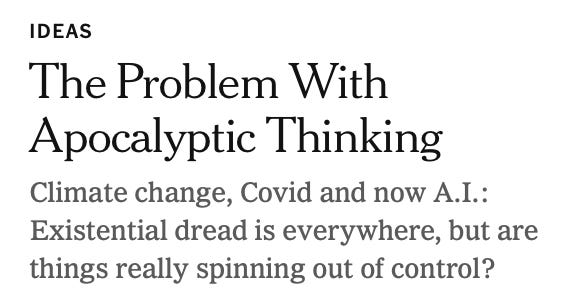
and I imagine a reader thinking: “Hmm, climate, pandemic, A.I… are we missing any other apocalypse scenarios here? Well, there was that one that was portrayed in Oppenheimer (2023) a few years back. But those people were wearing fedoras, they were practically dressed up like Al Capone for vintage photos at the mall, so clearly their concerns cannot be the same as ours.” What I myself think however is that part of the society-wide psychosis I have described is a form of traumatic repression that makes us fundamentally unable to confront the greatest risk that faces us: that the world is built up out of sovereign states that constantly seek to bend the others to their own will and, at the same time, that openly declare that they are prepared to destroy the world rather than to see their sovereignty compromised. The simple untenability of this arrangement over the long term is a brute fact about our predicament, but one too horrible to contemplate, and so public discourse channels itself into what are ultimately trivial distractions by comparison.
And I find myself wondering: Why isn’t there a proper peace movement for the 21st century. Why did real commitment to achieving perpetual peace play itself out roughly between Kant’s 1795 treatise deploying that phrase, and the outbreak of World War I? It would seem that if ever a crisis moment were to come along that might stimulate new thinking about the abolition of war and of the global political order that is built on war, it would be the present one, with its history-changing technologies and its complete reshuffling of our collective conception of what’s possible. But instead we’re distracted by details, and by the endless lurch of discourse from one news-item to the next, with no cumulative lessons, nor even any expectation of the eventual arrival of something like wisdom.

Last year The Hinternet hosted an essay-prize contest on the theme, “How might new and emerging technologies best be used to achieve perpetual peace?” The contest, I am willing to say now, was a failure. Eliminating the 90% or so of submissions written in that unmistakable zombie A.I. “white-paper” style, the remaining 10%, from human beings who may at least be commended for their effort, did little more than to invite us back into the social-sorting mechanism of bumperstickers and tweets, to establish that one is of the “From the river to the sea” camp, or instead of the camp that says “One does not negotiate with terrorists.” The lesson for me was that it is hard indeed, perhaps impossible, to push with any success for a particular vision of the good without allowing that vision to be bent into a blunt tool of discursive factionalism.
If therefore there is ever to be a proper peace movement, one that all of humanity might in principle recognize as being in its own interest, it will have to capture human hearts by other means than direct language. I have held back from saying so outright, because it seems so insane and I admit I haven’t run it past my psychiatrist yet, but a good part of me has begun to believe that the real aim of our efforts here at The Hinternet, though we have utterly failed so far, is to see if we can’t feel our way towards those other means. We are, I mean, unlike Hector Hugh Monro, decidedly in the camp of peace — but we refuse to discuss this position directly so long as you see it only as a camp.
V.
In the loss of my force-field there is at least something psycho-developmentally similar to the experience of the newly recovering addict. Substance abuse was certainly a problem in my earlier life, and while its overcoming is not the defining element of my newer life, I am nonetheless close enough to that narrative to experience real fellow-feeling when, for example, I read Hunter Biden’s regular reflections on addiction in the Substack Notes feed, and I think: “I love this self-absorbed Gen-X goofball. He’s just like me fr!” The first time I had this thought was long before the force-field came down, when reading an interview with Mike Tyson in which he effused about his own love for fellow recovering addicts, how it was only among them that he experienced a feeling of home, etc. I was still hard as youth, still judgmental as hell, still convinced that recovery talk was for losers; but malgré moi I found I liked what Mike Tyson was saying, I understood him, though I could not say why.

I am reminded of the time A. J. Ayer encountered Tyson at some party or other, right at the moment the boxer was preparing to subject Robin Givens to another round of cruel abuse. Ayer placed himself in Tyson’s way and sought to detain him, saying something like: “You are the world heavyweight champion, and I am the Wykeham Professor of Logic at Oxford. We are both eminent in our fields. Let us discuss our respective achievements.”
What Ayer missed is that Tyson had at least some interesting philosophical commitments of his own. The famous line, “Everyone has a plan until they get punched in the mouth,” for example, believed to have been uttered in 1987, was, properly interpreted, really just a variation on Sartre’s observation, in his Critique de la raison dialectique of 1960, that “in a football match, everything is complicated by the presence of the opposite team.” And this has at least something to do with an earlier and better-known Sartrean observation, in Huis clos (1944), that “hell is other people”.
I disagree, strongly — in fact I am convinced that other people, and the opportunity for enactment of love that they present, are our only real hope for redemption. Anyone who sees others as hell is living in a hell of their own, and unsurprisingly continues to lash out in cruel abuses, of the sort that are well documented for both Sartre and Tyson. The boxer, much more so than the French existentialist, seems ultimately to have understood the limitations of this attitude, to have understood that life itself should not be lived as a boxing match.
The problem though is that non-human, mechanical forces have structured our world in such a way that, like it or not, to promote any particular vision of the good is, as Pierre Bourdieu said of sociology, to consent to participate in a sport de combat. If to promote peace one must think strategically, one must watch the metrics, one must deploy the same tools and methods as one would in spreading war propaganda, the pacifist might justifiably come to believe that the most urgent thing for him to do is to model silent refusal of the terms of all social action. And the best way to do this, as far as I can see, might, to start, involve cultivating a form of life in which other people do not appear as envoys from hell. And the best way to do this, in turn, is to abandon any “plan” for which getting punched in the face might be experienced as a foiling. Turning the other cheek is of course terrible advice for a boxer. But boxers retire, eventually, if they’re lucky.
VI.
I’ve been trying to work my way towards at least some brief praise for hope, yet here we are in section VI and the reader would not be judged harshly for summarizing what has been said so far as Lasciate ogne speranza…
But hold on. Hope is not, cannot be, a “plan”. In order to see why this is so, it is essential to hold onto the ancient conception of hope as, precisely, a virtue, rather than to portray it as something like a doxastic state or measure of epistemic commitment.

However great my love for Leibniz, I find myself attracted to something I’m tempted to call a “negative theodicy” quite nearly opposite his own. I do not at all see the admixture of evil into our human world as evidence against divine goodness or justice. On the contrary, it is because this world is so mixed up in evil, while nonetheless we remain so fully capable of conceiving of a pure good, that it seems, to me anyway, clear enough that that conception cannot be derived from the world itself. This then has been the circumstance of my crash-landing onto the fortunate island of Christianity. I have asked: On what vision of our earthly condition does it make sense to continue to have hope for humanity? And I have found only one answer: On the vision that still makes sense even or especially on the presumption of humanity’s imminent annihilation.
In this regard one who has hope is not at all in the same state of commitment as one who is “optimistic”, or “feeling good about this”, or prepared to place a monetary bet on the desired outcome. Hope is what you might still meaningfully have when all bets are off, and what alone gives sense to the enduring commitment one must have, for now, to leading a life of joy and purpose.
Optimism —a thoroughly modern invention— seems to me an overextension of the calculus-making mind into consideration of a domain of human existence that was anciently examined more productively in terms of the doctrine of the virtues. Optimism seeks the rational ground of our present happiness in arguments from optimization, not altogether different from the mathematical demonstrations that might show you why a catenary hangs in just the way it does. But to be hopeful is not to be optimistic, and is perfectly compatible with seeing this world as, to say the least, less than optimally arranged.
Indeed the more time one spends meditating in a classical elpistological key, the more it can come to seem that the early-modern turn to optimization, of our rockets and reckoning-engines among many other things, is what got us into this whole late-modern mess in the first place.



I could contest each of these epithets on a variety of grounds — the first of them, for example, on the grounds that I am almost certainly not going to live to 108.