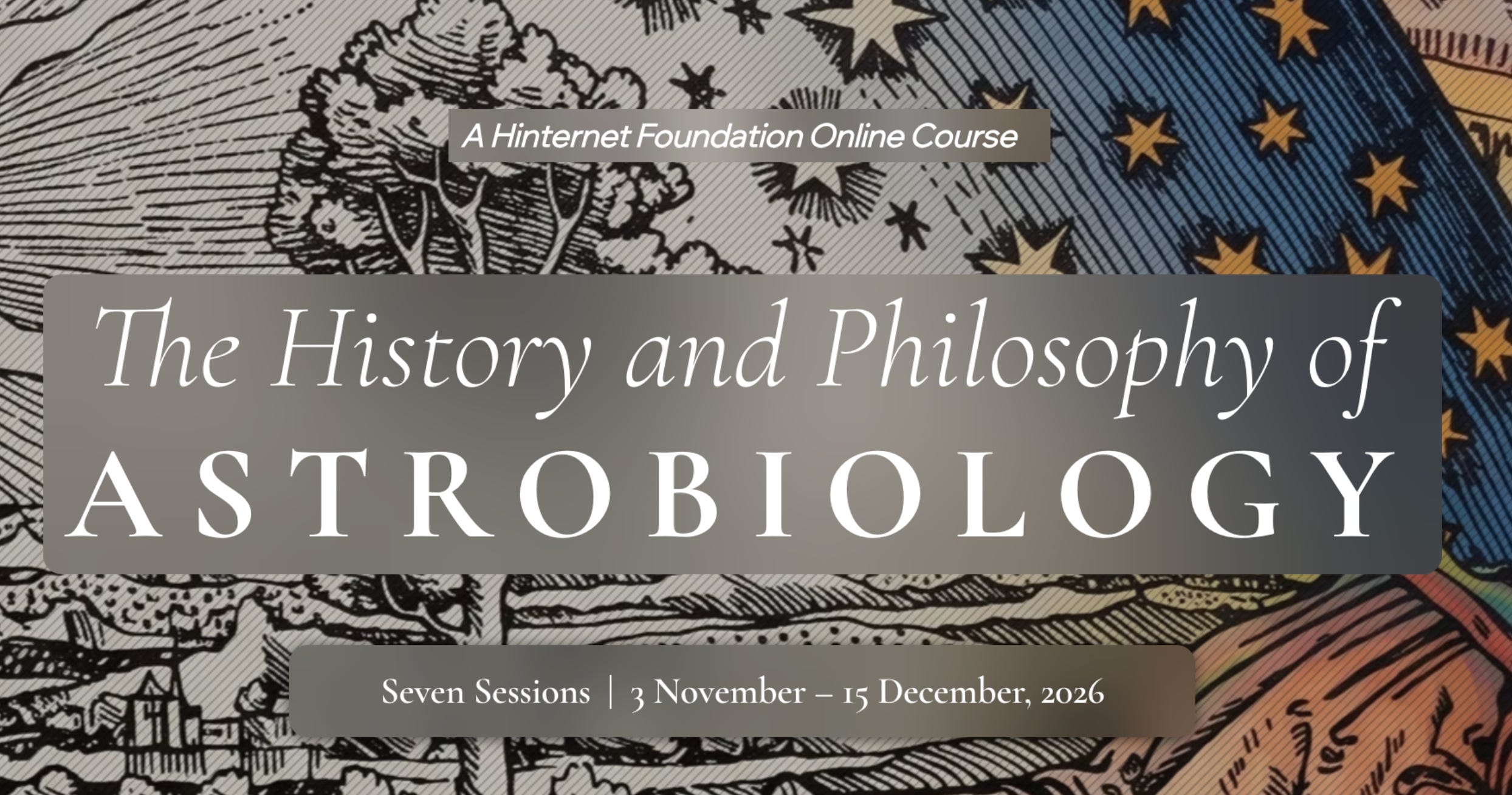
There are just three days left to sign up for the upcoming Hinternet Foundation online course on the history and philosophy of extraterrestrials! Don’t delay!
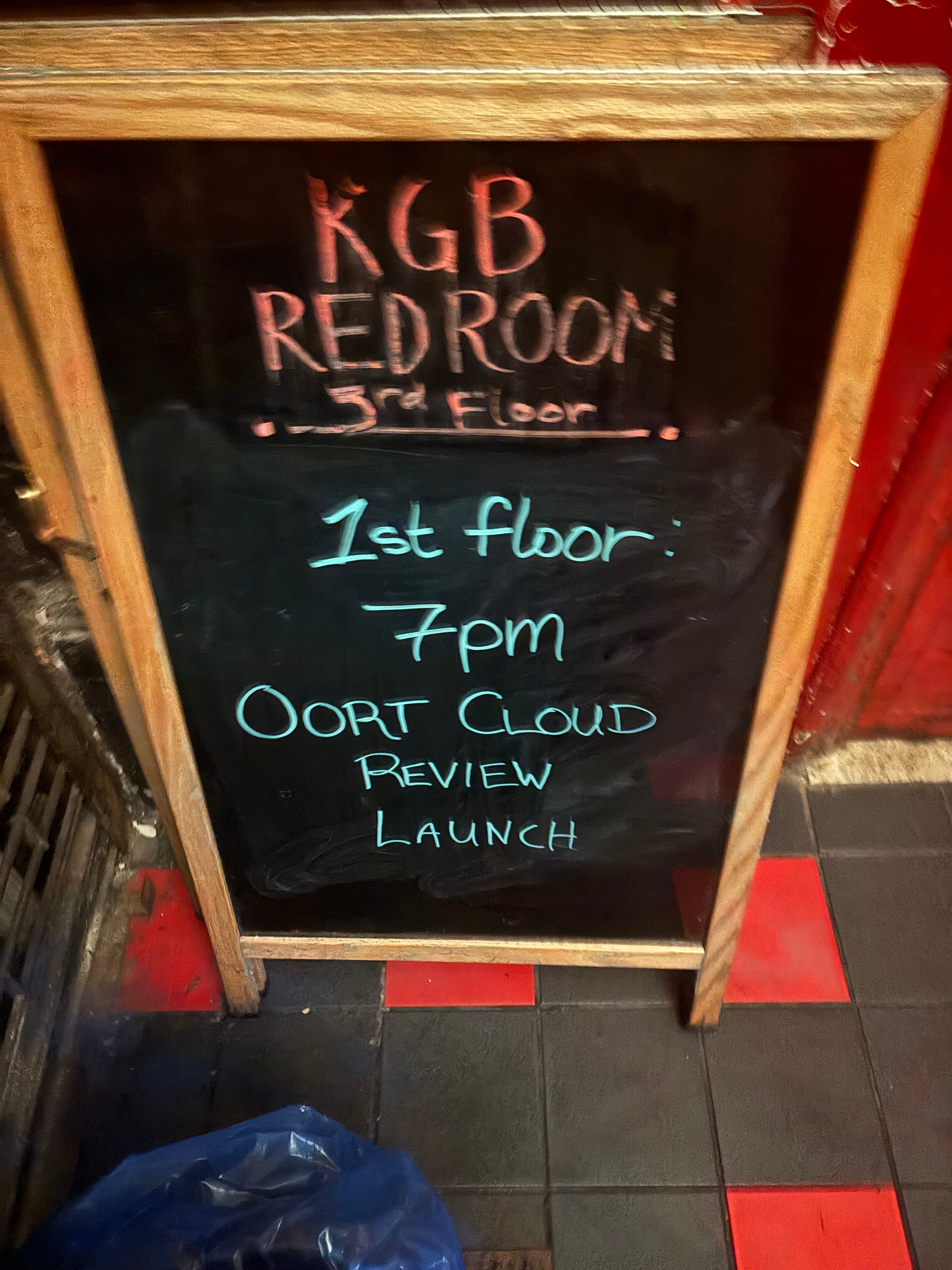
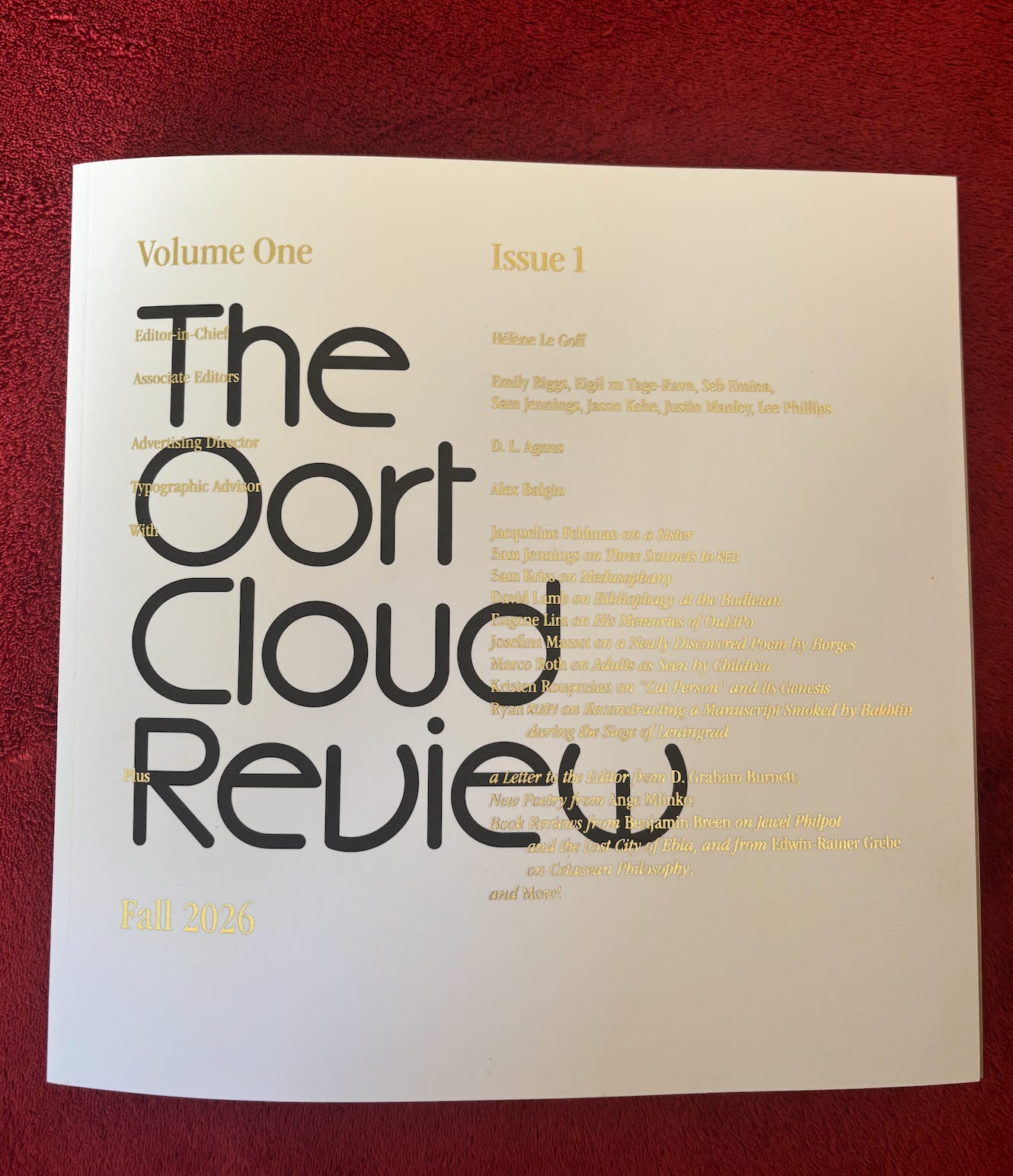
Isn’t it just like Hélène Le Goff, to assign me —a ghost!— to the role of Hinternet “scene reporter”? I suppose it’s her way of saying the scene itself is dead, and we would all have done better to stay home. On my most recent assignment, the launch party for The Oort Cloud Review at the KGB Bar on the Lower East Side on October 22, at least half the entities in attendance were ghosts too. Their presence had the desirable effect of filling the venue almost to capacity, at least for those of us able to see them.
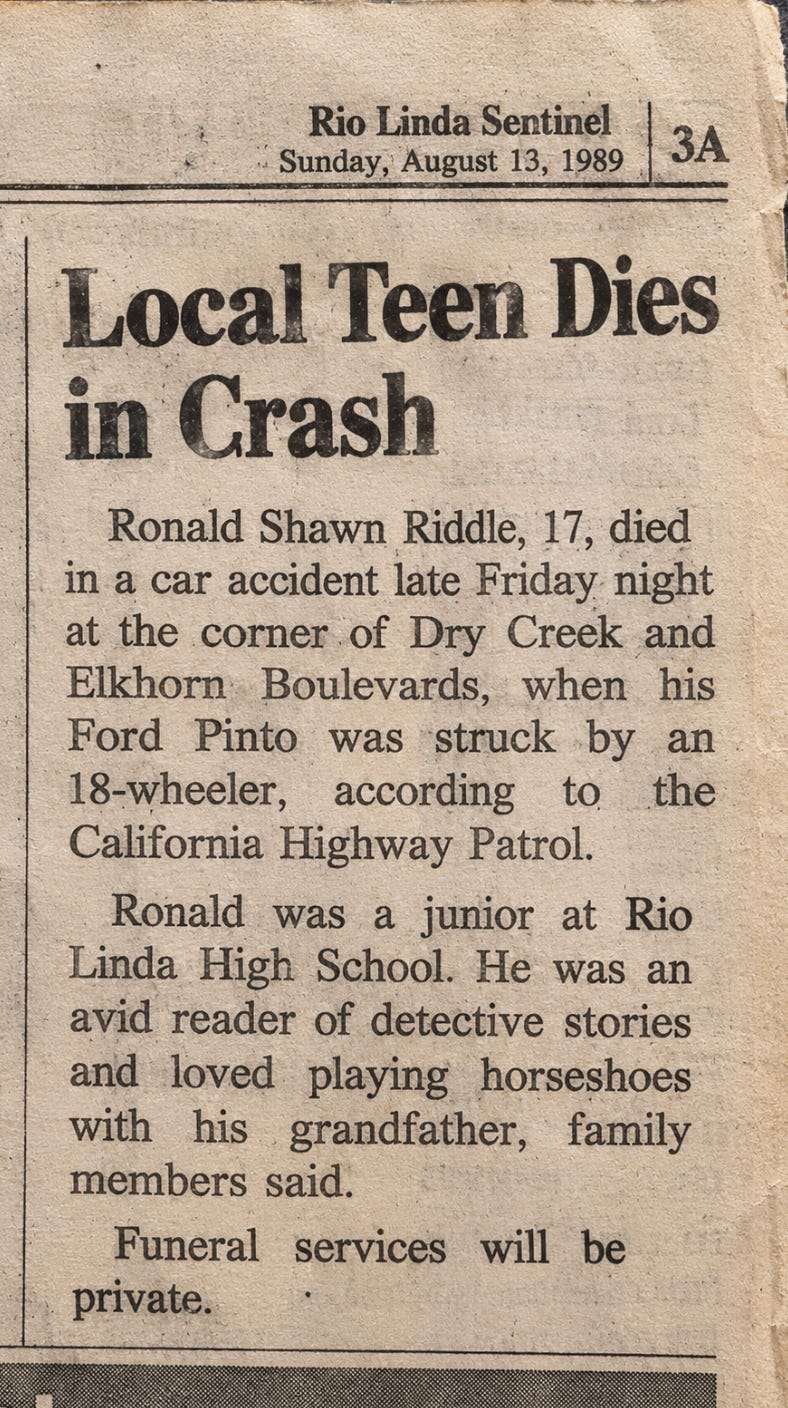
I was mostly just happy to get out of my attic, which I hadn’t left since Hélène brought me to France last year, and to which I had been, before that, continuously confined since 1989.
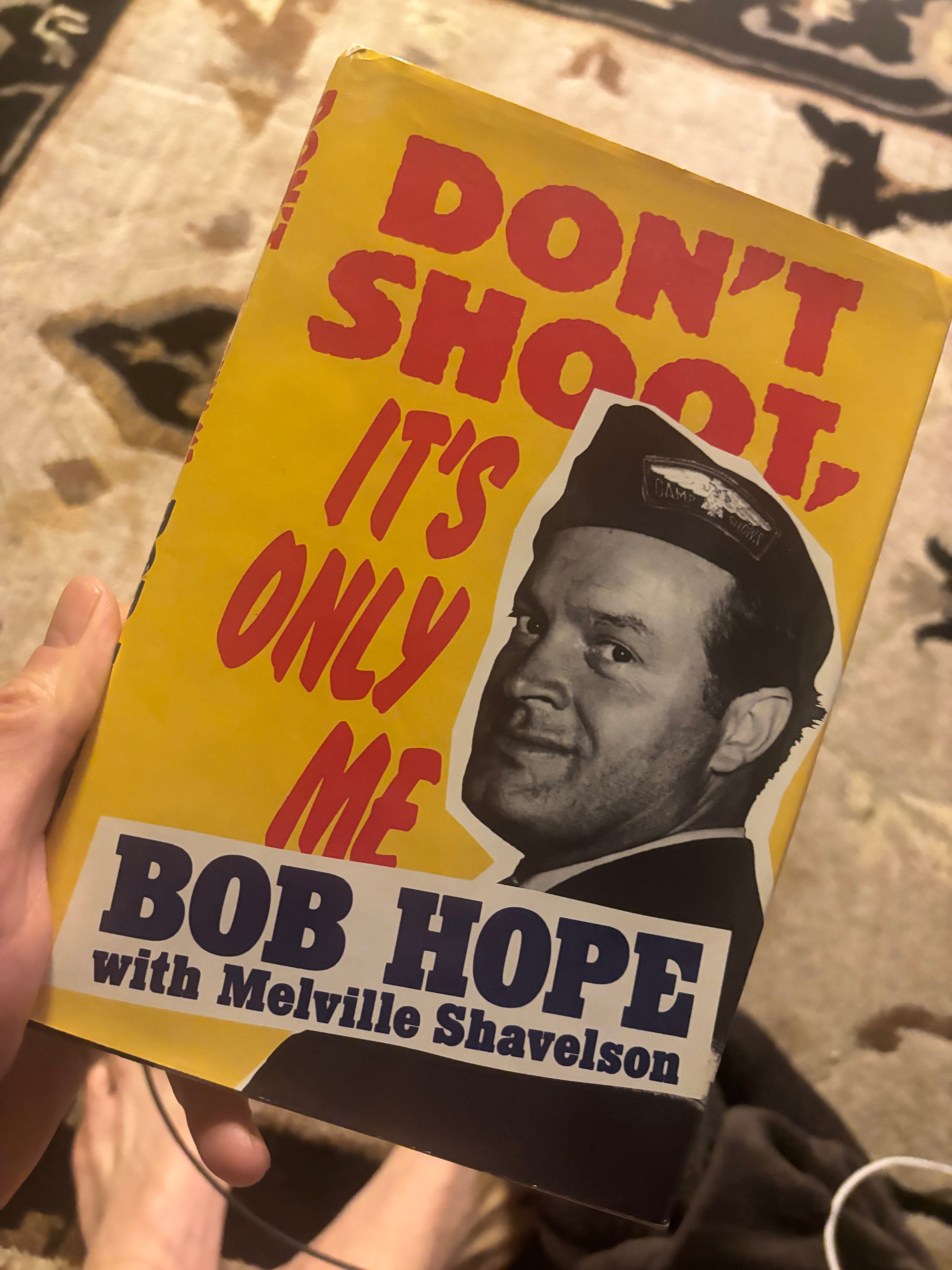
I have previously reported on my activities in that space, confined but expansive at once. I inventory its holdings —a paperback of Edgar Cayce on Reincarnation, Elizabeth Clare Prophet’s Access the Power of Your Higher Self, Bob Hope’s Don’t Shoot, It’s Only Me (with Melville Shavelson), a ceramic dachshund piggy-bank full of Roosevelt dimes and buffalo nickels and foreign coins with intriguing holes at their centers, a purple spongiform novelty likeness of Grimace— and as I inventory them it continues to generate new ones out of what I have come to call its “osculum”, in a dark place above the rafters. This is my work and I take it seriously, but even a creature of ether needs some fresh air, and so when my new assignment came I was happy to descend down the folding staircase, sneak behind the couch where the boarders were dozing as Newt Gingrich hawked mortgage insurance, or gold, or Franklin Mint collectibles, on the screen before them.
I proceeded as before, invisible, yet otherwise bound by the laws of physics. I got on RT bus 81, and went past the Cigarettes Cheaper and the waterski lakes, past the Country Comfort Lounge and past the escape rooms and the plasma clinic where the Air Force base used to be; and through several intermediary steps I arrived at the airport, and I flew to Denver, and then to Newark, and then I took the AirTrain, like a people-mover at the state fair, to the New Jersey Transit stop, and I boarded, and somehow it was only now that the human forms around me took on any haecceity, so that I could see and hear them as individuals, and I learned that they were coming into the city for some big game at the Garden, and they were eating Taki’s and making a great mess and passing the time immersed in New Jersey lore, of the son of a neighbor who got “15 years to life”, of a coworker who got “the pancreatic”.
I walked, if an ethereal body can walk, from Penn Station to the Lower East Side, and by the time I arrived at the venue, an auxiliary space of the KGB Bar, the crowd had already assembled. It was not a large crowd, at least, again, if you only count the more densely embodied. But if you count all haecceities the place was packed almost up to fire-code, and while I know a scene reporter should ordinarily remain focused on what can be seen and heard by all, I feel in this case my unusually heightened attunement to the presence of entities from across the spectrum can only help to convey a full picture of the evening’s mood. And so I noticed all the collaborators on the Oort Cloud in attendance — JSR, of course, and David Lamb, and D. Graham Burnett, and Kristen Roupenian. And I noticed the modest circle of friends and old associates who made the effort, even at this late stage of life, practically ghosts themselves, to dress up a bit, to put on a smile, and to follow the automatism of their still-heavy bodies to this old haunt of youth.
I see JSR, my old friend. He is still going strong, still tee-totaling, still conducting himself somewhat as if he had an electric current running through him. But I discern something else in him this time too, something I did not detect when I briefly stalked him in Paris last year. He seems lost, uncertain, as if struggling to operate under conflicting imperatives. And so I perform an ἐνσάρκωσις and I enter his person, which makes him say “ouch”, which in turn causes Kristen to ask him if everything is alright, to which he makes up something about joint pain. I think he knows what has just happened — not that it was me necessarily, but at least that he has been “entered”.
He has just taken the train down from Cambridge. His first night there he imagines he has himself become Massachusetts, Cape Cod spiraling out of him like an upcurled toe. He is able truly to feel all of Puritan New England beneath him and around him and cradling him, and he thinks of his great-great-great-great-…-great-grandfather William Brewster, author of A Treatise of the Ministery of the Church of England and co-founder of the Plymouth Colony, whose zeal, JSR reckons, is plainly ancestral to his own. And he thinks: “Ô America, why did I leave you? How could I have let my study-abroad year drag on 35 years too long?”
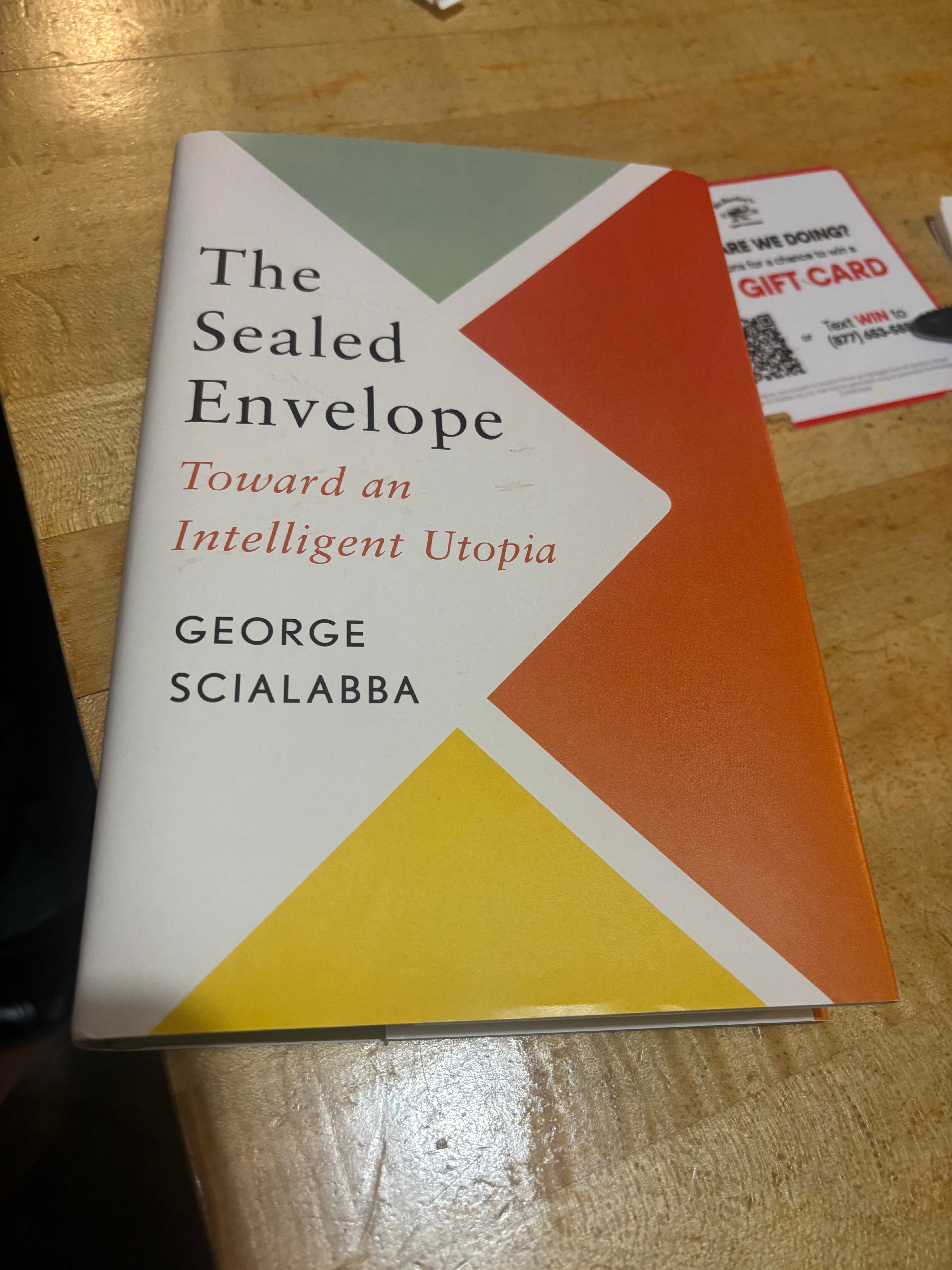
The next day he exchanges recent work and heartfelt dedications with his intellectual hero George Scialabba. Several local luminaries make time in their busy schedules for him, and he speaks with them of “the challenges and opportunities of AI” and so on. Neither there nor in New York does he quite understand his reception. He gets praise wherever he turns, but it all feels to him like puppy praise — diminutive little claps, endearing teases. He gets complimented on his new glasses (Cartier frameless, expensive), gets called “eloquent”, gets called “prolific”. Everywhere he senses complicity in a project he did not believe he had been pursuing, but is no longer so sure: the adulation-seeking, namely, of a vain boob. He had imagined in particular that The Oort Cloud Review was a “timely intervention”, speaking urgently to the most pressing issues of our moment. Now he sees it as other people see it, as quirky, as chungus. It is praised as a beautiful object, but that is all the work of its ingenious graphic designer Alex Balgiu, who stuck to his guns and insisted on the exquisite gold-foil lettering for the cover, coûte que coûte, over the panicked protestations of our budget managers; as for the words, plainly no one would ever read them if they were printed out in Times New Roman on A4 paper.
“I need to start speaking plain truth”, I can hear JSR thinking as he sits on stage hamming it up with D. Graham Burnett, a familiar old sweet pleasure. “I need to strip away all these ridiculous affectations, all these heteronyms and subterfuges, and start saying what I mean. Time is short. Life is serious, and I’m frittering it away on jokes. I am so hopelessly far from where I need to be. If I were to say, right now, what my true purposes are, it would sound laughable, delusional. I am failing.” And then Graham asks how The Oort Cloud Review came into being, and JSR launches into his routine about “Inter-World Transfer Protocol”.
It’s painful to inhabit JSR’s point of view for long, so great is the gap between his thoughts and his words, so when I spot Mary Cadwalladr leaning against the bar I immediately float out of him and into her. She has convinced the bartender to put on her Spotify playlist, and is now in ecstasy from the experience of hearing her private and familiar music in a public and unfamiliar setting. “I am old enough,” she is thinking, “to have been shaped by people who were shaped in the era of light orchestras and bandleaders, and had thick stereo consoles on shag rugs with old LPs in them not only of Lawrence Welk, but sometimes, if fortune favored you when you were flipping through them to pass the time while your parents mingled, of Miguelito Valdes and Elvira Rios too, so that somehow you got a very clear sense of the midcentury style in mass-market Latin American export music and culture.”
And she thinks of a video she had watched on YouTube in her hotel room just before coming to the KGB. It is a grainy low-quality recording of an evening of Latin music, performed in the BBC studios in London circa 1960. It begins with Bobby Capo’s “Luna de Miel en Puerto Rico”. Mary must have replayed it 100 times, and it is still reverberating inside her. When, at around 1’29’’, Bobby initiates a dance that will unfold with ever-increasing complexity until the end of the song, she repeatedly felt as if she were leaving her body and transmigrating to the realm of dance itself, where dance no longer depends on bodies at all. So smooth! So confident! That moment at 1’53’’ and then again at 1’56’’ when the three male dancers bob their shoulders, quasi-robotically and in unison — what is that? It is the most ancient art, a ritual locking with the cosmos, a groove outside of time.
Mary now thinks her ecstasy is best experienced privately, and longs to return to her hotel room to watch Bobby Capo a few hundred more times.
Being inside Mary is depressing me too, so I migrate out of her and into the person of Edwin-Rainer Grebe, whom I find in the middle of a characteristically well-developed thought: “The United States, properly understood,” Grebe considers, “is a Mormon country. Their center in the American West is the nucleus of theocracy that binds the rest of this crypto- or quasi-theocratic union together.” He believes that no author makes this clearer than Mark Twain, in the postscript on Mormonism to his 1872 travelogue, Roughing It.
For the most part Edwin-Rainer has been immersed these past weeks in a rereading of the Greek New Testament. He is especially preoccupied with Mark 10:46, where Jesus encounters a blind man named Bartimaeus, and restores his sight to him. Commentators have suggested that this “son of Timaeus” must be seen as representative of the Platonic tradition, as indeed the Timaeus was the one dialogue of Plato that in the period had acquired the status of a cultural touchstone throughout the Eastern Mediterranean, a work that every half-educated Hellene had to pretend at least to have read. Now the Timaeus deviates somewhat from Plato’s usual view, in holding that ordinary vision is a valuable thing, as it is what enables us to study astronomy, from which we get, in observing the perfect motions of the heavens, our first idea of perfection itself, which then sets us along the path of study of the purely intelligible entities for which the eyes are not at all necessary. Thus the Timaeus envisions (as it were) a sort of ascent, not unlike the ascent in the Symposium from carnal love to direct apprehension of Love itself, rather than what we find in the more canonical Platonic account in, say, the Republic, where visible things are but shadows, and can only hinder your progress towards knowledge of the intelligibles. Half-educated Hellenized Jews circa 30 AD, therefore, could easily have imagined that the Platonists value ordinary vision more than they in fact do, a misunderstanding that appears to set the stage for this encounter between the son of Timaeus and the son of David, wherein the Platonists are depicted as aspiring at most to catching sight of the visible perfection of the heavens, while the Christians alone can expect to have sight beyond sight, an apprehension of truth in comparison with which all inherited pagan learning, for example of astronomy, is a form of blindness.
So the great historical irony here, Edwin-Rainer reflects, indifferent to the conversation taking place right next to him on the question whether “Substack is so over”, is that Mark’s apparent correction of Platonism is itself profoundly Platonic. The allegory of the cave had already demonstrated that bodily eyesight is not true vision, as to see the shadows on the cave wall is to remain blind to the true nature of reality. But Mark is writing before the synthesis effected in the following centuries by the Church Fathers and, later and more decisively, by Augustine, which preserves a consciously Platonic distinction between sensible appearance and intelligible reality, while reimagining the terms of communication between these two realms. The transcendent is no longer something towards which one ascends by cultivation of philosophical reason, but rather something revealed in history to ordinary men and women through the becoming-flesh, or as it were the ἐνσάρκωσις, of Logos itself. Christianity thus personalizes the Platonic vision, gives it cultic meaning and mass appeal. The transcendent order is no longer primarily the home of triangles and other abstractions, but the true destination of the soul and the ultimate ad-quem of its progress, a progress made not through learning but through emptying oneself out and becoming as a fool or a child, not through puffing oneself up with astronomical tables, but through building oneself up with love.
Most of the other ghosts are gone by now, and the heavy-bodied humans still present can hardly maintain a quorum of conviviality. All copies of The Oort Cloud Review have been sold, but because of a fuck-up with the routing for several boxes of copies sent from LA, only the 18 of them that JSR had brought in his suitcase from Paris made it to the venue. JSR was now reckoning up with the bartender, who had taken a $750 deposit on his credit card, $640 of which had now been paid off by drink orders, including a wide variety of exquisite mocktails. (As he had agreed to go halves with his publisher, the whole evening will now have ended up costing him $55, or roughly twice as much as an annual subscription to The Hinternet.) The bartender had previously been affiliated with the Museum of Jurassic Technology, and asked JSR whether he knew David Wilson, or had thought about sending him a copy. JSR told her that Wilson’s biographer, Lawrence Weschler, had intended to be present that very evening, but was stuck at home up in Purchase with a head-cold. He showed her a WhatsApp message confirming as much. He also has a text from Maya, who is among the only people yet to have opened the physical pages of The Oort Cloud Review, and who affirms that it is something like an LP version of The Hinternet. She’s playing in a production of The Sun Also Rises up at the 92nd Street Y. Both Ren and Maya, however, are among the more rarefied haecceities whose presence I could yet faintly detect, notwithstanding their bodily commitments and incommodities elsewhere.
JSR is now hugging people, saying goodbye, and smiling big, and all the while thinking: “I’ve got to get serious.” It dawns on me that I could just float away now, but I know the rules, and so I walk, or at least bob up and down while moving forward at roughly six feet above the ground, to the Q train to Times Square, then I take the E to Sutphin Boulevard Jamaica Station, then the AirTrain to JFK; then I get on the JetBlue flight to Sacramento, then I get off, and this time I walk, out along I-5 to Elkhorn Boulevard, past the Archway Frosty, past where the Mar-Val and the Mister M.’s used to be, and at last I come to my home, and I enter the front door, and I knock the Boba Fett action figure off the little table by the entryway, and the boarders wake up from their couch-bound stupor, and the fat one says to the thin one: “What was that?” And the thin one says: “That’s just Rawn.” And the fat one says: “I guess he’s coming out of his attic now.”
I pay them no mind and I go back up to my attic, and I immediately return to my inventories. There are 4-H ribbons and laminated Trapper Keepers with great white sharks on them and decades-old unopened WeightWatchers meal-replacement pouches. There is a t-shirt commemorating the stranding of Humphrey the humpback whale deep in the Sacramento Delta, and another that says “74 isn’t old… if you’re a tree”. There is a set of novelty silverware for dieters, consisting in a blunted knife, a fork with sawed-off tines, and a spoon with a hole at the center. There is a nearly empty bottle of Blue Curaçao, and a crocheted piece of wall art declaring that cleanliness is next to Godliness. There is a red velvet Shriner’s fez that says “19 Ben Ali Westwood Temple 84” on it.
As is my recent habit (picked up, for some reason, after Paris), I take all these things and I absorb them into myself, and at exactly the same rate as they vanish, new ones pour forth from the osculum. Sometimes it seems to me that it is this infinite fluxion of things, as they move through my attic repository, my storehouse, that is keeping the world in balance, or at least JSR’s world: the ordinary empirical world of “launches” and “pre-orders” and “mocktails”. Hélène would like for me to be The Hinternet’s “scene reporter”. But is this not, right here, the scene behind the scenes? He’d deny it of course, but perhaps every public life is epiphenomenal in just this way — the mundane trace of ghostly inventories.
The Hinternet needs your support! Upgrade to a paid subscription now!
Upcoming Events
November 11. Oort Cloud Review launch event, Camden Art Centre, London, 7pm. REGISTER NOW!
November 23. Hinternet Foundation Inaugural Summit, La Gaîté Lyrique, Paris, 2pm-10pm. REGISTER NOW!
Hinternet Foundation Online Courses
November 3-December 15. “History and Philosophy of Astrobiology”. REGISTER NOW!
October 1-November 12. “Clavis: How the Voynich Manuscript Tells the Story of the Modern World.” IN PROGRESS!
August 7-August 22. Hinternet Foundation Inaugural Summer School: “Whither the Humanities?”