

We are delighted today to feature this exclusive excerpt in translation from Céline Curiol’s most recent novel, La Dynamique de l’œuf (Actes Sud, 2026). Céline is the author of eight novels, including, in English translation, Voice Over (with foreword by Paul Auster, Seven Stories Press, 2008). Her work traverses genres and styles, and includes memoir and essays as well as fiction. We at The Hinternet love her latest novel in particular, for the way it weaves strands of the most intimate first-personal voice with explorations in what we might pedantically call the history and philosophy of the life sciences.
As Céline explains to us, her latest novel was born “from a desire to get away from the overwhelming influence of a certain type of realism, derived from media news coverage, on contemporary literature. I also wanted to play with the very French and very popular concept of ‘auto-fiction’. Over all, the novel gravitates around the concept of ‘reproduction’, whether in biology or in art, exploring how it orients or defines our relationships to unity and self, creation and purity, life [le vivant] and death.”
“The novel follows Léna Nistier, a middle-aged woman who dreamt of being a writer but became ‘a painter on stones’ [peintre sur cailloux] after following an unsuccessful writing workshop with the not-so-encouraging Odile Travy. In this passage, Léna has just been dumped by her partner, leaving her with a very thin hope of procreating. She has been hired by the wealthy Ondré Sangres, who, along with his brother Pavo, owns a castle in Bretagne. Her job is to reproduce a famous Renaissance fresco in his garden. There, in the Domaine de K., Léna will meet a very special chicken, named Gilda, and, through this encounter, will relive her childhood dreams and face some of the paradoxes for which her late father, Arthur, had given her a taste.”
—The Editors
In the Library
I’ve always loved letting my eyes wander over the spines of books, whether lined up on the shelves of a bookshop or of a library. What I love most, I think, is that array of titles from which the eye may trace a peculiar sequence, as though composing rebuses, or long twisted verses never before written.
For although the books in a library are arranged according to a system, they are almost never arranged by title, so that the juxtaposition of their names owes nothing to their meanings. Back when the urge to write still gnawed at me, I had imagined composing texts out of titles gathered at random from several libraries. When I mentioned the idea to Odile Travy, she warned me against it: exercises of that sort —formal experiments, or “constraint-based writing,” as she called them— were unlikely, in the case of an amateur like me, to amount to much.
It was therefore a stroke of luck that, on my way back to my room, I opened the wrong door. The room beyond was large and imposing, its walls lined from floor to ceiling with books —three entire walls, with the fourth occupied by a broad window— and despite the hour I felt an irresistible urge to let my eyes play over the shelves. A deep-green art-deco lamp had been left glowing on a small table, its halo holding a portion of the titles back from the surrounding gloom. The impulse to indulge, here, in a little linguistic gleaning after such long abstinence made me forget the following day’s tasks. Just a few minutes, I told myself, piqued by the curiosity of discovering what the Sangres brothers read — a way of sounding out their tastes and loyalties, and so, perhaps, of being a little better prepared for their company.
Literature took hold of me late. At fifteen I was reading nothing apart from one or two magazines that obsessed me; at twenty, still nothing beyond the required books, and the texts on my mobile phone — more of the latter than the former, truth be told; at twenty-five, not much more.
It was only at thirty-three that I began reading novels, and I remember this because it coincided with Arthur’s death. My upheaval was then so complete, so shattering, so alien to everything I thought I knew about my self, that all the things to which I ordinarily devoted myself whenever the murderous storms of melancholy and morbid rumination raged within me, my escapes and my rituals, those activities I pursued with such relish —dancing, listening, cooking, swimming, playing, humming...—, and which, through steady repetition, had come to have the power to soothe me, were suddenly closed off to me. I no longer had the slightest taste for anything, nada, nyet, and if a person is sustained by desires and attractions, then that should have been the end of me. Overnight, everything familiar became repellent, reeking of staleness and futility. Whenever I forced myself, as I tried to do at first, I was overwhelmed by the feeling that I had reached the end.
One day someone handed me a novel, or perhaps I found it. Yes, that’s right: I found it in a café I used to drift into now and then, utterly spent, my gaze fixed on the ground in front of me, maimed by loss. As decoration, shelves of books had been hung along the café walls, lending some life to an otherwise rather dreary room. All I had to do was turn in my chair and stretch out a hand for the first volume within reach, simply because I needed something to occupy myself. I couldn’t shake the feeling that the other customers were staring at me because I was carrying my grief so indecently in public. Sooner or later, one of them would ask me to leave.
So I began reading novels to keep up appearances, the way one reaches for a cigarette or a drink. It was my eyes that needed occupying, because they wandered everywhere, over everyone seated around me. They wandered like dogs following the scent of a happiness whose very smell would have disgusted me, dogs desperate for a caress that would have delivered them from nothing, least of all from being a dog. So I read. The book I read was called Le Grand Cahier.1 From the very first pages, although it too was a story of catastrophe, I felt myself carried away even as I had the sensation of finally regaining my footing. Those sentences let me breathe again, let a current of air pass through me once more. A zephyr. I gulped down that magic potion, and when I reached the final full stop, I wept. Never before had I read like that. Until then, literature had meant punishment, or else an obsolete pastime, something for old people , a way for the stiff and the tedious to live by proxy, hidden away in some cramped corner, shut in rather than riding along on the wave of the real. In two days I finished all three volumes. From that moment on, I never stopped reading novels.
It is easy to understand, then, why, finding myself in that magnificent library, I felt almost dizzy, astonished by such an immense reserve of promise. I couldn’t resist. I let my eyes loose upon the rows of spines as one might turn a spirited horse loose to gallop across that vast plain of titles.
After a few erratic turns, they caught on a midnight-blue volume striped with fine lines of gold. It was not a novel. Diderot, Œuvres. It took me a few minutes to realize that I might actually have a chance to understand the power Diderot attributed to eggs. But the volume ran to 1,372 pages, and it seemed most unlikely that I would be able to find the passage Jacob had quoted as an epigraph. Hadn’t the reference been to the Entretien entre D’Alembert et Diderot? I turned the pages one by one, then more quickly, skipping ahead in small batches, trying to follow a kind of intuition. And then, by sheer, unimaginable, improbable, utterly implausible luck —and I am not exaggerating— it was there. The very section. The very sentence…
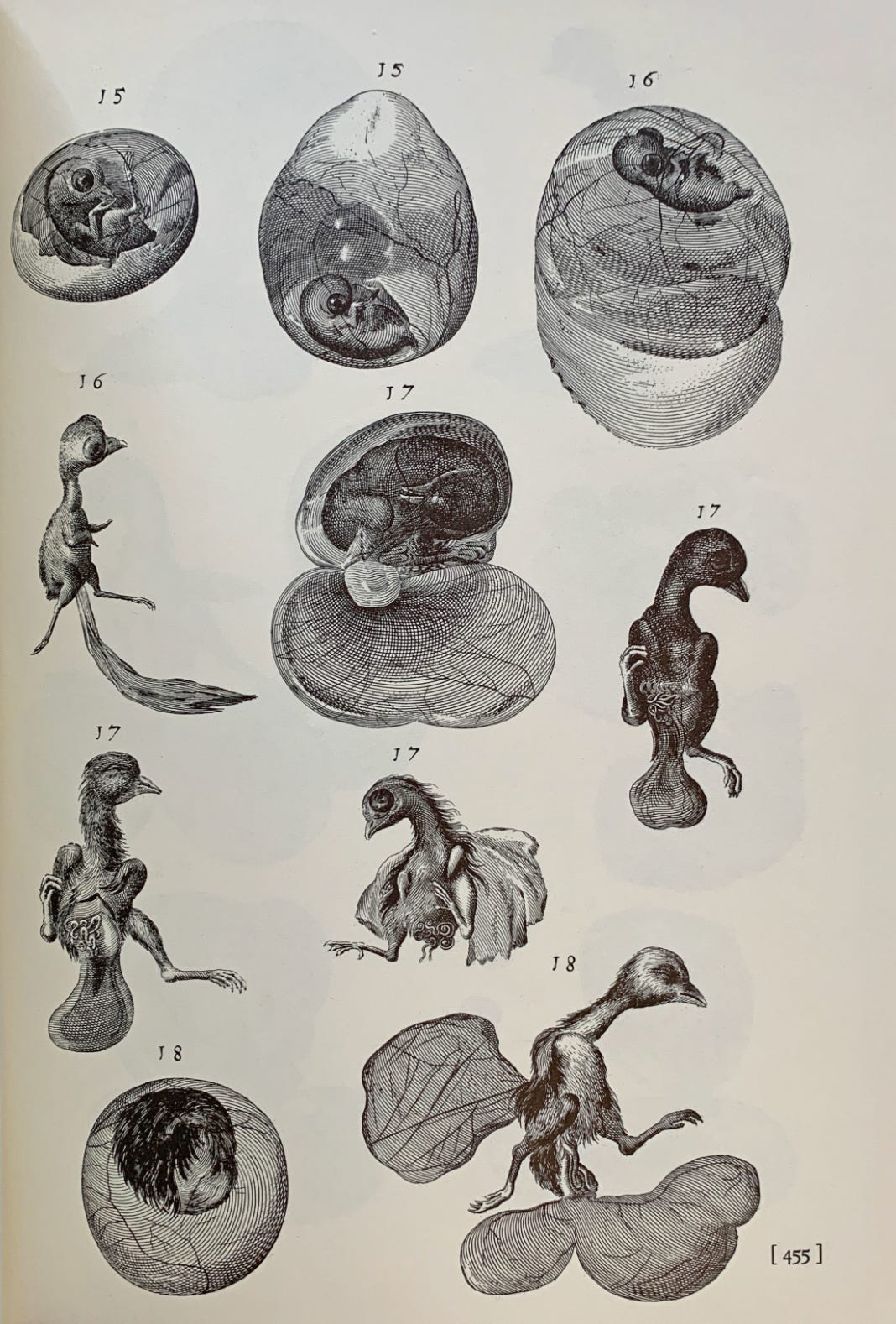
Do you see this egg? With this you can overthrow all the schools of theology, all the churches of the earth. What is this egg? An unperceiving mass, before the germ is introduced into it; and after the germ is introduced, what is it then? still only an unperceiving mass, for this germ itself is only a crude inert fluid. How will this mass develop into a different organisation, to sensitiveness, to life? By means of heat. And what will produce the heat? Motion. What will be the successive effects of this motion?2
Gradually I see matter coming alive. For Diderot there is only one substance, only one sensibility. He is determined to describe the chick’s gestation as a gradual process: first the emergence of a form, then of distinct parts, then of movement. The chick is not already there inside the egg, fully cooked, if I may put it that way. The philosopher declares that it arises through development, a formation by stages that stands opposed to the spontaneous generation to which academic orthodoxy had until then adhered. This is epigenetic emergence, as Ondré explained to me. What I take away is that the power Diderot attributes to the egg is its power of revelation. What the examination of the egg, aided by ever more sophisticated instruments, was to disclose about the origin of living beings had ensured the defeat of theology — that defender, through the idea of divinity, of an unconditional coherence. Until then, nature was thought to produce beings that owed no heredity to matter itself: although certain traits of their progenitors impressed themselves upon them during gestation, they nevertheless remained unique beings, born from a multitude of possible combinations made conceivable by the still nonexistent concepts of species and of life itself.
What is this egg? It is dynamism… disguised as inertia.3
At the creak of the floorboards I nearly dropped the volume, which lay open, balanced in one hand. Ondré stood motionless in the doorway. I could barely make out his features, and I had no way of telling whether finding me in a room he considered his own was about to earn me a reprimand. At once, the feeling that I was in the wrong compelled me to speak.
It’s full as an egg in here!
I couldn’t believe I had just said it. The words had burst out like a hiccup, and yet they filled me with a certain happiness: my father had not left me. When I explained to Ondré that it had been one of my father’s favorite expressions[1] , he shook his head with all the fervor of his rationalism.
But an egg isn’t full.
Of course it is. I’ve seen for myself.
His iceberg-stare stopped me.
A full egg would be unviable. It has to contain an air pocket so that the chick can breathe during the final twenty-four hours before hatching; otherwise it would suffocate. In fact, if it happens to end up with its head at the wrong end, it suffocates before it’s even born. Which, put that way, I admit, sounds rather paradoxical. Haven’t you ever peeled a hard-boiled egg? You notice it immediately.
I don’t like hard-boiled eggs.
Then you should at least know that this was one of the great questions modern embryology succeeded in answering. On the twenty-first day of gestation, the shell, which until then has been protective, can become a prison. The symmetry of the embryo during its first thirty-five hours is broken by the appearance of the heart, which determines the orientation of the head. As for how the cells of the mesoderm distinguish left from right so as to activate on the correct side, that...
Ondré searched my face for a reflection of his own wonder, then took the book from my hands.
— Diderot. An excellent choice. Did you know that for those trying to understand Nature’s unpredictability, it became crucial to understand the egg just as Galileo and Bruno had sought to understand the stars? In fact, from the sixteenth century onward, understanding the egg became one of science’s great preoccupations. Omnia ex ovo: all things come from an egg. That famous phrase, with its prophetic ring, is attributed to the English physician William Harvey, who between 1600 and 1603 studied under the Italian anatomist Girolamo Fabrici d’Acquapendente, whose earliest work on chicken eggs sought to observe the chick before it came out of the shell. The dissection of those eggs laid the foundations of modern embryology, and by the end of the seventeenth century no one any longer disputed that to be female was above all to bear eggs. But contrary to what those two eminent scholars, Harvey and Fabrici d’Acquapendente, then supposed, the egg turned out not to contain a tiny preformed specimen. By Diderot’s time, the living being no longer possessed a permanent blueprint, an immutable constitution; it had become transformation itself, exposed to the contingencies of its own growth. Whenever I look at a hen’s egg, I am brought back to the emergence of life, to an extraordinary form of transmission, an entelechy that cuts through the potentialities surrounding it. Though anyone hoping to catch life in the act within the egg can only fail...4
Ondré, something has just occurred to me. I’d like to keep the grass.
He frowned, but he already knew what I meant.
Keep the grass... between the stones? It’ll be awful.
Not necessarily.
He rubbed his forehead with the tips of his fingers.
The grass will ruin everything.
Not necessarily.
I repeated it, though I knew those two meager words had little chance of reassuring a man as methodical as he was. The idea was new to me, and I had not yet worked out how to defend it. It would be a good way to keep the fresco from becoming fixed.
Ondré stared at me.
Keep the fresco from becoming fixed? Keep the fresco from becoming fixed? You’re talking nonsense. It’s a fresco!
He sighed, more than once, and I fought the temptation to tell him I’d forget the whole idea.
In no time at all, you won’t be able to see anything anymore. It’ll be awful.
No. You’ll cut the grass. It will be a way of... bringing the fresco back to life. Or perhaps not. There may be times when you would rather leave it hidden.
Egg and Individuality (1)
Jakob von Uexküll was a champion of worlds—those worlds that every living being weaves through its perceptual and active relations with what surrounds it. In doing so, the German biologist became one of the forerunners of modern ethology, convinced that animals should be understood not as mechanical assemblages of reflexes, but as subjects, capable of exercising volition within an environment5 peculiar and proper to each of them.
Ondré looked up from the pages in his hands. His questioning gaze rose over the rims of his glasses until it met mine. I smiled to encourage him to go on, aware that he was sharing with me an article he was proud of. I wrote it back when I was still teaching, he had explained, and since I seemed to have taken an interest in chickens, he thought these reflections might broaden the scope of my inquiries. Most of all I think he quite enjoyed having an audience, an attentive listener.
At the beginning of the twentieth century, it was von Uexküll who made the transformation of the egg into the hen the exemplary instance of those invisible forces that shape and fashion our states of being: a force that escapes materiality —call it power, energy, or principle—, a thrust that passes unfailingly from one generation to the next, continuing through time without boundaries, beyond the reach of our instruments of measurement, yet by which life gains... something that, unfolding from the egg to the hen, gradually extends its ordered structure without interruption, [and] constitutes a chain of objects without itself becoming an object. The egg, for its part, continued to furnish proof of the existence of individuals— not yet actual, perhaps, but at least potential. In the 1850s, the British biologist Thomas Huxley, an ardent defender of Darwin’s theory of evolution, defined the individual as that which unfolds ab ovo ad ovum— from egg to egg.
A century and a half later, the work of the microbiologist Lynn Margulis called into question the very notion of the individual— as defined by embryology, but also by anatomy, genetics, immunology, and physiology—through her investigation of a phenomenon that biologists had until then largely neglected: symbiosis. The significance of Margulis’s work has never been universally acknowledged, perhaps because, and perhaps precisely insofar as, it unsettles several fundamental dogmas.
Ondré interrupted his reading and glanced at me once again. Something tells me you’re wondering why an old researcher like me should have become interested in so revolutionary a theory. Needless to say, I was in no position to wonder any such thing, so I merely smiled. Then listen to the rest. Once reconsidered and brought to light in this way, symbiosis proved to be a phenomenon potentially constitutive of reproduction, development, and immunity. It thus became more difficult to regard each individual as a unity if it turned out that it was, first and foremost, a component of a holobiont. For example, in many organisms,6 the development of certain organs depends upon chemical signals emitted by the symbionts they harbor— or perhaps one should say with which they associate.
In mammals, microbial symbionts are acquired at birth, during passage through the birth canal, and then through mucosal contact between mother and offspring. Contrary to what was long taught, the genetic inheritance transmitted from one generation to the next is not confined to the DNA contained within eukaryotic cells: the genomes of the symbionts are transmitted as well. In that sense they too contribute to the development and functioning of the host’s offspring!
From an immunological point of view, microbial symbionts are an organism’s external guards and sentinels, but they also mediate that organism’s relations with the wider community of living beings. Thus, according to Margulis, there exists, biologically speaking,7 no autonomous, self-contained entity that could serve a priori as the bearer of an autonomous self. The subject is dynamic and context-dependent, relying on alliances with other species that, by incorporating themselves into it, alter its very substance. The egg opens the question of individuality and its limits. To inquire into the egg is to inquire into the contradictions inherent in every existence conceived as one’s own— untouchable and untouched. For the egg is both inclusion and alterity— inclusion within a lineage, alterity born of heredity. It is the indispensable condition of life: immersion within another body that is not quite other— the egg and the hen thus standing in a relation of temporary endosymbiosis... I had never heard the term endosymbiosis, and I found it difficult to think of the hen as anything other than a complete individual.
It’s true that a hen carrying an egg is still a hen, and its egg, before it is laid, is still the hen, though after it has been laid it is mostly no longer the hen, though in a sense it still is, a little bit.
Exactly! We come back to Diderot and his great question about the transition from contiguity to continuity. You must have studied that at university... But it’s getting late.
Ondré stood up and, with a ceremonious gesture, invited me to leave the library ahead of him.
A Miracle of Nature
I was about to head back upstairs to my room when I remembered the portrait in the red drawing room that had caught my attention upon arrival. I recalled that it hung in the last room on the right before the staircase. The moment I found myself standing before the painting again, I saw it. It must somehow have escaped me the first time, though I cannot explain how such an oversight could have been possible. There it was, almost dead center, bursting through the canvas the way a star commands the screen: a breast. A round, naked breast emerging from the neckline of an ochre tunic. It was exquisitely rendered, its coloring giving it the texture of living flesh, the nipple encircled by a dark areola just brushing the lips of the newborn cradled in the woman’s arms.
How could I have failed to notice it right away? It was the painting’s visual focal point, an erotic provocation around which the entire composition revolved. Yet before long an impression of strangeness, perhaps even deception, began to mount until, at last, the anomaly struck me: the woman possessed only a single breast.
Even examined closely, there was no trace of another— not beneath the folds of the fabric, not so much as a bulge or a shadow. One solitary breast had been painted squarely in the middle of the chest, improbably close to the base of the throat, pressed against the neckline of the garment: a single, centrally placed breast set unusually high. Once I had made this discovery, my gaze shifted, and I was able to perceive the second oddity. What I had taken for the woman’s hair was in fact a beard. Hanging between breast and chin, it appeared like a kind of misty hollow, an incongruous excess. There the colors of the portrait dissolved into an almost absolute black. Once recognized, the beard suggested that I was looking at a man, all the more so because the head showed the first signs of baldness—a supposition that seemed, nevertheless, to be contradicted by the insistent presence, just below, of the breast.
Was I looking at a nursing man, or at a woman with an extravagant beard? The redistribution of gender has become one of the defining concerns of the twenty-first century, but four hundred years ago, when, I assumed, this painting had been made, would such a conjunction of divergent sexual attributes not have been scandalous? Unless it was meant to depict a masculine maternity, the kind indirectly claimed over the world by the Catholic Church.8
The painting possessed the power of the monstrous, of something that, rendered with realism, sheds the air of fable in order to unsettle the boundaries of the real. Fascinated, I suddenly felt an intense desire to touch the breast, and I stepped even closer to the canvas. Only then did I notice, emerging from the painting’s dark background, two carved stones bearing a Latin inscription whose opening words were: En magnum naturae miraculum. I tried to commit the phrase to memory as I made my way back upstairs.
Although the window was shut, I could hear, every so often, the shrill, indignant hooting of an owl somewhere nearby. I pictured it perched on a branch at the edge of the woods, quarreling with another owl over a morsel of field mouse. I was wearing nothing but a T-shirt, and the touch of the cool sheet against my buttocks stirred the beginnings of arousal. My hand caressed and explored my pubis, searching for the budding tip of my clitoris, setting it gently rocking with all the deftness its awakening required. Orgasm came quickly, with explosive force. It hurled me outside myself before gathering me back into the smallest possible point.
My onanism did not bring sleep. What exactly had the inscription said? En magnum naturae miraculum. I did not need to turn on the light to find my phone by touch on the bedside table. Behold, a great miracle of nature. Did miracle refer to the newborn, to the bearded woman, or to the man with the breast? Unless the expression miracle of nature itself was misleading. After all, a miracle is supposed to be an extraordinary event, often brought about by divine intervention, provoking astonishment precisely because it occurs outside the normal, natural course of things. What, then, could a miracle of nature be? Nature acting against itself? Ondré had used the expression against nature...
Which led me to wonder whether unity might include divergence. If I am one, then my dead nature must differ from my living one. Is it possible, then, that still-life and against nature coincide? What lies beyond my control is generally taken to constitute my nature, whose immutability is established by the fact that I cannot change it. A contrario, whatever I do succeed in changing no longer belongs to it. If I deliberately force my voice lower or higher, people who know me will say that I am not speaking naturally. And yet the natural sound of my voice has itself been shaped by influences, even early ones —it is not impossible that I imitate certain cadences that once sent a shiver through me— and I would be wrong to claim that it was given to me once and for all, since it continues to modulate according to factors intrinsic to my experience— to that I which is nothing more than the name of the one who, at every moment, assumes responsibility.
Damn it, I have to quiet this swarm of thoughts, at any cost! I switch on the bedside lamp, get up, have a drink, piss, and only when I lie down again do I notice it. On the lower shelf of the bedside table, to my astonishment, there is a copy of Hystérectomia. That the very book which had shaken me so profoundly should be lying there, its double, struck me as absurd, and I could not resist rereading a few passages as sleep gradually overtook me.
Now I find myself leaning against a balustrade. The ocean stretches out on every side, its surface streaked with splinters of reflected light, the swell invincible and replete. We are under way; the ship, broad and swift, bears us into a gentler season than exists anywhere else. It is always her scent that announces her first. She walks across the deck, or rather seems to float across it. It hurts to find her still so beautiful. Her dress is the violet of heliotrope blossoms, embroidered with pale arabesques. I realize it too late: my shoes are too large, and, as always, I am about to meet her gaze without finding what I am looking for there. The hand I raise to my face in an effort to steady myself has the opposite effect. What horror! I can feel the first growth of a beard upon my face. My beard. I do not dare touch myself elsewhere to discover what I have become.
After that it is always the same, ever the same. She measures me with her gaze, then lavishes me with affection, smiling and teasing, only to withdraw again as soon as I regain my confidence. The hairs on my face seem not to frighten her. Desire swells through me from head to foot, and I think I can feel a sex, my own, growing. But already she is wary whenever I dare brush the boundary of her refusal. I must abide by her rules, remain her well-behaved admirer. Before long we will come ashore, and a carriage will take us to Caprarola. Perhaps the splendor of the palace will overcome her reluctance.

Agota Kristof, Le Grand Cahier, Stock, 1986.
Voyez-vous cet œuf ? C’est avec cela qu’on renverse toutes les écoles de théologie et tous les temples de la terre. Qu’est-ce que cet œuf ? une masse insensible avant que le germe y soit introduit, qu’est-ce encore ? une masse insensible, car ce germe n’est lui-même qu’un fluide inerte et grossier. Comment cette masse passera-t-elle à une autre organisation, à la sensibilité, à la vie ? par la chaleur. Qui produira la chaleur ? le mouvement. Quels seront les effets successifs du mouvement ?
Attracted by the perfection of this form, the poet Pierre de Ronsard would take it up and carry it further.“L’oeuf en sa forme ronde, / Semble au ciel qui peut tout en ses bras enfermer / Le feu, l’air et la terre, et l’humeur de la mer, / Et sans être compris comprend tout en ce monde.” See Pierre de Ronsard, Je vous donne des oeufs. L’œuf en sa forme ronde, in Les Amours [1578], Garnier, 1923, pgs. 339-340.
See Maurice Merleau-Ponty, “Il n’y a pas d’accès à l’ontogénèse,” in La Nature. Cours du Collège de France (1956-1960), Points, 2021, pg. 400. “When the zygote appears, the living being comes into existence, both through submission to the determinism of its own type and through its response to contingencies arising from interactions within its own system. It establishes itself as a variation upon something invariant. It becomes the envelope of a tension between the inevitable and the impossible, the maintenance of a whole in and through each of its parts.”
The German term used by Jakob von Uexküll is Umwelt.
This is the case, for example, with the intestines of baby mice.
Scott Gilbert, Jan Sapp, Alfred Tauber, “A Symbiotic View of Life: We Have Never Been Individuals,” The Quarterly Review of Biology, 87/4 (December, 2012): 325-341, p. 333.
See Émilie Hache, De la génération, La Découverte, “Les Empêcheurs de penser en rond”, 2024, pgs. 109, 119, and 121.



Fascinating, deeply considered, and beautiful writing! Many thanks for sharing. I hope I can find/procure a copy in my part of the world.
This is fantastic. Are there plans for an English translation (and who translated this extract?)