

Apply to participate in the Hinternet Foundation Summer School,
“WHITHER THE HUMANITIES?”,
taking place in August, 2026. Application deadline June 1.
And please support our work here at The Hinternet by taking out a premium subscription — for just $6 per month
1.
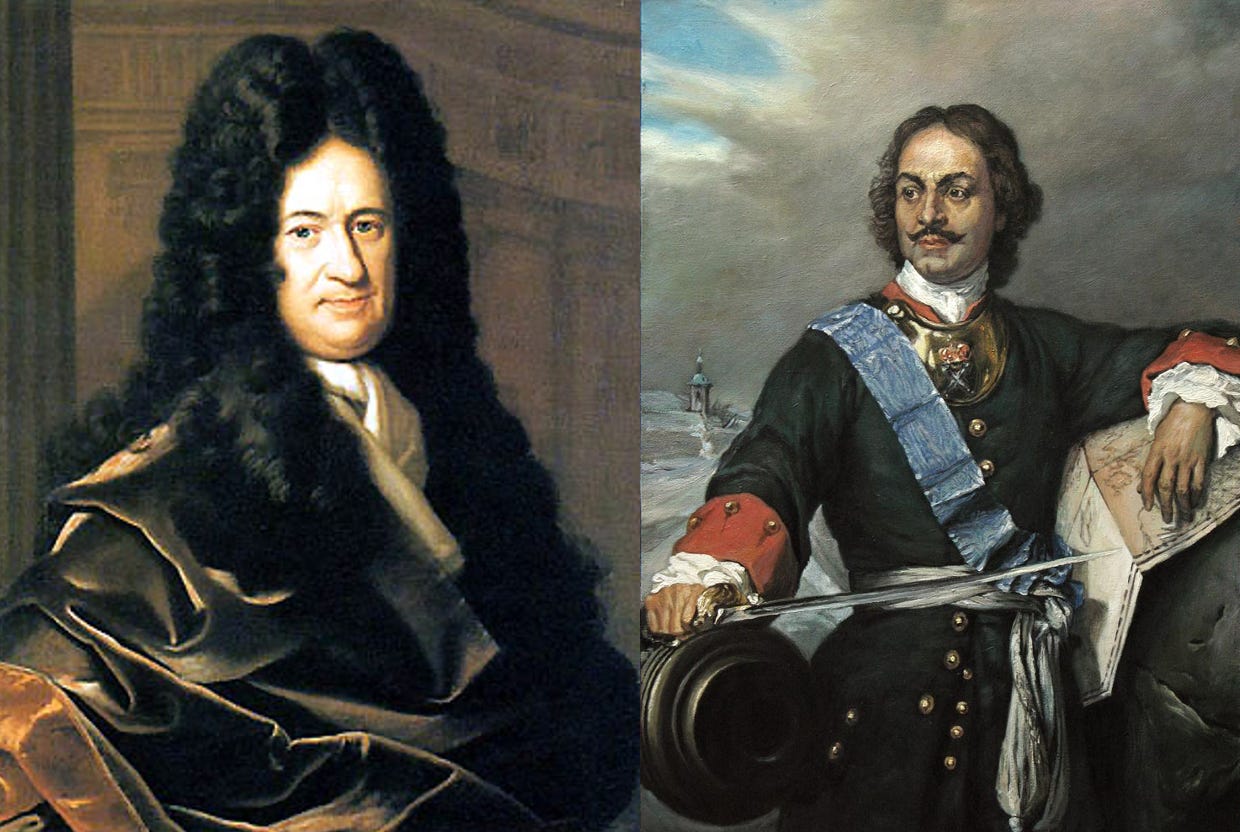
In March, 1697, Peter the Great set out from Moscow, along with a select group of councilors, for his so-called “Grand Embassy”, a two-year tour of Western Europe. The voyage was shrouded in secrecy and disguise, and was aimed at the strategic collection of information concerning primarily Dutch and German advances in science and technology. Through the usual gossip networks, Gottfried Wilhelm Leibniz would soon learn every detail of the Tsar’s early visit to the Königsberg court of the Elector of Prussia, Friedrich I, and of the time these two more-or-less Enlightened sovereigns spent together at Friedrich’s maison de plaisance or country home.
The philosopher remarks in a letter that during the visit the Tsar had been “very gay, and spoke familiarly with everyone”, and that he “approved of the gentleness [douceur] with which people conduct themselves in these [German] lands, and disapproves the cruelties of his own.”1 When the Tsar took a walk with the elector, we learn, one of the servants made a gross error of some unspecified sort in tending to this distinguished visitor. The Tsar tells the servant that if he had been in Muscovy he would have been subjected to the whip, but, since they are in a “gentle” country, he will let it pass.
The philosopher is envious of the fact that the Tsar has graced the Prussian court rather than visiting Hanover, even as he is trepidatious about what appear to him clear signs of the Tsar’s intemperate personality. The letter in which he discusses this visit seems to be the earliest indication of a recognition on Leibniz’s part of the tremendous opportunity that Russia might offer to him personally. And the circumstances that create this opportunity, Leibniz is beginning to realize, are precisely the same circumstances that make the prospect of outreach to Russia so daunting. In the same 1697 letter, Leibniz mentions his colleague, the German astronomer and physicist Erhard Weigel, who is “working to introduce reform in our schools.”2 And this gives him an idea: “I am going to write to [Weigel] that, since the Tsar wishes to debarbarize his own country, [Weigel] will find a tabula rasa there, a sort of new earth.”3
What Leibniz first proposes for Weigel, he will soon enough come to see as ideally suited for himself.
2.
Though initially envious of those at the Königsberg court, Leibniz will soon be gratified by a visit of the embassy to Coppenbrügge, in Lower Saxony, where the Tsar arrived in the company of Leibniz’s close friend, the Electress Sophie Charlotte, on August 10, 1697. The Tsar is still travelling incognito, and has sought assurances from the electress that the visit should be accompanied by as little fanfare as possible. Leibniz relates in a letter to an unknown recipient, written shortly after that event, that the townsfolk had nonetheless figured things out, and arrived in great numbers to catch a glimpse of Peter, only to be chased away by the electoral guard.
Once installed for dinner, Sophie Charlotte brings out an ensemble to perform Italian music, which, Leibniz will subsequently recall, “the Great Tsar seems to find beautiful,” even while admitting that “music is not his greatest penchant.”4 Sophie Charlotte asks the Tsar whether he perhaps prefers hunting to music, and Peter replies that while his father, Tsar Alexis, had been an avid hunter, he himself is mostly interested in “navigation and fireworks”.5 He boasts that he is currently having 75 warships constructed in Amsterdam, and has participated in building them himself. From this very first report of Peter’s arrival in Leibniz’s world, then, we find the Tsar hyper-focused, monomaniacal, concerned, almost to the exclusion of everything else, with the modernization of Russian military capacities. He remains ever affable, however, and after the discussion of warships ends, the Tsar brings out, to everyone’s delight, “his four little dwarves, very pretty, very well-trained, and dressed in the French style.”6
3.
In a letter to Nicolaes Witsen of March, 1699, Leibniz expresses at least some disquiet about the Tsar’s recent actions in response to a wave of domestic political turmoil. During Peter’s absence in Western Europe, around 2,300 of his streltsy (riflemen) in Moscow rose up and sought to install Princess Sophia as Tsarina, evidently hoping to turn back the tide of Peter’s Westernizing reforms. In late 1698 and early 1699, no fewer than 57 streltsy were publicly executed in Moscow, and several hundred more were whipped, branded, and otherwise tortured. Leibniz seems to have been both shocked by the viciousness of the Tsar’s response, observing that it “retains something of the Scythian”,7 but also disappointed from a strictly strategic point of view. He writes that “[t]he Tsar is without doubt a great prince, and it is a very great misfortune that domestic strife has recently forced him to resort to so many terrible executions.”8
Yet Leibniz continues to fear “that so many tortures, far from stamping out the animosities, will only sharpen them by a sort of contagion. The children, parents, and friends of the executed have a wounded spirit, and that maxim that says oderint, dum metuant [Let them hate, as long as they fear] is dangerous.”9 Witsen, in response, seeks to justify Peter’s conduct, and assures Leibniz that there is nothing to fear from the surviving families of the executed streltsy, since “the custom is to send to Siberia, and to the most distant lands, the wives and children and even all the relatives of those who have died from torture.”10 Russia, the implication appears to be, is large enough to absorb the consequences of despotic actions that would be far more destabilizing in a smaller polity.
Already put off by the upheavals in Moscow, Leibniz grows more estranged from Peter after the beginning of the Great Northern War, which broke out in 1700 between the Russian and Swedish Empires, and pitted Peter against the young Swedish king Charles XII — still shy, at the war’s beginning, of his eighteenth birthday. In a letter of September, 1701, to Justus Henrik Storren, a representative of the Swedish king in Berlin, Leibniz does not seek to maintain neutrality, or even to hope for a return to the status quo ante bellum. He hopes, quite the contrary, to see Russia completely defeated by Sweden: “As for me, I would like to see your young King reigning in Moscow, and all the way to the Amur River that separates the Empire of the Muscovites, they say, from that of China.”11 And he goes on to wax poetic on the happy resemblance between “Amur” and the Latin word for “love”.
We get a sense, here, of Leibniz’s general strategy as a cosmopolitan free agent. However much he will warm up again to Peter, this will certainly not be the result of any particular loyalty to the Russian regime, but only of Leibniz’s attunement, sharp and flexible at once, to where the most promising opportunities lie. As a courtier, Leibniz is always striving to watch which way the wind blows, and is a master of the art of saying different things to different people.
4.
In the two years leading up to Tsarevich Alexeï’s marriage to Princess Charlotte Christine of Braunschweig-Lüneburg in 1711, Leibniz maintains a vigorous correspondence with Johann Christoph von Urbich, a German diplomat in the service of the Russian court, constantly angling for opportunities to share his ideas about the promotion of the sciences with the Tsar. There are some indications in this period that Leibniz’s ideas are in fact making their way to the desired destination, that Leibniz’s existence, and the potential opportunities he represents, are at last sinking into the Tsar’s consciousness.
All these efforts will finally pay off when Peter arrives in the German town of Torgau to participate in the Tsarevich’s wedding, held on October 25, 1711. From various letters over the following months we gain small glimpses of the encounter between the two men. Leibniz relates for example that he “had the honor to speak with the Tsar at Torgau and His Majesty will arrange for magnetic observations in his vast territories. He also seems disposed to promote other research.”12 Leibniz would not however gain as much access to the Tsar on this visit to Germany as he had hoped. At Torgau he was not granted a private audience, but was only able to speak with Peter furtively when the occasion arose at dinner. Nor did Leibniz’s plan for a separate visit of the Tsar to Wolfenbüttel come to fruition.
In September, a month before the wedding, Leibniz wrote to his employer, Duke Anton Ulrich, of an elaborate plan for a novel sort of entertainment that might be premiered over a sumptuous meal in the dining room at Salzdahlem, part of the ducal estate at Wolfenbüttel. Instead of the usual dinner theater or comic entertainments by dwarves, Leibniz proposes, “the might of the great Tsar could be represented with a model of his Empire.”13 This would have to be placed “on the floor of the hall, so that water could be carried to and from it.”14 It would not be a typical level land map, but rather a complete representation of “the summits and depths of the land, the sources of rivers, their flow and issue into the sea.”15
Leibniz has here an opportunity to indulge his instinct for diplomatic flattery and his longstanding interest in hydrology at once. In the proposed apparatus the seas must be located at the lowest level, and the high land at the highest, while between these two extremes we will find “the White Sea with the Dvina, the Ob, the Yeniseï, and the Lena tributaries; the Baltic Sea with the Narva and the Duna tributaries; the Black Sea with the tributaries of the Don, the Dniepr, and the Dniester; the Caspian Sea with the Volga tributary; the Eastern or Japanese Sea with the Amur tributary, which comes out of Muscovite Tartary.”16 A complicated system of hidden pipes was to be constructed to pump the water through the giant relief map, and ultimately to expel it beyond the walls of the dining hall and into a neighboring garden. But Leibniz’s vision for a microcosm of the Russian Empire does not end with the seas and rivers. “The peoples with their traditional costumes could be added,” he continues, “as well as the exotic animals of each region, together with the mountains and forests and the most prominent cities, together with the boundaries and names of the provinces.”17
The entire construction would stand, according to Leibniz’s specifications, on four columns, two of which are described as the “gates of triumph”, one of which will represent Russia’s Eastern conquests, and the other of which will depict the empire’s Northern (i.e., Northern European) victories, “with a representation of the battles at Poltava and on the Prut.”18 Above the entire work, Leibniz proposes, personifications of Fame and Victory might be made to hang, spreading their wings. After the occasion of the Tsar’s visit, the work might be placed in a Kunstkammer or art collection, which would surely inspire other sovereigns to have “living relief maps” constructed for their own territories, in confirmation of their own power.
5.
In a letter of January 16, 1712, to Peter’s councilor Gavrill Ivanovich Golovkin, then serving as a diplomat in Berlin, Leibniz notes that at Torgau he had broached the idea of an official position for himself at the Tsar’s court. Peter had seemed favorable to this, but the state of the plan now seemed uncertain.19 Leibniz seems impatient, and worried that his long efforts to enter the service of the Tsar may come to nothing. He is now 65 years old, and attuned to his own mortality. “We must save time wherever possible,” he writes, “for time is the most precious thing that God has given us to manage.”20 In a letter that follows shortly after this one, Leibniz will complain to von Urbich of a wound he must treat as a result of his gout, the disease that will ultimately kill him in 1716.21
Leibniz tells his Russian correspondent that “since my youth my great goal has been to work for the glory of God through the increase of knowledge,” and he adds that he has succeeded “in part through divine grace, having made some important new discoveries that are well known in the Republic of Letters.”22 He says that because the advancement of science anywhere is good for humanity everywhere, he distinguishes “neither nation nor party,” and adds that “I would rather see the sciences made truly to flourish among the Russians than to see them cultivated in a mediocre way in Germany.”23 The country where the sciences flourish the most, he says, will be, for that same reason, the country he loves the most.
In a note drafted for Peter a short time later, likely in the spring of 1712, Leibniz moves from his earlier somewhat vague talk of “promoting science” to a more concrete vision of institution-building. “It would seem,” he writes, “that the city of Moscow, capital of the empire; that of Astrakhan, bordering on Persia; that of Kyiv, approaching the Turks; and that of St. Petersburg on the Baltic Sea, which opens up new communication with Germany and its neighbors; would be the best places to found Academies and to create suitable establishments.” But, he adds, “it would be fitting to begin with the Academy of St. Petersburg.”24 This is the first hint of any explicit plan in Leibniz’s mind for that new city, which had been founded by Peter only in 1703, in a marshy region of the Gulf of Finland previously inhabited by Finnic tribespeople, known by the Russians generically, and somewhat disparagingly, as the Chud’.
On October 24, 1712, the Tsar’s Scottish-Russian councilor Jacob Bruce, or Iakov Brius, writes a letter to Leibniz summoning him to Karlovy Vary, where Peter and his men are currently staying.25 The next day Duke Anton Ulrich composes his own letter to Peter, recommending Leibniz to his service and informing the Tsar that the philosopher-courtier is already on his way.26 Leibniz had already had the mineral baths of that resort town recommended to him as a possible treatment for his gout, but in advance of his trip he avers that he will not make use of them, preferring to dedicate himself strictly to the business that brings him there.27
On November 11, an ukase, written in Russian, is issued at Karlovy Vary, in Leibniz’s presence, officially making him, at long last, a privy councilor to the Russian court. This document is worth quoting in full (English follows):
Мы пεтръ пεрвыï Цръ и самѡдεржεцъ всεросиïскиï: Iпротчая ипротчая ипротчая; изобрѣли мы заблго всемилтивѣйше кȣрѳирстского икняжаго браȣнщвигъ люнѣбȣргъ таиного юстицъ рата готѳрида вилгεлма ѳонъ леïбница. Заεто намъ выхвалεнныя иот насъ изѡбрѣтεнныя изрядныя достоинства и искȣства тамождε внаши таиныя юстицъ раты опрεдεлить иȣчрεдить. Что намъ помεжε мы извεстны. Что ѡнъ поȣмножεнию матεматичεскихъ Iиныхъ искȣствъ ипроизыскиванью гисторεи ïкприрашεнию наȣкъ много вс’помоши можεтъ. Его поимεющемȣ нашεмȣ намѣрεнию что наȣки Iискȣства вншεмъ гдрствѣ вящεи цвѣтъ произошли употрεбить. Имы для вышεпомянȣтого εгѡ чина ншεго таиного юстицъ рата годовоε жалованьε потысячи ефимковъ опрεдεлить изволили, которыя εмȣ отнасъ εжεгодно исправно заплачεны быть имѣютъ инчεму мы налεжащи Указы дать изволимъ. Аεто слȣжба начинаεтца снижεписанногѡ числа; воȣвεрѣние того сие заншимъ собствεннымъ рȣкопописаниεмъ игдрствεнною ншεю пεчатью
Дано в Карлсьбадε [11 ноября] въ 1712 году.
Пεтръ
I, Peter the First, Tsar and Protector of All Russia, et cetera, et cetera, have selected the Privy Councilor of the Elector and Prince of Braunschweig-Lüneburg, Gottfried Wilhelm von Leibniz, in view of his good qualities and his achievements, for which he has been recommended to me and of which I have been able to learn for myself, to serve me as councilor as well, so as to contribute to the progress of mathematics and of the other sciences, as well as to promote research in history and erudition in general. I hope that he will contribute to the flourishing of the sciences and arts in our State, and for his rank of Privy Councilor I am prepared to offer an annual salary of 1000 talers, which are to be paid to him each year in my name, and for which I engage to submit the necessary requests, from the date indicated below.
In witness whereof I give my signature, with the seal of state,
At Karlsbad, 11 November, 1712.
Peter28
6.
Leibniz will accompany the Tsar and his men from Karlovy Vary to Dresden, and from there they will part ways on November 25. Leibniz gives a report of at least some of the things they discussed, in a letter to Anton Ulrich of that same day. He relates that in conversation the Tsar is very eager to discuss all manner of topics. They speak much of the ongoing war, which now includes not just Sweden, but also a new front at the boundary of the Russian and Ottoman empires. Leibniz notes that he has made a special effort, during these weeks with the Tsar, to show that he is prepared to talk about more than just “my own things and curious matters.”29 He says that in addition to the 1000 talers specified in the ukase, he has also received 500 ducats in specie, which cover the expenses of his voyage.
By December, Leibniz is writing to Peter from Vienna, giving him very concrete advice for the prosecution of war against the Turks. The Russian army should set up forts along the length of the Dniepr and the Dniester from which to “rout the Tartar swarm.”30 It seems Leibniz believes his purview has now extended, from the arts and sciences, to law, and now to military strategy.
Significant time goes by with no word at all in reply. Leibniz continues to maintain his one-way correspondence, sending several more drafts of proposals for the advancement of the sciences in Russia, as well as more advice in legal and military affairs. By January, 1715, Leibniz is desperate enough to write to Golovkin in order to inquire about the Tsar’s silence. Leibniz reminds the Russian diplomat that two years prior the Tsar had brought him into his service, and that since then “I have striven on several occasions, at Vienna and elsewhere, to let His Majesty know of my zeal for service.”31
He continues, seeming almost desperate: “As I do not doubt that the intention of this great Monarch is that his decree should have its effect, I pray Your Excellency to assure me of his protection before his Majesty the Great Tsar, and if I were capable of being useful on some particular occasion, to send me the orders.”32 But Golovkin does not reply either. In May Leibniz writes to him again, reminding him that while he was paid his annual salary in the first year of his service, as indicated in the decree signed at Karlovy Vary, he had not been paid since. He says he does not wish to make trouble, but “it might be taken for negligence, and for a diminution of my attachment” to the Tsar, if he were to wait any longer.33
7.
In November, 1715, Charlotte Christine, now the Tsarevna of Russia, will die in childbirth at the age of 21, leaving the Tsarevich Alexeï a widower. In fact, the young heir to the Russian Imperial throne is in love with a teenaged Finnish serf named Afrosina, with whom he had carried on a relationship already for some years before his wife’s death. Alexeï will eventually seek to retreat from politics in order to be alone and unperturbed with his true love, though he will himself die within another three years, at the age of 28, with his personal life and his place in the dynasty still very much unsettled. But Leibniz does not know any of this, and immediately upon Charlotte’s death he writes to von Huyssen with some proposals regarding the possible remarriage of the Tsarevich. “We may suppose,” Leibniz writes, “that this great Prince, at his age, however deep the sentiment he may have for the one he has lost, will not follow the example of turtledoves”34 — a bird known for monogamous pair-bonding so strong that even death cannot dissolve it.
In June, 1716, Leibniz is still waiting for his opportunity truly to serve the Tsar, and, perhaps more importantly, he is still waiting to get paid. He writes to another of the Tsar’s advisors, Piotr Pavlovich Shafirov, to whom he relates his his history with Peter to date: the initial overtures of the 1690s, Torgau in 1711, then Karlovy Vary and Dresden in 1712, where he received 1000 talers plus 500 ducats. He says that he has incurred significant expenses in the service of the Tsar, “which through your encouragement might be reimbursed.”35 Within a month, he will have one more visit with the Tsar, who is passing through Bad Pyrmont on his way to Copenhagen. It turns out that Peter had not forgotten him, but was only preoccupied with other matters. In Peter’s company is Laurentius Blumentrost, the Tsar’s personal physician, who will be one of the principal founders, and, from 1725 to 1733, the first president of the St. Petersburg Academy of Sciences. It is under Blumentrost that the Kamchatka Expedition of 1731-41 will be organized and executed.
Leibniz is once again under Peter’s spell. He writes to a friend: “I cannot express enough my admiration for the vivacity and judgment of this great Prince.”36 Leibniz reports again of a conversation he might just as easily have had on Peter’s visit to Coppenbrügge almost twenty years earlier: “He informs himself of all the mechanical arts, but his great curiosity is for everything connected to navigation.”37 Leibniz says he hopes that “by his doing we will learn whether Asia is attached to America.”38 And indeed, this is what will come to pass: the Kamchatka Expedition may be said definitively to end on December 19, 1741, when Vice Admiral Vitus Bering, a Dane in the service of the Russian navy, died of scurvy on an uninhabited island of the Commander Islands chain, having crossed the strait that would soon bear his name, and arrived in North America.
Leibniz himself will die on November 14, 1716, still unpaid, of complications related to the ill-advised self-treatment of his gout.
Cборникъ писемъ и материалов Лейбница относящихся к России и Петру Великому [A Collection of Leibniz’s Letters and Documents pertaining to Russia and to Peter the Great], ed. V. I. Ger'e [Guerrier], St. Petersburg: V. Golovin, 1873, 9.
Сборникъ, 9.
Сборникъ, 9.
Сборникъ, 13.
Сборникъ, 13.
Сборникъ, 13.
Сборникъ, 42-43.
Сборникъ, 42-43.
Сборникъ, 42-43.
Сборникъ, 44.
Сборникъ, 49.
Сборникъ, 194.
Сборникъ, 169.
Сборникъ, 169.
Сборникъ, 169.
Сборникъ, 169.
Сборникъ, 169.
Сборникъ, 169.
Сборникъ, 201.
Сборникъ, 202.
Сборникъ, 210.
Сборникъ, 203.
Сборникъ, 203.
Сборникъ, 220.
Сборникъ, 260-61.
Сборникъ, 261-62.
Сборникъ, 262.
It is significant here that the Russian borrows heavily from German for the designation of courtly roles; e.g., a “privy councilor” is a tainyï yustits rat, which is to say a “privy Justizrat”. In later Russian the standard term would be taïnyï sovetnik.
Сборникъ, 282.
Сборникъ, 285.
Сборникъ, 325-26.
Сборникъ, 326.
Сборникъ, 334.
Сборникъ, 342.
Сборникъ, 345.
Сборникъ, 360.
Сборникъ, 360.
Сборникъ, 360.