

I’m certainly not going to say “no one reads anymore,” a phrase that has by now degenerated into one of those non-thoughts that do so much to drive discourse while doing nothing at all to solve the problem it pretends to bemoan. It would be an insult to my many very close readers, you might say my Hinternet Talmudists, who plainly do read very carefully, and can cite back to me years later the most minor arcana of the Hinternet cosmos. God bless them!
What I will say is that Substack is no longer principally for writers. It is, rather, for whatever works. It aspires to be the universal platform, in an emerging global information environment that Agnes Callard has helpfully identified as the “uni-context”. I prefer to think of it as the social-technological equivalent of a cloaca, of the sort we observe in a number of species of Antipodean monotremes — in the future, which is to say now, there is to be a single passage through which everything flows. By “everything” I mean not just text, image, and video —which is what is usually understood in talk of the ideal universal platform. I mean work, leisure, social ties, creativity, banking, music, governance — all of these, like it or not, are going to be passing through the same metaphorical hole.
History gives us reason to predict that those who don’t like this transformation will protest for a while, and eventually either get in line or get sidelined. It’s an old story. Just read Zola’s Au bonheur des dames (1883) (about which, incidentally, Agnes and I had a nice discussion a few years ago), a fictionalized version of the story of Aristide Boucicaut and the foundation of Le Bon Marché, the first department store in the world, and of the impact that had on the Paris artisans still taking five years each to sculpt the figure of an elephant’s head into a single umbrella handle with a pocket knife. The world changes — it’s tough, and it’s exhilarating.
Uni-contextualization is what makes a French satirical magazine with a history of anticlericalism the target of global jihad, and it is what subordinates directors and musicians to the tyranny of their fandoms. It is what has brought what remains of the. classroom experience to the point where students are using their phones to dispute their professors, in real time, on points of fact, by now entirely unaware that the purpose of the such encounters had in any case never really been fact-delivery at all — at least not for us humanists. Uni-contextualization is also what slots what I am doing at this very moment ambiguously between leisure, creative practice, public outreach in my capacity as an institutionally based philosopher, and illicit moonlighting. Who can even say at this point? One solution is simply to go with “Oliver Bateman Does the Work” and call it all, indiscriminately, “the Work”. The Work is all that’s left, and any hope that it can be separated out into lowercase “work” on the one hand, and other finer-grained categories on the other, is at this point nothing more than desperate clinging to a lost world.
The signs of this transition are too numerous to summarize. I can remember shortly after September 11, 2001, reading that on that momentous day Stephen King briefly glanced at the television, muttered something like “What a shame”, and then took his headphones, put on Beethoven’s 9th, and got back to writing. In the 2010s I can remember Walter Kirn mocking Gary Shteyngart for doing some over-the-top early-online-video stunt intended to promote some of his new work. What about now? Can you imagine any two writers more fully cloacalized than King and Kirn? They are showing up for “the Work” every day; they are feeding the feeds! I do everything I can not to see them, but it’s a hopeless effort.
In sundry ways, writers are learning that if they don’t show up —and, more than that, if they don’t show their faces, their bodies, their weaknesses and worries— they will be left behind. The aspiration to a universal platform creates, in this regard, a parallel expectation of universal self-branding. One must open the doors to one’s salon; one must host.
This cloacalized, uni-contextualized Work brings with it another upshot that, for at least some of us, makes the current rapid disappearance of any real venue for a certain kind of writer to practice their vocation somewhat easier to bear. Ten years ago I would have felt deeply ashamed if an academic colleague of mine were to learn that I was out there doing extracurricular online lectures on the Critique of the Faculty of Judgment and topics like that (which I in fact did, during the first lockdown, which in truth did a great deal to bear me through that trying time). Now, when I do it, I feel like I am part of the vanguard of what is in any case going to turn out, in the next few years, to be a near total transition of humanities instruction into para-academic spontaneous clusterings, many of which will happen online.
What I mean in part is that I find myself at a curious juncture. I’ve been a philosophy professor for 26 years. Between 2020 and 2025 I was able to turn to Substack to cultivate a very different side of my intellectual and creative self, to leave the credentials at the door, and to be, at least in my own view of my work here, everything but a philosophy professor. Now I find that the acceleration of the cloacalizing process has effectively made it impossible for anyone to keep any of the strands of their lives separate at all. So I’m like: ok, then, if that’s how the world is shaping up, if that’s what this latest iteration of Boucicaut’s universal store1 compels of us, then I might as well ride the wave of history, and not only show my face here in the medium of the livestream, but also start doing some version here of what I have anyhow spent a good part of the last quarter-century doing — for example, hosting livestream courses introducing interested readers-listeners-viewers to questions in the history of philosophy on which I have a certain amount of specialist expertise.
The advent of the uni-context, I hope I’m making clear, is, like everything in history, both destructive and generative. I have had conversations these past months with more than one American friend, all in elite institutions, who tell much the same story. Ten years ago they had to do their quirky creative public stuff on the down-low, hoping all the while it would not generate too much press. Now their deans are holding them up as shining examples of how to adapt to a rapidly changing world, and as models of what a scholar-thinker-intellectual in the 21st century might yet be. France, as always —or at least at any time since roughly the end of the 1900 Paris World Expo, though definitely not at the time of Boucicaut— will take another decade or so to come up from behind. But that’s alright. As I’ve previously acknowledged my primary concern is with the country from which I find myself in quasi-exile, and whose civic potentials I’m most concerned to help to awaken and to foster. I mean, I remain a cosmopolitan and a committed enemy of the entire Westphalian order, but that doesn’t mean I’m not an American, synchronized for life with that country’s tempo whether I wish to be or not. And at present that country, as global tech vanguard, is pushing us all into the cloaca.
We are already running a very enjoyable literary salon at The Hinternet this month, on Wednesday evenings (CET). There are two sessions left:
Hinternet Summer Livestream Literature Salons
Wednesdays at 20:00 Paris / 19:00 London / 14:00 NY / 11:00 LA
Wednesday 1 July — Introduction: Reflections on the Philosophy of Translation [DONE!] Recording here.
Wednesday 8 July — The most beautiful short story ever written: Anton Chekhov’s “A Day in the Country” (1886) [DONE!] Recording here.
Wednesday 15 July — Pan-Soviet Chekhovism: Amma Achchygyïa’s “Motuo” (1927) [DONE!]
Wednesday 22 July — Before À la recherche: Madame de Sévigné, Saint-Simon, and the Non-Fiction Sources of Proust’s Masterpiece
Wednesday 29 July — Zola’s Nana (1880) and the French Proto-Cinematic Imagination
Beginning in August, we will be running a crash course on the philosophy of this one guy I’ve been getting into recently. It will look something like this:
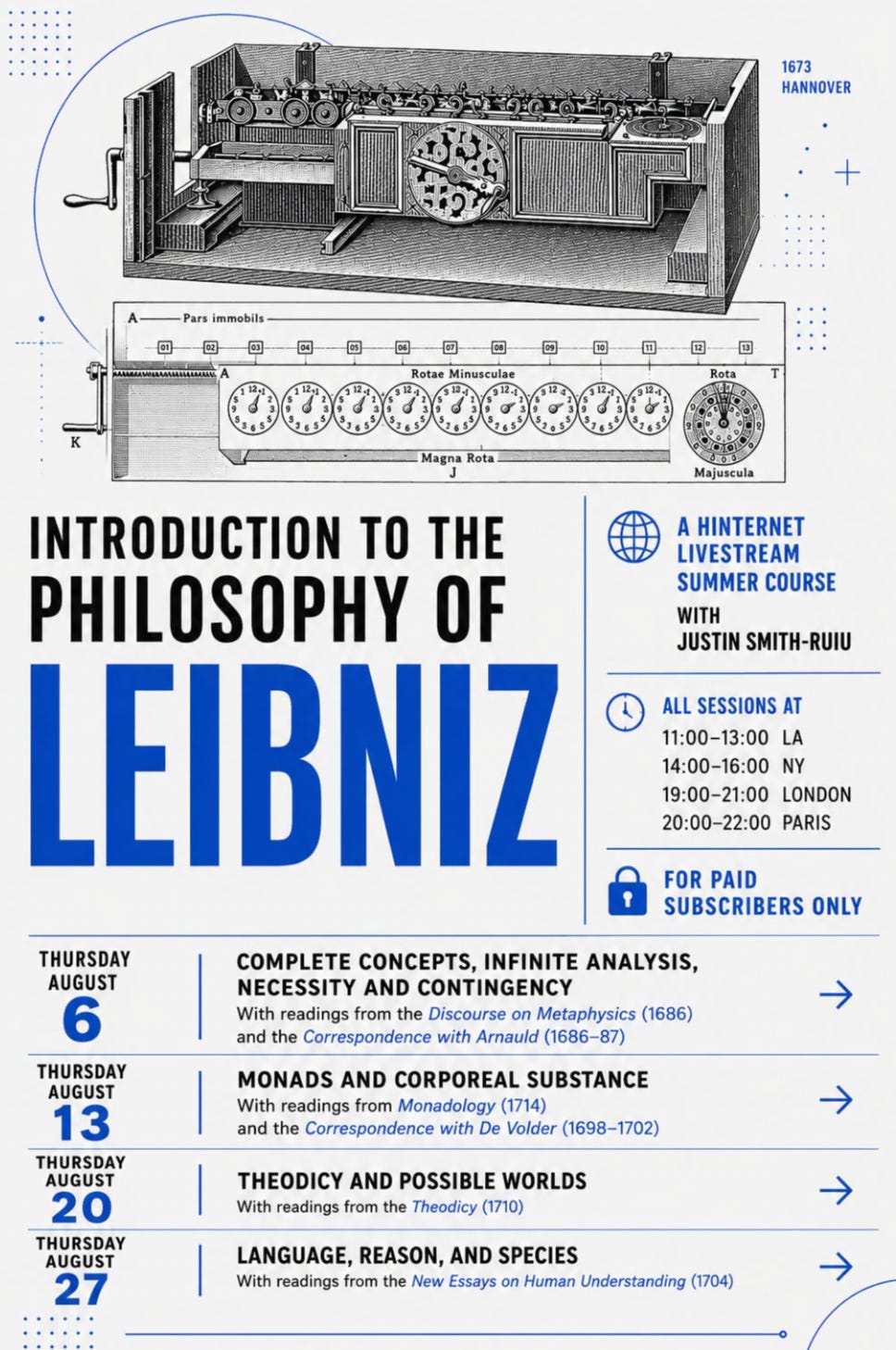
Please join us if the topic interests you (which it must, given that you are a rational being like everyone else). There’s no “enrollment cap” or anything like that; this is the internet!
The course will be open to paid subscribers to The Hinternet, and materials will be shared in Substack Chat, which is likewise open to paid subscribers.
Through the end of July we’re offering a 50% discount to new subscribers so be sure to upgrade your subscription now if you want to join the final two literature salons, or the Leibniz livestreams next month.
As usual, we are grateful for your support as paid subscribers to The Hinternet, which not only gives you access to so much more of what we do here, but also enables us to pay our guest contributors, to pay for technical support and development, and to fund our larger-scale projects and initiatives.
Thanks as ever!
Interestingly, the Russian word for a department store (likely other languages too that aren’t on my mind at the moment), is универсальный магазин, a “universal magazine”. The term “magazine” in this context, which is borrowed from French (though in French a lexical distinction evolved between magasin and magazine), ultimately stems from an Arabic word meaning “storehouse” or “storage space”. It thus shares the same etymology as the name for the place in a gun where the ammunition goes, and in this respect there really is more continuity between Boucicaut’s Bon Marché and the social-media companies that aspire to become the universal platform than the simple fact that both are “disruptive”. Both are quite literally doing the same thing, even if the older one did it with merchandise and the newer one is doing it with “content”.


Thanks, your explanation of the unicontext makes a lot of sense. When I read that interview Callard did with Derek Thompson, I found the idea incoherent and self-contradictory. The examples you provide make it clear. Maybe your version differs from the original, but then the original is often unfaithful to the translation.
Since you are compelled by the uni-context [manifested in Substack incentives] to "play host", may I make a request?
Why not host Agnes Callard to discus the unicontext?
I would particularly like to know how she would differentiate it from similar notions articulated in Clay Shirky's "Here Comes Everybody" or Martin Gurri's "Revolt of the Public".