There is a good deal of follow-up left to be done, in the wake of Generative Humanity, our Inaugural Hinternet Foundation Summit, which took place on November 23 at the Gaîté Lyrique theater in Paris. I already wrote a “Part One”, a week before the event, of reflections on the future of the humanities, as well as an hors-série addendum to this reflection the day before. Parts Two and Three were theoretically to follow, yet in spite of my occasional lapses into enthusiasm about a future mode of work enhanced by numerous bot doubles to whom I might delegate some of my writing tasks, I remain but one human agent, which is to say an agent in the fullest and most unqualified sense — which is also, importantly, an agent with serious limitations, who must often choose between competing obligations.
All the promised writing will come in due time. I am likewise concerned to get back to the other veins of writing so many readers expect from The Hinternet, some number of whom must by now be saying “Enough with this ‘Generative Humanity’ stuff! Who cares! We want a 7,000-word pseudonymous piece on Burt Bacharach and the Vietnam War!” (I have seen at least one anon shitposter, who enjoys our more unhinged features, declaring that this grown-up and straitlaced side of ours is “so lame”. What can I say? We are in fact grown-ups, and there would probably be reason for concern if that fact never showed through at all.)
Briefly, anyhow: there is now a separate Hinternet Foundation Substack. It is there that you will find the archived livestream recordings of the entire event, divided into four parts. These are unpaywalled, for now. If you enjoy them, we invite you to click on the “Donate” button and to make a fully tax-deductible contribution to the Hinternet Foundation, a California-registered 501(c)(3) educational nonprofit.
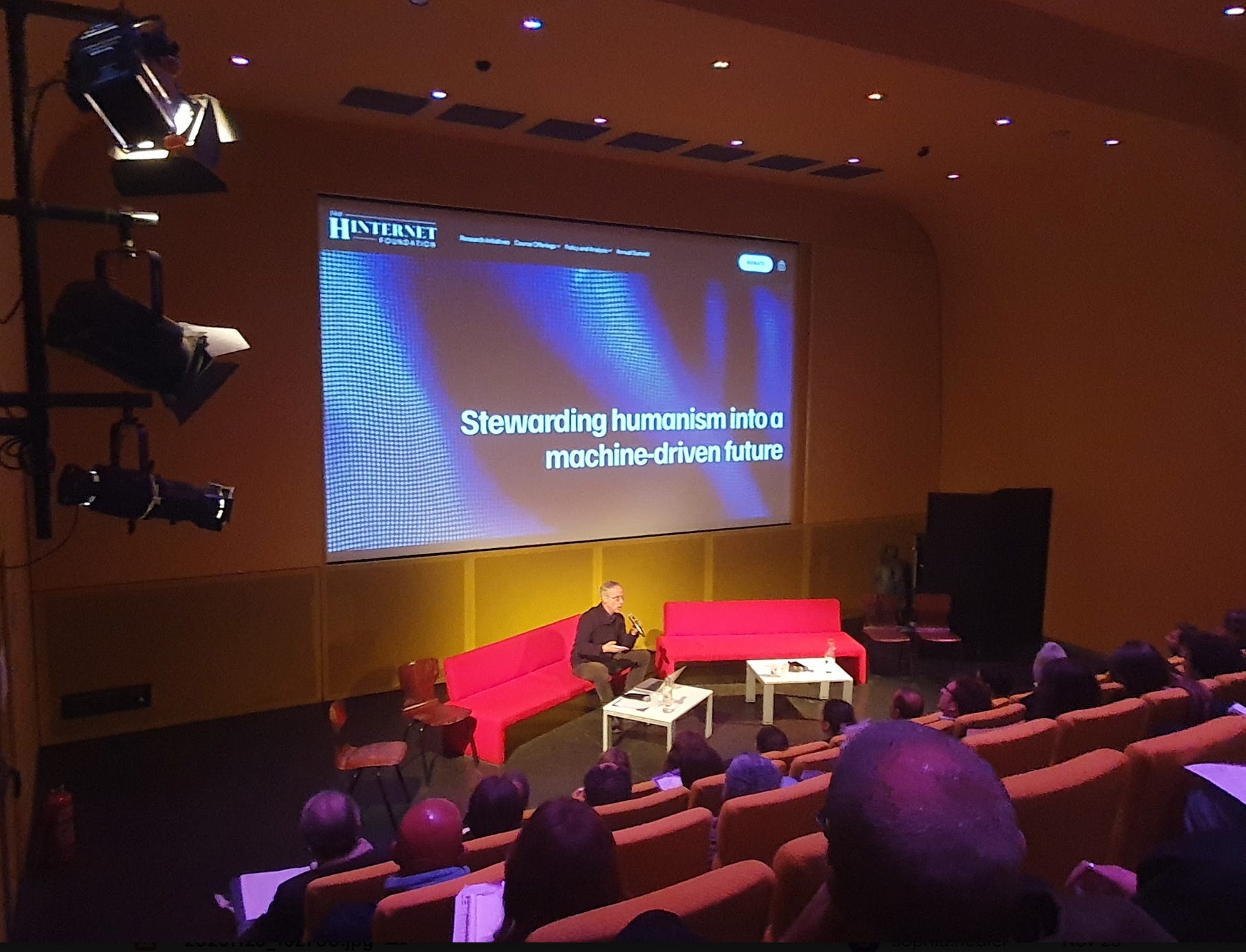
The talks and panels were uniformly great, and the spirit in the packed auditorium was buzzing off the charts from beginning to end. I am certain, now, that this was only the beginning of an initiative that will continue to grow, and that we will be back a year from now with something larger and indeed somewhat more high-end as regards production values and so on.
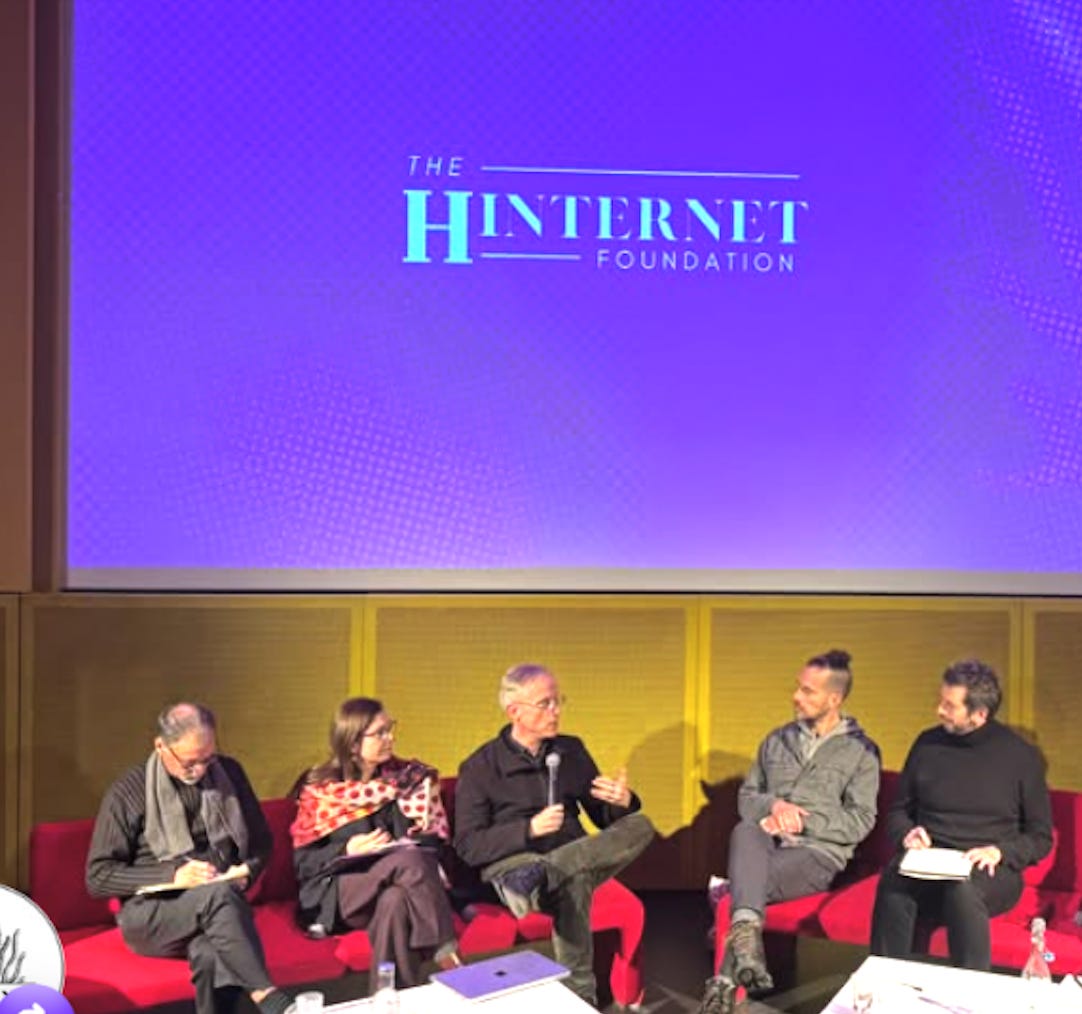
Many themes were covered — not all the ones I was anticipating, and indeed many that I was not anticipating. Certain disagreements between speakers that I thought I saw on the horizon failed to materialize, and if I had anything to complain about it would be that we all remained perhaps a tad too eirenic and mutually supportive, though I suppose coming into this event in a community spirit rather than an adversarial one was inevitable, given the totality of the social circumstances of its happening. I mean, just look at how nice and cool and amicable everyone in these photos obviously is!
My own talk, which comes in the fourth and last of the recordings, was entirely spur-of-the-moment, and only really crystallized in the 30 minutes or so before I gave it. I knew I had wanted to say at least something about the special inspiration Margaret Cavendish (1623-1673) has given me in my work over the past years, notably in her insistence that the use she makes of the faculty of “Fancy” in her proto-science-fiction novel The Blazing-World (1666) is in no way a “disparagement to Philosophy”, but indeed is perfectly complimentary to the exercise of Reason she puts on display in her Observations upon Experimental Philosophy of the same year.
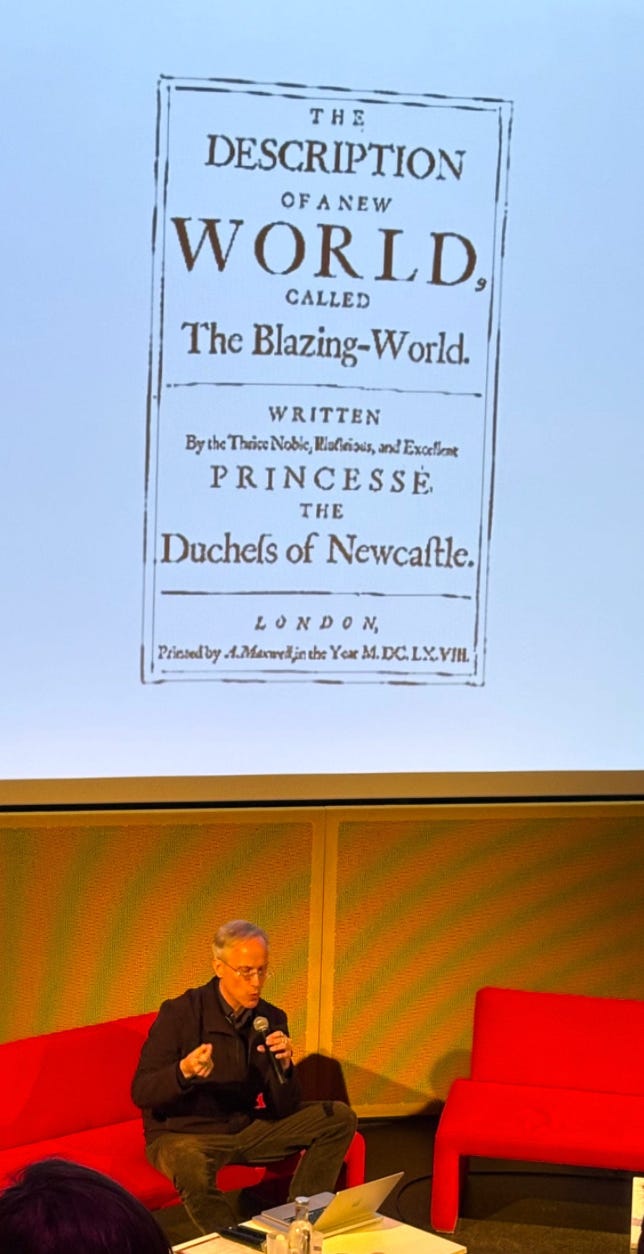
But it was only when I went back to check the exact wording of her prefatory apologia in The Blazing-World that I was struck by just how much my own position on how we should be using our minds echoes hers. I quote:
If you wonder, that I join a work of Fancy to my serious Philosophical Contemplations; think not that it is out of a disparagement to Philosophy… The end of Reason, is Truth; the end of Fancy, is Fiction: But mistake me not, when I distinguish Fancy from Reason; I mean not as if Fancy were not made by the Rational parts of Matter; but by Reason I understand a rational search and enquiry into the causes of natural effects; and by Fancy a voluntary creation or production of the Mind; of which, as that is a more profitable and useful study than this, both being effects, or rather actions of the rational part of Matter so it is also more laborious and difficult, and requires sometimes the help of Fancy, to recreate the Mind, and withdraw it from its more serious Contemplations.
From here I erred into a sustained reflection, and I hope not a longwinded one, on the special archaic force of Cavendish’s recreate, which she uses as a verbal equivalent of the substantive recreation, which still exists in English of course, but also, curiously, in the shortened form récré as used in French today to designate recess, as in, going out to the playground in the middle of the school-day. I proposed that willy-nilly AI is going to be sending all us academics, and plainly not just the humanists, out to recess, while it stays behind to do the knowledge-production work we had once imagined would remain our exclusive purview through to the end of our careers. And yet, I proposed, this may not be all bad for us, since indeed there is a conceptual link between recreation, as in “recreational activities” and re-creation as in “creating anew”. I suggested therefore that humanists, if they hope to find a way to stay in the game, are going to have to rediscover Fancy, creativity, the free play of the imagination, etc., so as to recreate the human mind in a way that might prove durably complimentary to the parallel, largely automated system of knowledge production in the 21st century. You must play — I know this seems a strange and perhaps a contradictory commandment. But these are strange times.
This is in no way the exclusive concern of the Hinternet Foundation, most of the several arms of which I could not even have dreamt of evoking in my allotted 20 minutes. This was simply the arm that it seemed most fitting, “day of”, to lift up and to flex. Anyhow listen to the full talk before you tell me the above paragraph is just so much word-play and riffing.
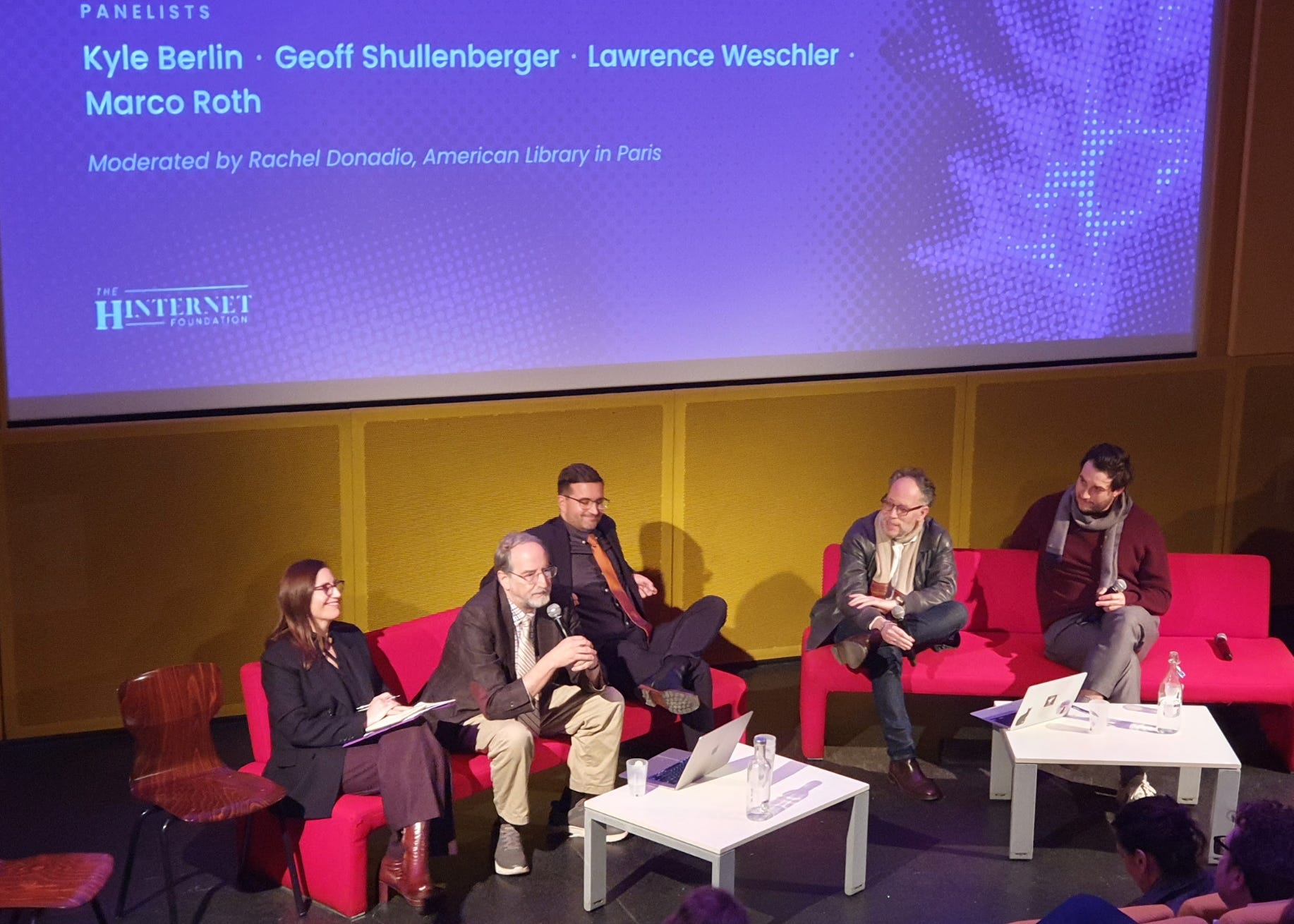
And listen to all the other talks too! I’m sorry I can’t possibly summarize them all here, but each one of them amounts to a fine subtle spice added to the perfect mix of the whole. Thank you immensely to D. Graham Burnett, Yves Citton, Natasha Schull, Matthieu Husson, Blaise Aguera y Arcas, Maya Vinokour, Leif Weatherby, Rachel Donadio. And thanks to every one of our wonderful panelists: Ross Barkan, Kyle Berlin, Lapham’s Quarterly (as embodied by Donovan Hohn), S. Abbas Raza, Max Read, Marco Roth, Geoff Shullenberger, Hinternet Managing Editor Olivia Ward-Jackson, and the towering Lawrence Weschler.
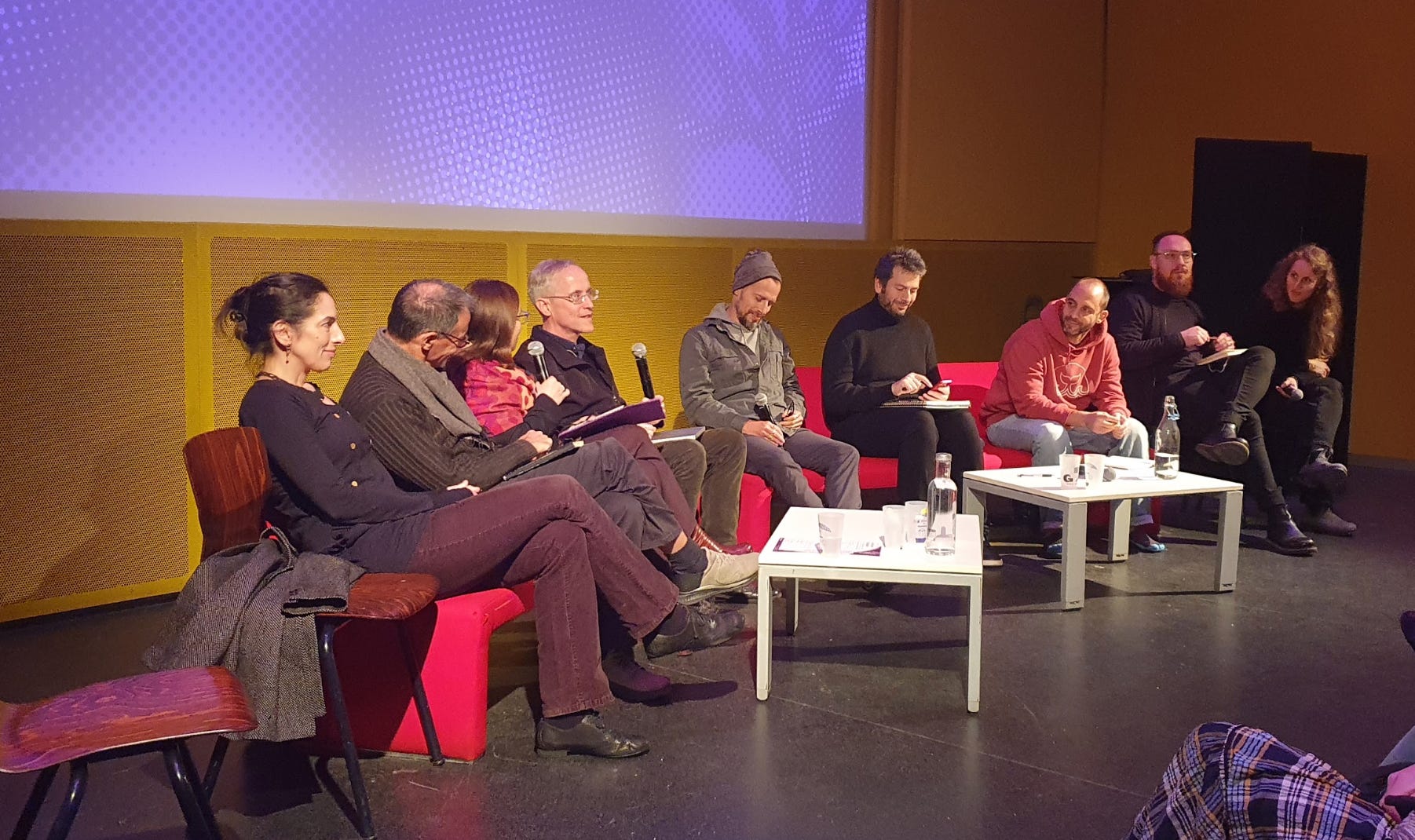
It was a peculiar event for me, personally, as it brought together so many people from so many different walks and periods of my life, as sometimes to seem more like one of those scenes in dreams involving impossible combinations — of dead grandparents, former co-workers and roommates, second cousins, and celebrities we’ve never met. This all made me nervous in the weeks and months beforehand, but when the day came I found myself marveling at the seamlessness and naturalness of it all — as if these people, simply by all being co-inhabitants of my head, had already formed a proper community with one another before ever meeting in person. Weird!
In part this is all, I think, a clear demonstration of the process of what Oliver Bateman Does the Work and I have discussed under the heading of “cloacalization” — there is, increasingly, only one passage through which all our productions pass, even if we continue futilely to maintain our ancien-régime distinctions between our work writing and our recreational writing; between legitimate academic activities to be given a line on our bloated CVs, and para-academic activities that we might hesitate to put there for fear of making some out-of-touch dean roll his eyes. Five years ago one might still have deferred to the upper academic administrators in charge of conferring or withholding our newly earned chevrons; now, more than ever, by contrast, it seems that such hypothetical instances of decanal eye-rolling would be better met with a gentle correction: You need to get with the times, dear Dean. There is simply no way to keep the flow of these parallel rapids separate. Everything passes now through the great cloaca of “just doing stuff”, and those who prove most eager to do stuff, to gab their way from one audience to another, virtual or real, as communicators with distinctive voices and an ability to use them, are the ones whom we might expect still to find thriving after the new technological order’s installation is complete and undeniable.
I am not saying it is “good” that everything, including scholarly output, is collapsing into “content”. I am saying that in a total economic and information-technological system that is based on content creation, there is going to come a time, soon, when the deans (for example) will be forced to acknowledge this system not with belated half-measures and grudging accommodations, which really only serve further to compromise the old model of academic work that they are hoping to preserve, but with a lucid understanding that it is up to us to help give this new system its contours and character, indeed perhaps to make it somewhat less the vacuous, presentist, cynical, polarizing, lowest-common-denominator slop circus it seems, so far, mostly destined to remain.
In this connection I should give special acknowledgment to Substack —my own cloaca provider—, which has convinced me more than any other new force in the 2020s that the future of work is, for better or worse, fully integrated with life itself, with friendship and community, and with both the creative and the more hard-nosed dimensions of human mental endeavor. A corollary of this is that in the future it is going to be very important to enjoy your work, because, to the extent that any public gesture you make is going to be folded automatically into your work-file-in-the-cloud, enjoying your work will be increasingly indistinguishable from enjoying your life as such. This is the great paradox, perhaps, of the end of work: that it is not so much an end as a sublation, where work and its opposite come together into a newer category, which only the most optimistic would at this point dare to call a “higher form of life”.
I’m certainly not going call it that, not yet, but I will acknowledge that I am having fun, and I am not yet entirely convinced that I will be unable to find a way to make this new economic and technological regime something less onerous, at least for me, than what comes to mind when such terms as “technoserfdom” are thrown around. One way of formulating the purpose of the Hinternet Foundation is that we are searching for ways to spread the fun, or at least some real possibility of it, as far and wide as possible, in accordance with our enduring commitment to equality, democracy, and the as-yet-unfulfilled promise of mass participation in the life of the mind.
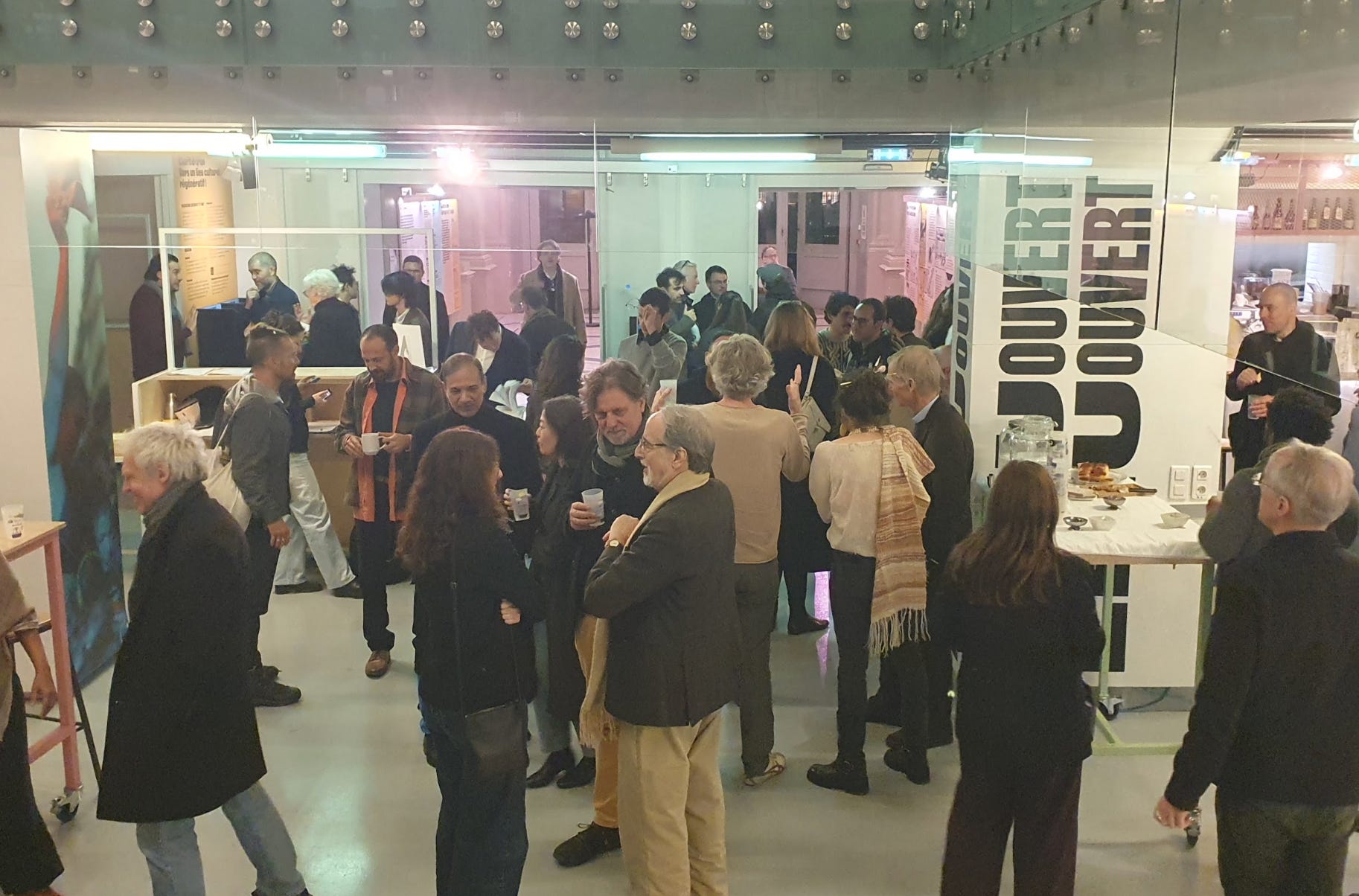
In view of all this I want especially to thank all the people I know from Substack who made the trip to Paris for this event, and whom I got to see in person in some cases for the first time: notably Udith Dematagoda, cal revely-calder, Sam Jennings, Thomas Peermohamed Lambert, as well as a surprisingly large number of others who, previously unbeknownst to me, have been reading my work for a long time and came to Paris —from London, from New York, from Berlin, from Bucharest and beyond— in search of something like a fully embodied and multidimensional Hinternet experience. Amazing!
Back with your regular Hinternet programming, as well as regular interventions on the “higher-ed beat”, soon.
—JSR, Paris